On this page
How to identify it
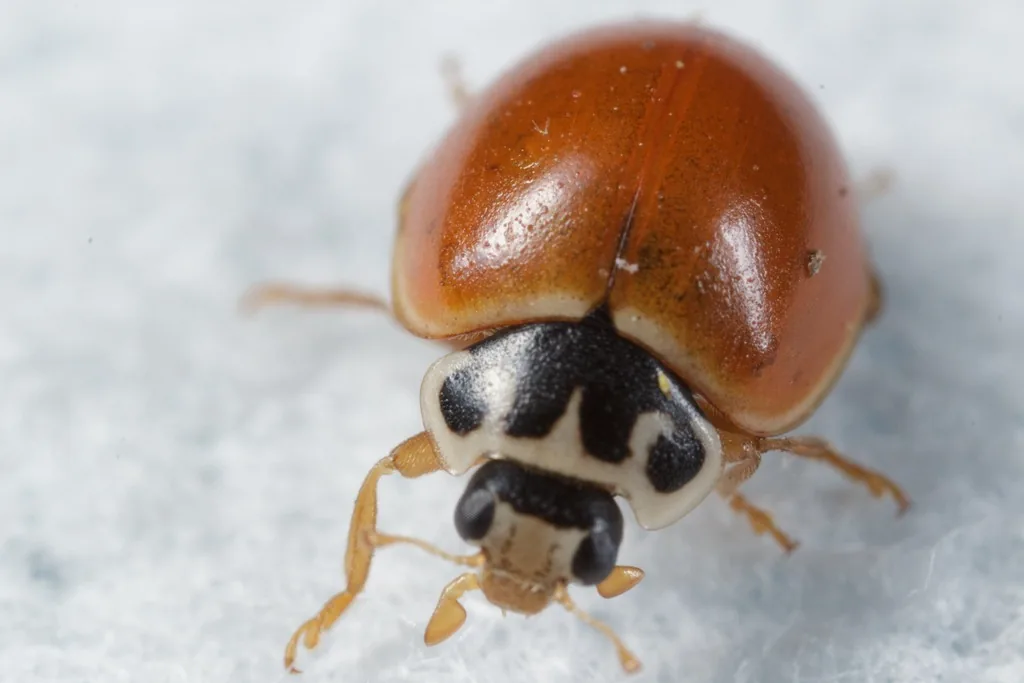
- Adults are 4 to 6 mm (1/6 to 1/4 inch) long, round from above and dome-shaped from the side.[1][2]
- The wing covers are typically orange, sometimes red or tan, and have no spots, except that some show two pale blotches just behind the thorax.[1][2]
- The pronotum is black in the center with a white or pale yellow border. On each side the pale area forms a C shape, nearly a complete ring and uncommonly a full circle; the Nebraska guide describes two thin pale lobes reaching into the black center.[1][2]
- The legs are yellowish brown.[1]
- The face between the eyes is black and white in females and mostly white in males.[1]
- Larvae are long-legged and shaped like tiny alligators, up to about 1/4 inch long, dark gray to black with orange or yellow spots on many segments. Pupae are oval, about 1/5 inch long, black and orangish, and glued by the rear end to plants out in the open.[1]
Look-alikes
| Look-alike | How to tell them apart |
|---|---|
| Western polished lady beetle (Cycloneda polita) | Cycloneda polita has the same spotless look and C-shaped thorax markings but usually black or dark brown legs and red wing covers; the polished lady beetle usually has yellowish brown legs and orange wing covers. Both can be orange or red, and experts may need to dissect males to be sure.[1] |
| Spotless lady beetle (Cycloneda sanguinea) | Cycloneda sanguinea has a pale yellowish or white spot ringed with black on each side of the thorax; the polished lady beetle has a C-shaped pale mark there instead.[1] |
Where it lives
MDC lists it as one of Missouri's native lady beetles, and in Nebraska it is sometimes found in gardens, ditches and fields. A 1985 reference work reported that it did not reach as far west as California, but the California Academy of Sciences collection now documents it from at least San Diego County, California, north to British Columbia.[3][2][1]
Biology and life cycle
It feeds primarily on aphids. An adult female eats about 300 aphids over her life span of several weeks, and each larva eats about 400 as it develops.[1]
It is found where plants are infested with aphids: field and tree crops, gardens, landscapes and wildlands.[1][2]
Like other lady beetles it goes through egg, larva, pupa and adult. Females lay groups of commonly one to two dozen football-shaped, orange to yellow eggs about 1/25 inch long, standing on end.[1]
Larvae grow through four stages, and mature larvae pupate openly on plants.[1]
It has several generations a year, and adults live longer when they can feed on nectar and pollen.[1]
Damage and signs
- UC IPM lists it in its Natural Enemies Gallery as a predator of aphids in field and tree crops, gardens, landscapes and wildlands.[1]
Health risk
It is a small predatory beetle, and none of these sources describes any risk to people.[1][2][3]
Control
Prevention
Leave it alone. To help lady beetles and other natural enemies, avoid broad-spectrum, persistent insecticides, which are toxic to them.[1][2]
Biological control
Grow flowering plants that supply nectar and pollen, control ants that attack lady beetles, and hose dust off small plants now and then, since dust disrupts natural enemies.[1]
Buying lady beetles to release is not recommended, because released beetles usually fly away within a few days; it is better to let lady beetles arrive on their own.[2]
Common questions
- Is an orange lady beetle with no spots a polished lady beetle?
- It may be. The Cycloneda lady beetles, called spotless lady beetles, look very similar to one another, and California alone has three species. The polished lady beetle has a pale C shape on each side of the black thorax and yellowish brown legs.[1][3]
- What does the polished lady beetle eat?
- Mainly aphids. An adult female eats about 300 aphids in her several-week life, and each larva eats about 400 while it grows.[1]
- What do polished lady beetle larvae look like?
- They are long-legged and look like tiny alligators, up to about 1/4 inch long, dark gray to black with orange or yellow spots on many segments.[1]
Sources
- University of California Statewide IPM Program, “Polished Lady Beetle, Natural Enemies Gallery.” ipm.ucanr.edu/natural-enemies/polished-lady-beetle/ (accessed 2026-11-08)
- University of Nebraska-Lincoln Extension, “Lady Beetles of Nebraska, EC1780 (A. P. Cunningham, J. R. Brandle, S. D. Danielson and T. E. Hunt, 2007).” extensionpubs.unl.edu/publication/ec1780/2007/pdf/view/ec1780-2007.pdf (accessed 2026-11-08)
- Missouri Department of Conservation, “Polished Lady Beetle (Field Guide).” mdc.mo.gov/discover-nature/field-guide/polished-lady-beetle (accessed 2026-11-08)
- iNaturalist, “Cycloneda munda taxon page (order and family).” www.inaturalist.org/taxa/55489 (accessed 2026-11-08)