πŸͺ² Wharf Borer

Nacerdes melanura Β· Coleoptera: Oedemeridae

Finding wharf borers in a structure is a moisture emergency indicator β€” they can only breed in wood with very high moisture content (above 30% MC).

BeetleWet WoodMoisture IndicatorStructuralOedemeridaeEmergency
πŸͺ²
Risk Level
Wet Wood Indicator
πŸ“ FIELD GUIDE ILLUSTRATION
Wharf Borer & Wood-Boring Beetles in Wet Wood identification illustration with labeled anatomical features β€” PestControlBasics.com

Original illustration by PestControlBasics.com. Use anatomical labels above to confirm your identification. For photo references, see the identification section below.

πŸ”¬
PestControlBasics Editorial Team
Reviewed by Derek Giordano Β· Updated 2026

πŸ” Identification

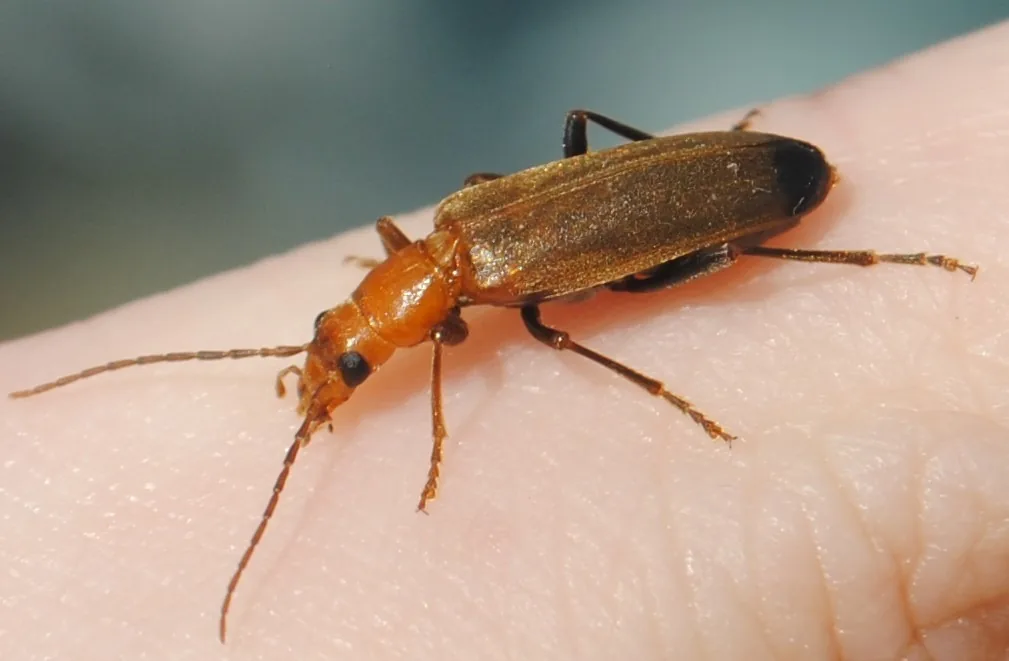
Adults: 10-18mm; pale yellow to yellowish-brown with dark wing tips; slender, elongated. Found near very wet or waterlogged wood β€” dock pilings, boat hulls, waterfront structures, flood-damaged buildings. Large numbers of adults emerging from sill plates, floor joists, or sub-floor indicates severe hidden moisture damage in structural wood.

🧬 Biology & Behavior

Larvae of the wharf borer require wood with moisture content above 30% (saturation point) β€” far more moisture than powderpost beetles or other wood borers require. Their presence in a structure is diagnostic: structural wood has reached or exceeded fiber saturation point, indicating plumbing failure, foundation flooding, or chronic moisture intrusion.

⚠️ Damage & Health Risk

Exit holes in structural wood; the damage they represent (severe moisture in structural wood) is the real concern β€” the wood is already significantly degraded. Wood at this moisture level is also highly susceptible to wood-rot fungi.

πŸ”§ DIY Treatment

Address the moisture source immediately β€” this is the only meaningful action. Eliminating the moisture eliminates the breeding conditions. Affected wood must be assessed by a structural engineer for load-bearing capacity. Wood that has reached 30%+ MC and harbored wood borers may have significant decay that compromises structural integrity.

πŸ‘· When to Call a Pro

Professional moisture investigation and structural assessment is essential when wharf borers are found in load-bearing structural elements.

❓ FAQ

What does finding wharf borers mean?
It means your structural wood has reached saturation moisture level (30%+) β€” this is a building emergency, not just a pest problem. This level of moisture indicates active water intrusion through flooding, plumbing failure, or chronic drainage failure. Call a structural engineer alongside a pest control professional.
Are wharf borers the same as powderpost beetles?
No β€” they're different families with different moisture requirements. Powderpost beetles attack dry wood (less than 20% MC). Wharf borers require saturated wood (30%+ MC). Finding powderpost beetles = dry wood pest problem. Finding wharf borers = severe moisture emergency.
DG
Derek Giordano
Certified Pest Control Operator Β· Former Business Owner
Derek ran his own pest control company in Florida for several years, servicing thousands of regular customers. All content is based on hands-on field experience and current EPA & university extension guidelines.

πŸ—ΊοΈ Geographic Range & Distribution

FactorDetails
U.S. RangeAll or most U.S. states
Regional DetailDistribution varies β€” consult your local extension service for regional prevalence data.

πŸ“… Treatment Timing Guide

Treating at the right time dramatically improves results. Pest control timed to the life cycle uses less product and achieves better long-term control.

PeriodAction
SpringInspection and perimeter treatment before pest season starts.
SummerActive monitoring and targeted treatments as needed.
FallPreventive treatment before overwintering pests seek entry.

πŸ’° Professional Treatment Costs

Service TypeDIY CostProfessional Cost
Initial inspectionFree (self-inspect)$75–$150 (often credited to treatment)
One-time treatment$30–$100 in materials$150–$500
Annual service contractN/A$400–$900/year
Severe infestationOften ineffective alone$500–$2,500+

Prices vary by region, property size, and infestation severity.

❓ Common Questions About πŸͺ² Wharf Borer

How do I confirm I actually have this pest (not something similar)?
The most reliable confirmation is a physical specimen β€” capture one and compare to reference images on this page. For cryptic pests (bed bugs, termites), look for secondary signs: frass, shed skins, mud tubes, or bites with a specific pattern. When uncertain, a professional inspection is faster than months of misidentification.
Can I treat this myself or do I need a professional?
DIY is effective for small, accessible infestations caught early. Professionals are worth the cost when: the infestation is inside wall voids or structural elements, multiple rooms are affected, you have health-risk pests (hantavirus, venomous species), or DIY has already failed twice.
How long until the infestation is completely gone?
Expect 3–8 weeks for most infestations with proper treatment. Insects with dormant life stages (pupae, eggs) extend the timeline because those stages are impervious to most insecticides. Follow-up treatments at 2 and 4 weeks catch each new cohort as they emerge.
What's the most common mistake people make treating this pest?
Treating only the visible pest population while ignoring the harborage site, entry point, or breeding location. Killing adults provides temporary relief but the population rebuilds from hidden egg cases, pupae, or new arrivals through unaddressed entry points.
🧪 Recommended Treatment Products
Bifenthrin Carbaryl (Sevin) Beneficial Nematodes IPM Guide
Full product guides with mixing rates and safety info. → Browse All 130 Pesticide Guides
🔗 Related Pests
Powderpost Beetle Carpenter Ants Anobiid Beetle Carpenter Bee
Compare similar pests to confirm your identification. → Use our ID Flowchart
πŸ“š Sources: EPA Termite Guide Β· NPMA Termite Info
Published: Jan 1, 2025 Β· Updated: Apr 7, 2026

How to use this guide effectively

This guide is one entry point in a connected library. Each pest profile, treatment guide, and tool on this site links to related references that go deeper than any single page can. Working through a pest problem effectively usually means starting with identification (so you know what you're treating), reading the species-specific treatment guide, checking the product or tool references for specific selection guidance, and confirming approach with the FAQ and troubleshooting sections. Bookmarking a few core references β€” the species profile, the relevant treatment guide, and one tool that supports the decision-making (product selector, cost estimator, treatment schedule) β€” gives you a workflow you can return to as the situation evolves. The structure is intentional: surface-level summary first, then increasing depth, with the deepest detail in the dedicated tool and reference pages.

Reading pesticide labels: what most homeowners miss

The pesticide label is the most important document in any pest control decision, and it's the document most people skim. Under FIFRA (the federal law that governs pesticide registration), the label is legally binding β€” using a product inconsistent with its label is a violation, regardless of intent. The label has several sections that homeowners should read fully before purchase, not after: the use sites (where it can legally be applied), the target pests (some products legal indoors are not for the specific pest), the mixing rate (overdosing wastes product without improving efficacy and increases drift risk; underdosing accelerates resistance), the PPE requirements (some require respirators, not just gloves), and the re-entry interval (how long until the treated area is safe for people and pets). The signal word β€” Caution, Warning, Danger β€” indicates acute toxicity but not chronic risk; that's elsewhere on the label. Reading labels well prevents nearly every common DIY misapplication.

Sources used across this site

Editorial sources used consistently across this site: the EPA pesticide registration database for current product use directions and active ingredient information; CDC for public health context on pest-borne disease; the National Pesticide Information Center (NPIC) for homeowner pesticide questions; university Cooperative Extension publications (UC IPM, NC State Extension, Penn State Extension, University of Florida IFAS, and others) for region-specific identification and treatment guidance; the National Pest Management Association (NPMA) for industry context; and peer-reviewed entomological literature for biology, resistance management, and emerging issues. Product reviews reflect editorial testing and aggregated user-reported outcomes rather than manufacturer-supplied claims. Where regional information matters, we link to state and local extension publications rather than generalizing across regions.

How content is reviewed and updated

Content on this site is reviewed by Derek Giordano, a former pest control company owner and previously licensed Pest Control Operator in Florida with several years of field experience servicing thousands of regular customers. Reviews check treatment recommendations against current EPA-registered products and label use directions, cross-reference major treatment claims against university extension publications and CDC public health guidance, and verify that any product mentions reflect current registration status and reasonable consumer availability. Pages get updated as treatment recommendations evolve β€” pesticide products are deregistered, resistance patterns shift, regional pest distributions change. The 'Updated' date at the bottom of each page reflects the most recent review pass on that specific page; the site-wide approach to E-E-A-T (experience, expertise, authoritativeness, trustworthiness) follows Google's published guidance on health and safety topics.

Choosing the right product formulation for the situation

Active ingredient gets most of the attention, but formulation often determines outcome. The same active ingredient in different formulations performs very differently: microencapsulated formulations last longer on porous surfaces and reduce human re-entry exposure, wettable powders give the longest residual on porous substrates but leave visible residue, suspended concentrates give a balance of residual and appearance, dusts are uniquely effective in wall voids and dry harborage but should never be broadcast indoors, baits are appropriate when pests must transport active to the colony or nest, and aerosols are appropriate for direct contact and quick knockdown but rarely give meaningful residual. Choosing formulation by the substrate (porous vs. nonporous), the access (open spray vs. crack-and-crevice vs. void), and the goal (knockdown vs. residual vs. transferable) routinely improves outcomes more than upgrading active ingredient.

The role of local cooperative extension in pest decisions

State cooperative extension services β€” university-based educational and advisory programs in every state β€” are dramatically underused resources for residential pest decisions. Most state extensions employ entomologists who answer homeowner questions free of charge through county offices, online query forms, or scheduled call hours. The information available is specific to the state's pest pressure, climate, and recommended practices, and is typically much more locally accurate than national resources. Extension publications cover identification, life cycle, treatment options, and specific product recommendations for state conditions; the publications are peer-reviewed by university scientists and updated periodically based on current research. For any pest situation where identification is uncertain or treatment options are unclear, a clear photograph submitted to the state extension produces an identification, a brief biological explanation, and one or more treatment options within typically a few days. The benefit beyond any single inquiry is building familiarity with the local resource β€” extension contacts become a reference for future situations and produce better decisions than aggregated online advice.

Why most pest 'sightings' aren't what people think they are

Species misidentification is the single most common reason that DIY pest treatment fails or that homeowners describe products as not working. The patterns are consistent: bed bug bites are routinely attributed to mosquitoes, fleas, or unknown causes; carpet beetle larvae are mistaken for bed bug nymphs; small black ants are called 'sugar ants' regardless of actual species; carpenter ants and termites are confused despite very different treatments; bat bugs are treated as bed bugs (the treatment may work, but the actual problem is overhead). Even when identification is correct at the family level, species within a family often require different approaches β€” German vs. American cockroaches, subterranean vs. drywood termites, or pavement vs. carpenter ants are practical examples. The first hour of any pest problem should go to identification, not treatment: photograph specimens with a coin for scale, send images to a local cooperative extension office (most respond within a day or two), or post to one of the moderated identification forums where entomologists answer. Correct identification narrows treatment options to those that actually work and discards the larger pile that don't.

Choosing a pest control company: questions worth asking

Pest control companies vary substantially in approach, training, and pricing, and the questions to ask before signing a contract often aren't the obvious ones. Worth asking: what's the technician's training and certification (state pest control certification is the floor; advanced training in IPM, structural inspection, or specific pest specialties is meaningful additional credentialing); what does the service include beyond visiting and spraying (inspection, monitoring, exclusion recommendations, follow-up scheduling); what guarantees apply if pests return between visits; what's the protocol for hard-to-resolve issues (some companies escalate to senior technicians or supervisors; others repeat the same approach); what active ingredients are used and whether the company will use specific products on request (homeowners with chemical sensitivities, pollinator gardens, or other concerns may want specific products); and what's the contract structure (per-visit, annual, multi-year). Worth less than expected: brand recognition and advertising spend (large national chains and small local operators both produce excellent and mediocre service); 'green' or 'organic' labels (which mean different things to different companies and often don't correspond to specific product or practice differences); price alone (typical pricing variance is modest, and the floor of cheap options often includes poor service).

Understanding pest forecast reports and what they signal

Pest forecast reports β€” issued by some state agricultural agencies, cooperative extension services, and commercial pest control companies β€” are an underutilized resource for homeowners who want to anticipate rather than react to seasonal pest activity. These reports typically combine historical pest data, current weather conditions, and growing degree day calculations to predict when specific pests will emerge or peak in specific regions. A tick forecast for an upcoming spring season, a mosquito pressure forecast after a wet winter, a termite swarm prediction for a specific week in the Southeast β€” these aren't speculation but reasonably calibrated predictions based on biological timing. For homeowners, the value is in scheduling preventive treatment and personal protection to match the predicted high-pressure windows rather than reacting after problems have established. Subscribing to a regional pest newsletter from a cooperative extension service or state agriculture department is free or low cost and produces these forecasts during relevant seasons. The information is dramatically more actionable than generic pest control content because it's calibrated to your specific region and current conditions.

Pet-safe pest control: what the label actually communicates

Pet-safe is a marketing phrase that does specific work, and the work it does is narrower than most pet owners assume. A product labeled pet-safe is generally one that, when used according to label directions and after the specified re-entry interval, presents a low risk of acute toxicity to pets at expected exposure levels. That is not the same thing as zero risk, and it doesn't say anything about chronic exposure, behavioral effects, or exposure to pets with unusual physiology, age, or pre-existing conditions. The other thing it doesn't account for is real-world misuse: pets that lick treated surfaces immediately after application, products applied in higher concentrations than directed, or applications in locations the label didn't anticipate. The practical interpretation is that pet-safe products are a reasonable choice when used carefully, but the safer overall practice with any pet in the home is to keep animals out of treatment areas until products are fully dry or absorbed, choose lower-toxicity formulations like bait stations over surface sprays when feasible, and ask explicitly about ingredients and re-entry intervals rather than relying on the label phrase alone.

Pest control and HOA dynamics: where they overlap

Homeowners' associations vary widely in how they engage with pest control, and the variations create practical issues that affect individual treatment decisions. Some HOAs maintain common-area pest treatment programs that handle perimeter spraying, mosquito treatment, or rodent monitoring on shared property; others leave all pest control to individual homeowners. Some have rules about treatment products or notification requirements; others don't. Some include treatment in the HOA fee structure; others bill separately. For homeowners in HOA communities dealing with persistent pest pressure, understanding what the HOA does and doesn't do is the first step in figuring out what additional individual action is needed. For HOAs without coordinated programs in areas with significant pressure, organizing a neighborhood-level treatment plan often produces dramatically better results than individual treatment efforts that don't coordinate timing or coverage. The conversations are sometimes politically awkward in HOA contexts, but the underlying problem β€” that some pests are neighborhood-scale and unit-level treatment can't address them β€” is structural rather than personal. Bringing the issue to an HOA meeting with concrete proposals tends to produce more constructive responses than complaint-style framing.

πŸ—ΊοΈ US Distribution β€” Wharf Borer & Wood-Boring Beetles in Wet Wood

Common Occasional Not Present
States Present
49
Occasional
2
Primary Region
All agricultural regions
πŸ“Š Source: University extension services, USDA, CDC vector data, and published entomological surveys.