On this page
How to identify it
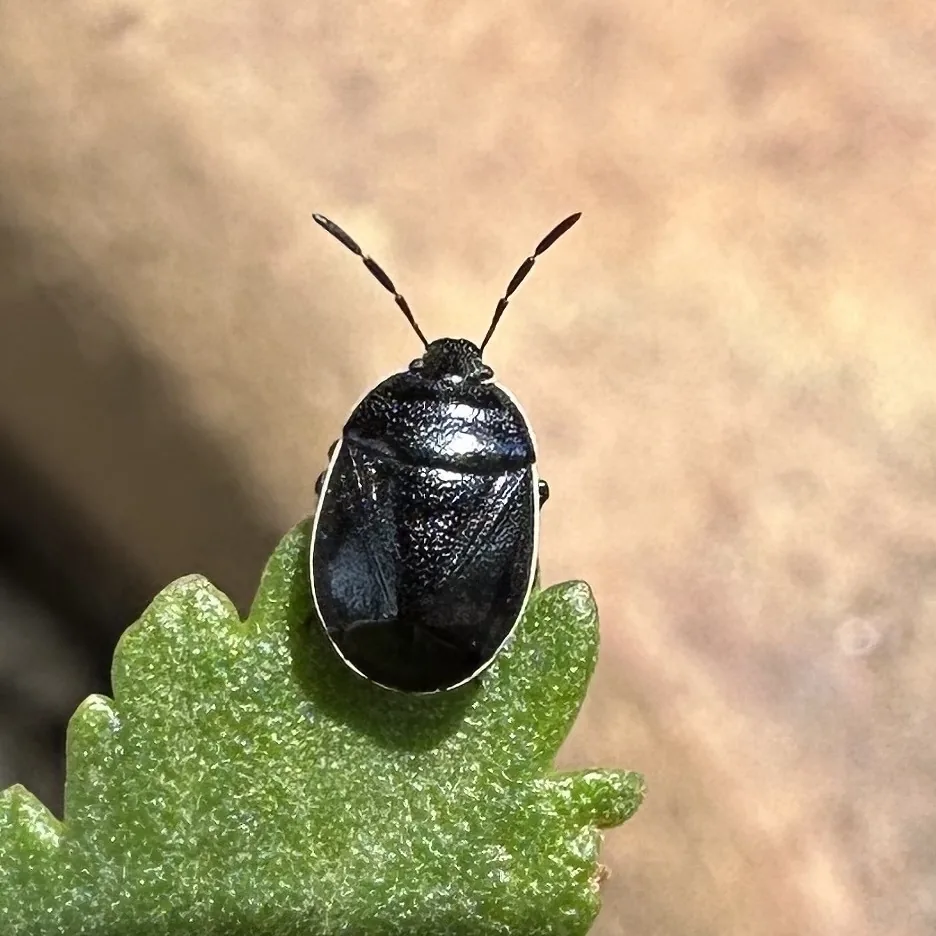
- Adults are about 1/4 inch long, shiny black and shaped like a stink bug, with a white border along both sides of the thorax and abdomen.[4][1]
- The lower legs (tibias) are covered with easily seen spines, which true stink bugs lack.[4]
- The nymphs are red and black and only 2 to 3 mm long, and they often gather in large clusters, including in cracks and expansion joints in pavement.[1][2][3]
Look-alikes
| Look-alike | How to tell them apart |
|---|---|
| Stink bugs | Stink bugs share the same shape, but burrower bugs are shiny black with a white border along the sides and have easily seen spines on their lower legs.[4] |
Where it lives
Texas A&M reports occasional outbreak years in parts of Texas, and Kansas State covers it in Kansas, where it is abundant on and under henbit in late spring.[1][4]
Biology and life cycle
Adults and nymphs feed on the seeds of nettles and mint-family plants. In Texas the hosts are thought to include horsemint and henbit, and Kansas State finds them most abundant on and under henbit in late spring.[2][4]
Kansas State reports one generation a year. Adults spend the winter, mate in spring, and the eggs usually hatch in mid-May.[4]
The female digs a shallow burrow, lays 120 to 150 eggs next to a supply of seeds and guards them, putting herself between a predator and the eggs. After they hatch she brings more seeds for 1 to 3 days before leaving the young on their own.[2][3]
Each clutch can hold up to 150 eggs, and a female may have two broods, which is how the numbers climb so quickly.[2]
Damage and signs
- The harm is nuisance: thousands of bugs can cover structures, plants, lawns and driveways, and they have even been seen crawling on dogs.[1][2]
- It won't damage garden plants. When herbicide kills the henbit they feed on, the bugs move to nearby green plants such as soybeans, which looks alarming but doesn't injure the crop.[2][4]
Health risk
It doesn't bite and isn't an insect to fear, Texas A&M says.[2][3]
Control
Prevention
Usually nothing is needed. The bugs disappear on their own after a while, and it may be years before another outbreak; Kansas State says no management is justified.[1][2][4]
Pesticides
If you feel you must spray, a synthetic pyrethroid insecticide labeled for lawns and landscapes will kill the bugs it contacts over a few hours, but it won't make a dent in future generations. Keep people and pets away from the treated area.[1]
Common questions
- Why are thousands of tiny black bugs crawling over my driveway in spring?
- It may well be the white-margined burrower bug, which has occasional outbreak years in parts of Texas. The red-and-black nymphs collect in pavement cracks and expansion joints, and the numbers drop again on their own.[1][3][2]
- Do white-margined burrower bugs bite or hurt plants?
- No. They don't bite, they won't damage garden plants, and even large numbers moving into soybeans don't injure the crop.[2][4]
- Should I spray them?
- Usually not. A pyrethroid kills the bugs it touches, but it won't prevent the next generation, and the outbreak fades by itself.[1][2]
Sources
- Texas A&M AgriLife Extension Service, “Pest Alert! White-margined burrower bug (Insects in the City, May 1, 2024).” citybugs.tamu.edu/2024/05/01/pest-alert-white-margined-burrower-bug/ (accessed 2026-11-08)
- Texas A&M AgriLife Extension Service, “The Mother bug (Insects in the City, May 4, 2011).” citybugs.tamu.edu/2011/05/04/the-mother-bug/ (accessed 2026-11-08)
- Texas A&M AgriLife Extension Service, “The "Mother" bug II (Insects in the City, May 12, 2014).” citybugs.tamu.edu/2014/05/12/the-mother-bug-ii/ (accessed 2026-11-08)
- Kansas State University Research and Extension, “Kansas Crop Pests: Burrowing Bugs, MF3613 (R. J. Whitworth, H. Davis and A. Norton, November 2022).” bookstore.ksre.ksu.edu/pubs/MF3613.pdf (accessed 2026-11-08)
- iNaturalist, “Sehirus cinctus taxon page (order and family).” www.inaturalist.org/taxa/360116 (accessed 2026-11-08)