On this page
How to identify it
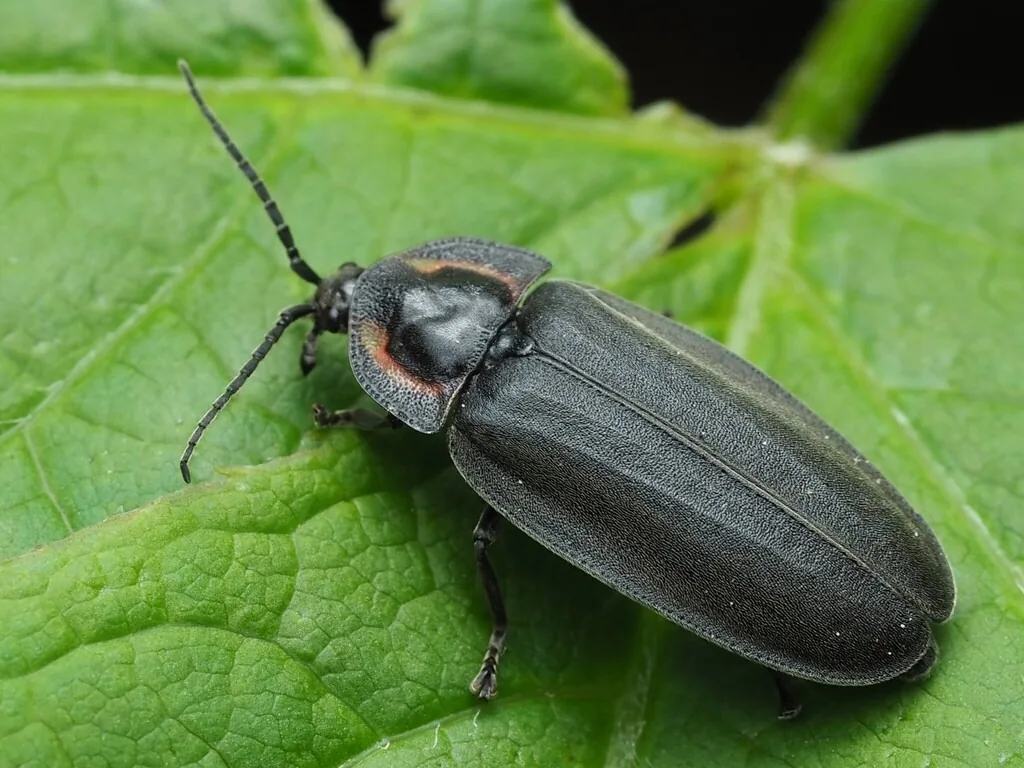
- Adults do not flash. Unlike the familiar summer fireflies, they lack light organs and are active during the day; Missouri notes that some firefly species lack bioluminescence altogether.[1][3]
- Like other fireflies, it is a soft-bodied beetle. Missouri describes adult fireflies in general as brown or black, with somewhat leathery wing covers and a shieldlike plate, usually red or orange, covering the head from above.[3]
- In late winter and early spring adults rest on the sunny side of large-diameter trees. At one Pennsylvania study site they were the only beetles of that size on the trees at that time of year.[1]
Look-alikes
| Look-alike | How to tell them apart |
|---|---|
| Summer fireflies (other Lampyridae) | Summer fireflies flash from dusk into the night to find and choose mates, and Missouri says fireflies generally spend the winter as larvae. Winter firefly adults have no light organs, are active by day, and spend the winter as adults on tree trunks.[1][3] |
Where it lives
It is native to North America, ranging from Alaska to Mexico, and researchers suspect it may be a complex of several closely related species rather than one. GBIF's public U.S. records since 1990 (about 11,000) come from 29 states on the map, most from Massachusetts, Vermont and New Hampshire.[1][7]
Biology and life cycle
Its seasons differ from those of summer fireflies. Adults emerge in fall before their eggs or sperm are mature, spend the winter on the sides of large trees, mature in spring, and mate in late spring or early summer.[1]
Males are probably the searching sex, flying to perched females. On contact the male antennates the female and passes his mouthparts (palps) over her, and the two-stage mating that follows may last more than 20 hours.[1]
Females release a scent, (1S)-exo-3-hydroxycamphor, that draws males. In field trials in Vermont and Pennsylvania in May 2022, lures carrying the synthetic compound attracted large numbers of males, and the authors report it as the first volatile sex pheromone identified for any firefly.[1]
Unlike most fireflies, the adults are suspected to feed, possibly on nectar or sap.[1]
As in all fireflies, the larvae make light even though the adults do not. Firefly larvae in general spend most of their lives in leaf litter, under rotting logs and in other moist places, where they hunt snails, slugs and other soft-bodied prey.[1][3][4]
A bacterium new to science, Spiroplasma corruscae, was described in 1996 from the gut of winter fireflies collected in Maryland; related strains were later found in horse flies.[6]
Health risk
None of the sources describes any harm to people. Missouri notes that fireflies in general, larvae and adults, contain chemicals that make them distasteful or toxic to predators, so they are rarely eaten.[3][1]
Control
Prevention
Leave winter fireflies alone. Researchers cite concern over firefly declines and offer the new pheromone as a tool to monitor winter firefly populations. A 2021 red list review of 132 U.S. and Canadian firefly species found at least 18 (14%) threatened, from pressures including habitat loss, light pollution and climate change, and more than half could not be assessed for lack of data.[1][5]
To help fireflies in general, Missouri advises avoiding broad-spectrum insecticides, and Clemson suggests leaving fallen leaves, where firefly larvae live and hunt.[3][4]
Common questions
- Why don't winter fireflies light up?
- Adults lack light organs and are active by day, and females attract males with a scent instead of flashes. The larvae, like those of all fireflies, do make light.[1]
- Why are there fireflies on my trees in winter?
- Winter firefly adults emerge in fall and spend the winter on the sides of large trees, where they are found on the sunny side in late winter and early spring. They mature in spring and mate in late spring or early summer.[1]
- Do winter fireflies harm trees?
- None of the sources reports any harm. The adults rest on the bark, and researchers suspect they feed on nectar or sap.[1]
- Are fireflies declining?
- Researchers report concern over firefly declines. A 2021 red list review found at least 14% of 132 assessed U.S. and Canadian species threatened, and Missouri points to habitat loss, pesticides and light pollution.[1][5][3]
Sources
- Journal of Chemical Ecology (Springer), full text in PubMed Central (PMC10102081), “Lower, Pask, Arriola, Halloran et al. Identification of a Female-Produced Sex Attractant Pheromone of the Winter Firefly, Photinus corruscus Linnaeus (Coleoptera: Lampyridae). Journal of Chemical Ecology 49: 164-178 (2023), doi:10.1007/s10886-023-01417-2.” doi.org/10.1007/s10886-023-01417-2 (accessed 2026-11-11)
- iNaturalist, “Photinus corruscus taxon page (order and family).” www.inaturalist.org/taxa/1616267 (accessed 2026-11-11)
- Missouri Department of Conservation, “Fireflies (Lightning Bugs).” mdc.mo.gov/discover-nature/field-guide/fireflies-lightning-bugs (accessed 2026-11-11). Covers fireflies in general, not this species.
- Clemson Cooperative Extension, Home & Garden Information Center, “Leave the Leaves for the Fireflies.” hgic.clemson.edu/leave-the-leaves-for-the-fireflies/ (accessed 2026-11-11). Covers fireflies in general, not this species.
- PLoS One, via PubMed Central, “Evaluating firefly extinction risk: Initial red list assessments for North America (Fallon et al. 2021).” pmc.ncbi.nlm.nih.gov/articles/PMC8598072/ (accessed 2026-11-11). Open-access full text; red list assessments for 132 U.S. and Canadian firefly species.
- International Journal of Systematic Bacteriology, via PubMed, “Spiroplasma corruscae sp. nov., from a firefly beetle (Coleoptera: Lampyridae) and tabanid flies (Diptera: Tabanidae) (Hackett et al. 1996).” pubmed.ncbi.nlm.nih.gov/8863421/ (accessed 2026-11-11). Cited from the PubMed abstract.
- Global Biodiversity Information Facility (GBIF), “Photinus corruscus: occurrence records in the U.S., 1990-2026 (GBIF occurrence search).” api.gbif.org/v1/occurrence/search?taxonKey=11326368&country=US&hasGeospatialIssue=false&occurrenceStatus=PRESENT&year=1990%2C2026&facet=stateProvince&facetLimit=400&limit=0 (accessed 2026-11-11). State counts are records reported (iNaturalist research-grade, museum specimens, surveys), not abundance.