On this page
How to identify it
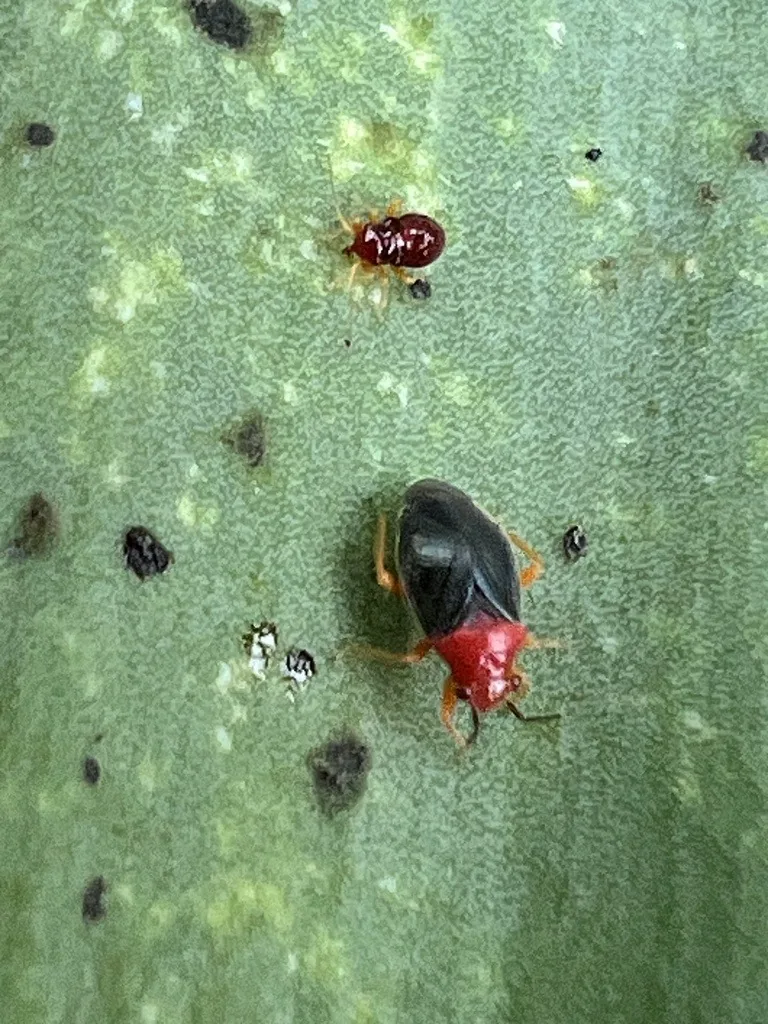
- Adults are tiny, about 1/8 inch (NC State) to 3/16 inch (Ohio State), with dark navy-blue to black wings and an orange to orange-red head and thorax.[1][2]
- Nymphs share the color scheme but look redder because their black wing pads don't cover the abdomen.[2]
- They are skittish, with sharp eyesight, and dart to the base of the blades when approached.[1][2]
Look-alikes
Where it lives
A native of the southwestern US found widely, especially in the South, and north into Ohio.[2]
Biology and life cycle
It overwinters as eggs inserted into yucca leaves; eggs hatch in early spring.[1][2]
NC State reports a second generation around the first of June; Ohio State sees at least three overlapping generations, with adults into fall.[1][2]
Damage and signs
Health risk
Control
Pesticides
Insecticidal soap, spinosad or other labeled products work, but repeat treatment may be needed because eggs in the leaves survive; wait until flowers drop before using a systemic, to protect yucca moths.[1][2]
Common questions
Sources
- NC State Extension, “Yucca Plant Bug (PDIC Factsheet).” content.ces.ncsu.edu/yucca-plant-bug-1 (accessed 2026-10-16)
- Ohio State University Extension (Buckeye Yard and Garden onLine), “Yucky Yucca (Buckeye Yard and Garden onLine).” bygl.osu.edu/node/2370 (accessed 2026-10-16)
- iNaturalist, “Halticotoma valida taxon page (order and family).” www.inaturalist.org/taxa/464230 (accessed 2026-10-06)