🏠 OTC/DIY
Active: hydroprene (juvenile hormone analog IGR)
Gentrol IGR — Hydroprene for Cockroaches
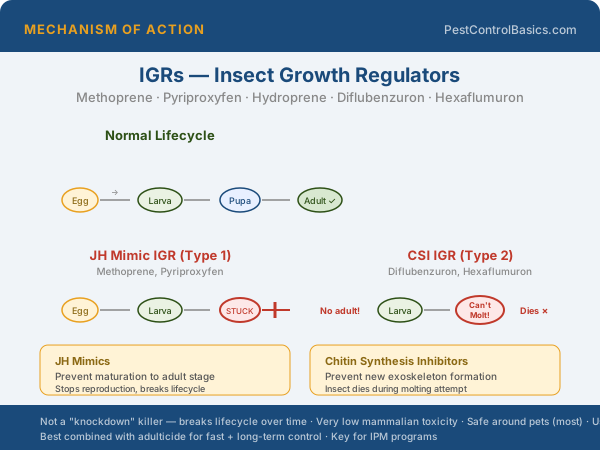
Gentrol contains hydroprene — a juvenile hormone analog IGR specifically for cockroaches and stored product insects.
🔮
Reviewed by Derek GiordanoContent reviewed by a licensed pest management professional and cross-referenced against EPA, university extension, and manufacturer technical data. Last reviewed: April 2026.
Application equipment that improves consistency
Better application equipment improves results more than better product. A one-gallon pump sprayer with adjustable nozzle ($30-50) outperforms hose-end sprayers for residual product application because it delivers consistent dilution. A hand duster ($15-25) is the only effective way to apply dust to wall voids, cracks, and crevices — pre-bottled dust products typically deliver inconsistent coverage. A foam machine adapter is useful for treating wall voids where dust would be inappropriate. Measuring cups and a measuring syringe ensure correct dilution at the label rate. A respirator (organic vapor cartridge) is required for some products and reasonable insurance for others. Equipment investments pay back across many treatments and are usually the missing element when product application produces inconsistent results.
Common DIY mistakes that defeat otherwise correct treatments
Most DIY pest control failures aren't product failures — they're application failures. The recurring patterns we see across reader emails and field experience: treating only where pests are visible rather than where they live (the active surface is rarely the harborage), spraying repellents over residual products and breaking the residual film, applying baits in already-treated areas (the residual kills foragers before they return with bait), overdiluting product because 'less chemical is safer' (it's not — it accelerates resistance), expecting overnight results when the kill curve is two to four weeks for most products, and stopping treatment at the first sign of improvement rather than completing the protocol. Each of these failure modes is independently preventable with attention to the product label and the pest's biology, and avoiding them improves outcomes more than upgrading to a more expensive product.
Storing pesticides safely
Pesticide storage at home should follow specific practices for safety and product integrity. Original containers only — label information must remain attached. Locked storage cabinet or location inaccessible to children and pets. Cool, dry environment (not in unheated garages where temperature swings degrade product, and not in direct sun). Don't store with food, beverages, or personal care items. Don't store near ignition sources for flammable products. Keep an inventory and dispose of products that have exceeded shelf life (most pesticides retain efficacy for several years if stored properly, but separated emulsions, crystallized concentrates, or color-changed products should be discarded). Disposal: check with your local hazardous waste program; most municipalities have collection days or permanent drop-off sites for household pesticide disposal.
What's actually in the active ingredient column
Most pesticide products use a small number of active ingredients across many brand names. Pyrethroids (bifenthrin, cypermethrin, deltamethrin, lambda-cyhalothrin, permethrin) are the dominant household residual class — fast-acting, low mammalian toxicity, but increasingly affected by resistance in major pests. Neonicotinoids (imidacloprid, dinotefuran, thiamethoxam) are systemic-leaning and have specific uses for ant baits, termite treatment, and some flea products. Phenylpyrazoles (fipronil) underlie many termite, ant bait, and pet flea products. Insect growth regulators (pyriproxyfen, methoprene, hydroprene, novaluron) interrupt development rather than killing directly and pair well with adulticides. Botanicals (pyrethrum, spinosad) offer rapid knockdown but limited residual. Knowing the active ingredient class lets you rotate products properly and recognize when a 'new product' is really an old active in new packaging.
Reading pesticide labels: what most homeowners miss
The pesticide label is the most important document in any pest control decision, and it's the document most people skim. Under FIFRA (the federal law that governs pesticide registration), the label is legally binding — using a product inconsistent with its label is a violation, regardless of intent. The label has several sections that homeowners should read fully before purchase, not after: the use sites (where it can legally be applied), the target pests (some products legal indoors are not for the specific pest), the mixing rate (overdosing wastes product without improving efficacy and increases drift risk; underdosing accelerates resistance), the PPE requirements (some require respirators, not just gloves), and the re-entry interval (how long until the treated area is safe for people and pets). The signal word — Caution, Warning, Danger — indicates acute toxicity but not chronic risk; that's elsewhere on the label. Reading labels well prevents nearly every common DIY misapplication.
Application timing within the day and weather conditions
Pesticide applications produce significantly different results depending on application timing, and matching application to conditions improves outcomes substantially. For outdoor liquid applications, early morning (after dew has evaporated, before pollinators are active) and late evening (after pollinators have stopped foraging, before evening dew) produce best results: temperatures are moderate, wind is typically lower, and non-target exposure is reduced. Mid-day applications during high temperatures cause volatility losses and faster degradation. For interior treatments, timing depends on the pest: cockroach baiting works at any time but should follow rather than precede cleaning; bed bug treatments need to follow vacuuming and clutter reduction; ant baits work best when active trails are present, which often means specific times of day for specific species. Rain within 4 hours of outdoor liquid application washes off most surface residue except specifically rainfast formulations; checking the next 24-hour forecast before any outdoor treatment is the basic discipline that prevents this loss. Temperatures above 90°F or below 50°F outside the product label's recommended range produce reduced efficacy.
When professional treatment is genuinely worth the cost
Professional pest control isn't always the right answer, but several specific situations genuinely justify the cost over DIY treatment. Severe bed bug infestations rarely yield to homeowner treatment because the required combination of vacuuming, encasements, structural treatment, and follow-up monitoring exceeds what most homeowners execute consistently. Subterranean termite treatment requires equipment (subslab injection) and product (commercial-grade termiticide quantities) not accessible to consumers, and inspection findings often dictate specific treatment that homeowners can't do safely. Roof and attic rodent problems benefit from professional exclusion that addresses access points consumers don't find. Mosquito reduction programs using barrier treatments and breeding-site management produce substantially better results than consumer foggers and yard sprays. Persistent cockroach problems in multi-unit buildings need coordination consumers can't provide. The pattern: professional treatment justifies itself when scale, access, regulatory product restrictions, or coordination requirements exceed what DIY can practically accomplish. Routine ant trails, occasional wasp nests, fruit fly outbreaks, and the like remain reasonable DIY targets where the cost-benefit math favors handling it yourself with the right products and information.
Pesticide rotation and the resistance management problem
Resistance management — using multiple active ingredients in sequence so that no single mode of action selects for resistant individuals — is standard practice in agricultural and commercial pest control but rarely makes it into residential treatment decisions. The underlying concern is real: chronic use of a single pyrethroid product against bed bugs has produced widespread pyrethroid resistance, with some populations now showing resistance factors of 1000x or more. The same pattern is documented in German cockroach resistance to chlorpyrifos and other historical actives, mosquito resistance to organophosphates in heavy-use regions, and house fly resistance across multiple compound classes. For residential treatment, the practical implication is to avoid using the same active ingredient repeatedly across multiple treatment cycles; rotating between products in different chemical families (e.g., pyrethroid → neonicotinoid → insect growth regulator → carbamate, or whatever subset is appropriate to the target pest) reduces selection pressure and preserves efficacy. The product label specifies the active ingredient family, allowing rotation choices to be made on actual chemistry rather than brand name.
Reduced-risk pesticide selection: a category worth knowing
The EPA's reduced-risk pesticide program identifies active ingredients and formulations that meet specific criteria for lower toxicity to non-target organisms, reduced potential for groundwater contamination, lower likelihood of resistance development, or better compatibility with integrated pest management. Products in this category aren't free of toxicity — they're pesticides, and all pesticides have some toxic profile — but they represent the lower end of the risk distribution within their pest categories. For homeowners who want to use pesticides but are concerned about minimizing exposure and environmental impact, looking for products with reduced-risk actives is a defensible filter. Examples include some of the diamide insecticides, spinosyns, and certain microbial products. The catch is that retail availability lags behind the professional market for many reduced-risk products, and consumer pesticide aisles still skew heavily toward older pyrethroid and carbamate formulations. For homeowners willing to source products from agricultural supply channels or work with a pest control company that uses these products, the option exists; for those buying off the shelf at typical retail, the choices are narrower.
Pest control warranties: reading the fine print before signing
Pest control warranties are not standardized, and the differences between contracts that look superficially similar can be enormous. Termite warranties in particular vary across at least three significant dimensions: whether they cover retreatment only or also include damage repair, whether the damage coverage is capped or unlimited, and whether the warranty is transferable to subsequent owners. A retreatment-only warranty on a property with significant termite pressure is much weaker than a damage-inclusive warranty, and the difference matters most precisely in the situations where the warranty is most likely to be needed. General pest control service agreements often have similar gradations — some include unlimited callbacks during the service period, some include a fixed number, and some charge for any visit outside the regular schedule. Before signing, the question to ask is not whether the contract has a warranty, but exactly what the warranty covers, what triggers a callback at no charge, and what the renewal terms are. Companies rarely volunteer this clearly; reading the document carefully and asking specific questions is on the homeowner.
Pesticide drift and the neighbor dimension
Pesticide drift — the off-target movement of applied product through air, water, or runoff — is an under-discussed dimension of residential pesticide use, but it's an increasingly common source of conflict between neighbors and a real factor in the cumulative environmental load of pesticide use. Foliar sprays applied in even light wind drift further than most homeowners expect, particularly with finer droplet sizes. Granular products applied near property lines wash into adjacent properties in significant rainfall. Mosquito fogging can move across multiple properties depending on conditions. The implications are partly legal — drift onto neighboring property without consent has been the basis of successful nuisance claims in some jurisdictions — and partly ethical. Applying products only in low-wind conditions, choosing coarser droplet sizes when possible, using granulars rather than sprays near property lines, and timing applications to avoid imminent rainfall all reduce drift. For homeowners concerned about pesticide exposure from neighbors' applications, the productive conversation is usually about timing and product choice rather than about pesticide use in general, and approaching it that way tends to produce cooperation rather than escalation.