On this page
How to identify it
- The full-grown caterpillar is 15 to 17 mm long and yellowish to grass green, with a dark green pin stripe down the back and two pairs of faint yellow spots on top of each abdominal segment. The head is yellowish green to pale brown with a black triangular mark on each side.[1][2]
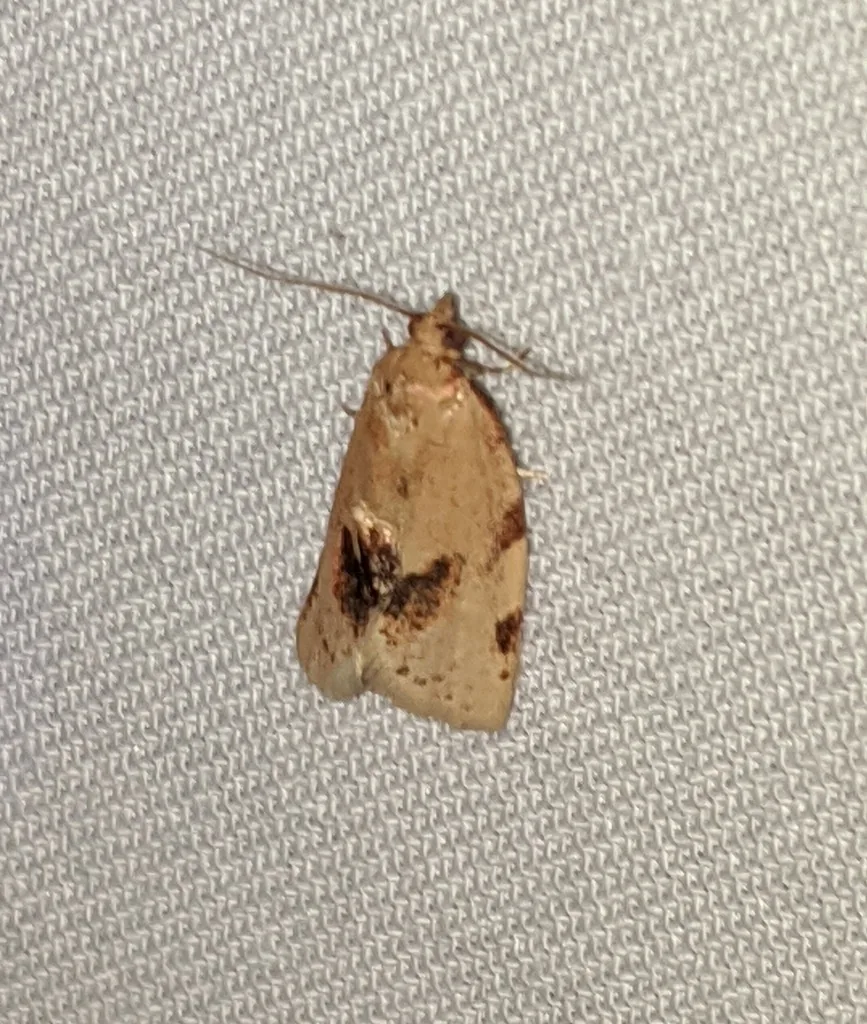
- The moth's forewings are straw yellow.[2]
- Caterpillars are on the foliage from early May to mid-June; they pupate in late June and the moths emerge soon after.[1]
Look-alikes
| Look-alike | How to tell them apart |
|---|---|
| Argyrotaenia provana | Argyrotaenia provana occurs widely in the Western States and British Columbia, and its caterpillar closely resembles that of A. dorsalana; the two are sometimes found together on Douglas-fir and white fir.[2] |
| Argyrotaenia occultana | Argyrotaenia occultana is a transcontinental Canadian relative that feeds singly on white spruce, lodgepole pine and other conifers without appreciable damage; its forewing is grayish with traces of reddish-brown banding rather than straw yellow.[2] |
Where it lives
It occurs on the south coast and in the southern interior of British Columbia south of 51 degrees latitude, and the USDA manual gives its range as California to British Columbia, Colorado and New Mexico; Natural Resources Canada adds Utah.[1][2]
Biology and life cycle
Douglas-fir is the principal host. Western hemlock, western redcedar and western larch are other main hosts in British Columbia, with grand fir, ponderosa pine and spruces as secondary hosts; the USDA manual records it on Douglas-fir, Engelmann spruce, white fir and western larch.[1][2]
The moth appears to overwinter in the egg stage. Caterpillars are present from early May to mid-June, pupation occurs in late June, and the adults emerge soon after.[1]
It is a free-living solitary defoliator that feeds on and moves about the foliage in the open, and it occurs in small numbers.[1][2]
Damage and signs
Health risk
The sources treat it only as a conifer foliage feeder and mention no effect on people.[1][2]
Control
Prevention
No control is needed; the insect is rated innocuous and occurs in small numbers. A green caterpillar with a black triangle on each side of its head on Douglas-fir needles in May or June can be left alone.[1][2]
Common questions
- Is Argyrotaenia dorsalana a pest of Douglas-fir?
- No. It is common in southern British Columbia but innocuous, and the USDA manual says it occurs in small numbers.[1][2]
- How do I tell its caterpillar from Argyrotaenia provana?
- With difficulty: the USDA manual says the larvae closely resemble each other and are sometimes found together on Douglas-fir and white fir.[2]
- When does the moth fly?
- Pupation is in late June and the straw-yellow moths emerge soon after.[1][2]
Sources
- Natural Resources Canada, Canadian Forest Service, “Argyrotaenia dorsalana (Dyar), Trees, insects and diseases of Canada's forests.” tidcf.nrcan.gc.ca/en/insects/factsheet/11993 (accessed 2026-11-10)
- USDA Forest Service, “Western Forest Insects, Miscellaneous Publication 1339 (R. L. Furniss and V. M. Carolin, November 1977; scanned copy).” archive.org/details/CAT78702369 (accessed 2026-11-10)
- iNaturalist, “Argyrotaenia dorsalana taxon page (order and family).” www.inaturalist.org/taxa/454807 (accessed 2026-11-10)