On this page
How to identify it
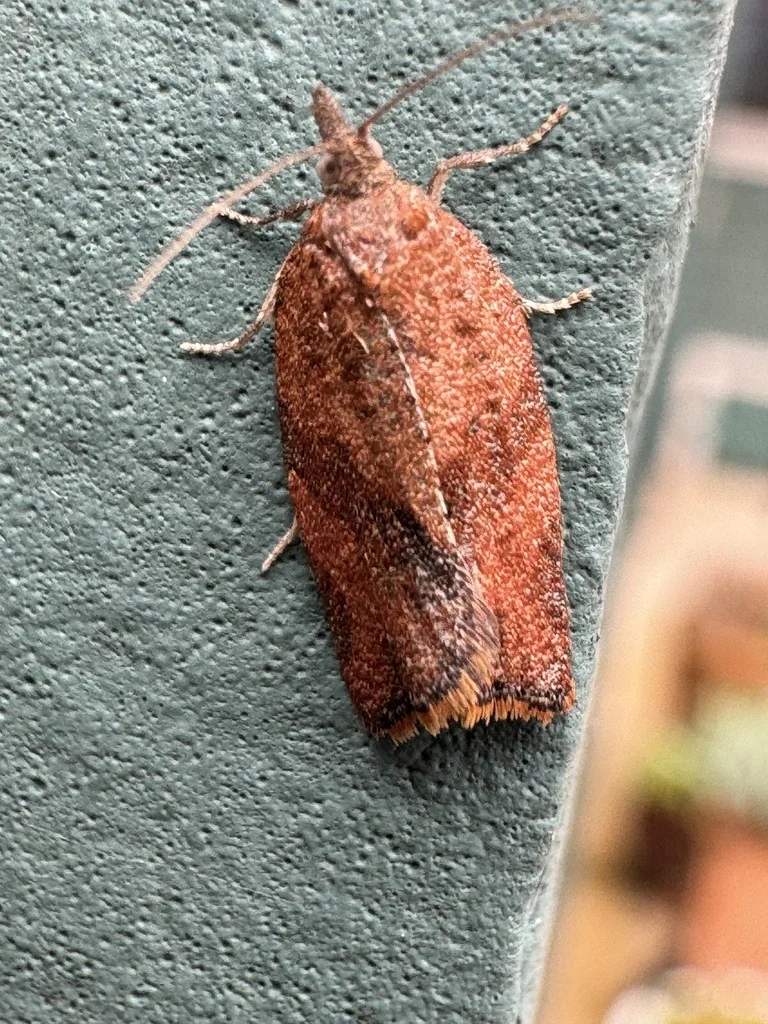
- At rest the moth is bell-shaped and about 1/2 inch (12 mm) long. Its forewings are light orange-brown to buff with a darker, V-shaped mark across the middle; females have a fainter mark, males darker markings.[2][3]
- Moths vary a lot. The orange form has broad orange to orange-brown forewings with a well-defined dark band and an outer dark spot on the front edge; the gray form has narrower gray to brownish-gray forewings. Both were once treated as separate species.[1]
- Caterpillars are straw-colored to green, with an unmarked tan to light brown head and shield behind the head, and grow to about 1/2 inch (12 to 15 mm). They are very active and wriggle backward or sideways, dropping or hanging on a silk thread when disturbed.[2][3][1][4]
Look-alikes
| Look-alike | How to tell them apart |
|---|---|
| Omnivorous leafroller | Its caterpillars look like orange tortrix but have small white bumps with bristles along the back and sides, and its moths have rusty brown and tan forewings.[3] |
| Garden tortrix | Often caught in orange tortrix traps. Its chevron pattern is darker and has a light-colored margin, and it is not a pest.[2] |
| Light brown apple moth and other leafrollers | Many leafroller caterpillars with a plain brown head and shield, including apple pandemis, look much like orange tortrix; light brown apple moth larvae are nearly indistinguishable from other leafrollers.[1][3] |
Where it lives
It is found in California, Oregon and Washington, mainly in cooler coastal areas and river valleys, and in British Columbia.[1][4]
Biology and life cycle
It is one of the most wide-ranging feeders among North American leafrollers, with hosts in more than 40 plant families, including grape, apple, citrus, blackberry, raspberry and conifer nursery stock such as Douglas-fir, pines and spruce.[1][3][4]
Females lay masses of about 200 overlapping eggs on smooth leaves, fruit and twigs. Young caterpillars skeletonize leaves under silk; older ones roll, fold or web leaves together or onto fruit, and pupate in their last shelter.[1][2]
The number of generations depends on climate. Inland in California larvae rest through the summer and there are two generations; UC IPM reports two to three in caneberries and three overlapping generations in coastal vineyards; and on the cool coast there may be up to five, with moths flying all year.[1][2][3]
Larvae or pupae spend the winter in dead leaves, dried fruit, under buds or on weeds near the crop. In vineyards, weeds such as mallow, curly dock, mustards, filaree, lupine and California poppy shelter them, as do oat and barley cover crops.[1][2]
Parasitic wasps attack it; in coastal vineyards the main one is Exochus nigripalpus subobscurus, which can give season-long control when parasitism is heavy in late spring. Spiders in the nests also feed on larvae.[2][3]
Damage and signs
- In grapes, larvae feed on buds in early spring and inside webbed leaves at the shoot tips, then make silk nests among the berries from bloom on. Their feeding opens berries to bunch rot.[2]
- In blackberries and raspberries, leaf injury is minor; the main problem is that larvae get into and contaminate the fruit.[3]
- In apple, citrus and grape, larvae feed directly on developing fruit, and feeding on stems can make fruit drop. In British Columbia it can cause losses in conifer nurseries, especially in greenhouses.[1][4]
Health risk
The sources describe it only as a crop and nursery pest; they mention no harm to people.[1][2][4]
Control
Prevention
Check shoots for rolled leaves webbed to them and, later, look for larvae and webbing inside fruit clusters. Pheromone traps track moth flights, but be sure to tell orange tortrix from garden tortrix in the traps.[2]
Sanitation
In vineyards, clean up during the dormant season: remove dried grape clusters left on vines, and disc weeds and fallen clusters at least a month before shoots start to grow. Harvesting early can also prevent damage.[2]
Biological control
Use insecticides sparingly to protect parasites, which can control orange tortrix. Coyote brush grown near vineyards in the Salinas Valley may help a key parasite survive the winter.[2]
Pesticides
If treatment is needed, UC IPM lists Bacillus thuringiensis and the Entrust formulation of spinosad as organically acceptable options. Spot-treat when possible and cover the vines thoroughly.[2]
Common questions
- Is orange tortrix the same as Argyrotaenia citrana?
- Yes. Much of the farm literature treats A. citrana and A. franciscana as separate species, but a 1999 molecular study concluded they are one species. The orange form was the one called citrana.[1]
- Why are there webbed nests in my grape clusters?
- On the coast, orange tortrix caterpillars enter grape clusters from bloom on and build silk nests among the berries; their feeding opens the berries to bunch rot.[2]
Sources
- USDA APHIS Identification Technology Program, “Argyrotaenia franciscana fact sheet, Tortricids of Agricultural Importance (T. M. Gilligan and M. E. Epstein).” idtools.org/id/leps/tortai/Argyrotaenia_franciscana.htm (accessed 2026-11-09)
- University of California Statewide IPM Program, “Grape Pest Management Guidelines: Orange Tortrix.” ipm.ucanr.edu/agriculture/grape/orange-tortrix/ (accessed 2026-11-09)
- University of California Statewide IPM Program, “Caneberries Pest Management Guidelines: Leafrollers.” ipm.ucanr.edu/agriculture/caneberries/leafrollers/ (accessed 2026-11-09)
- Natural Resources Canada, Canadian Forest Service, “Orange tortrix, Trees, insects and diseases of Canada's forests.” tidcf.nrcan.gc.ca/en/insects/factsheet/11992 (accessed 2026-11-09)
- iNaturalist, “Argyrotaenia franciscana taxon page (order and family).” www.inaturalist.org/taxa/214155 (accessed 2026-11-09)