On this page
How to identify it
- Larvae are green caterpillars with a green or brown head; UC IPM describes the head as straw- or gold-colored. Obliquebanded leafroller larvae look much the same except that their head is dark brown to black.[2][1]
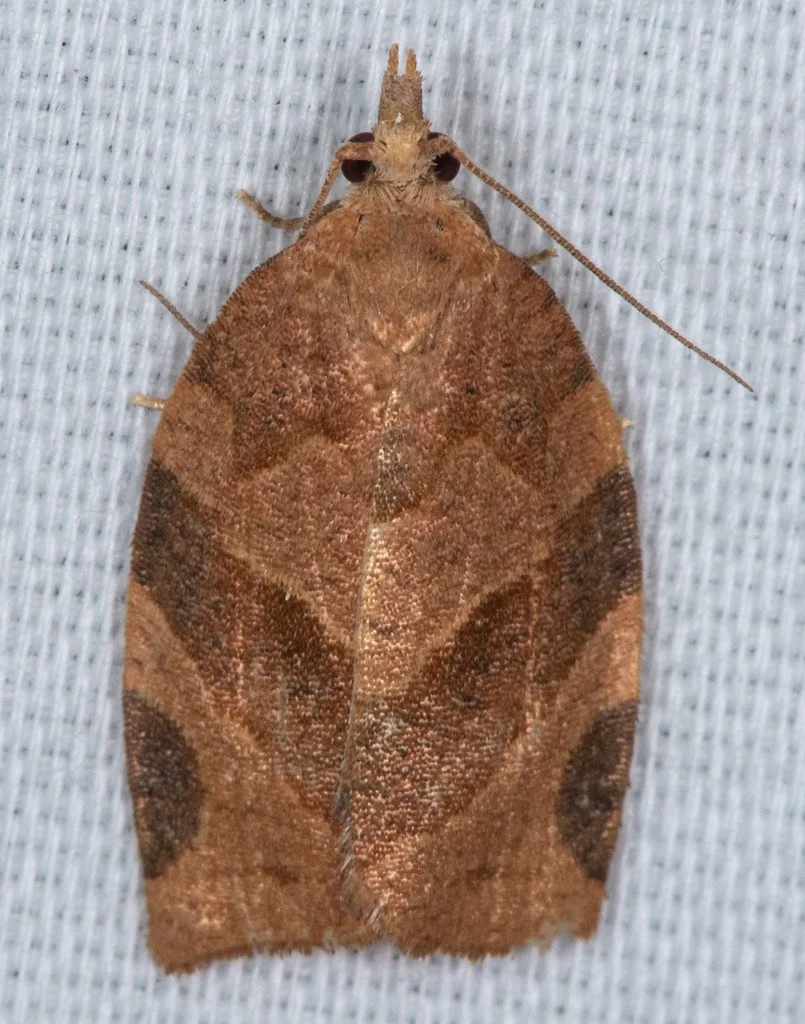
- Adult fruit-tree leafrollers, pandemis included, range from fawn-colored to dark brown with distinctive bands or mottling on the wings and wingspans of 0.5 to 1 inch.[2]
- Like other leafrollers, the larvae roll and tie leaves together with silk for shelter, thrash about violently when disturbed and may drop from the leaf hanging by a silken thread.[2]
- In summer the larvae windowpane leaves, which separates pandemis damage from orange tortrix; windowpaning can also be caused by eyespotted bud moth, especially in organic orchards.[1]
Look-alikes
| Look-alike | How to tell them apart |
|---|---|
| Orange tortrix | Orange tortrix larvae look similar to apple pandemis, but the two occur together in the orchard only during July, and pandemis larvae windowpane leaves while orange tortrix does not.[1] |
| Obliquebanded leafroller | Another two-generation leafroller whose green larvae are nearly identical to pandemis except for a dark brown to black head instead of a green or brown one.[2] |
| Fruittree leafroller | A single-generation leafroller that overwinters as egg masses on twigs and finishes feeding by early summer, whereas pandemis has a second, more damaging generation.[2] |
| Eyespotted bud moth | Also windowpanes leaves and leaves shallow feeding scars where leaves are tied to fruit, so the damage alone does not identify pandemis.[1] |
Where it lives
A pest of apple in the Pacific Northwest and California, where UC IPM calls it primarily a Central Coast orchard pest that occurs in higher populations in cooler years and cooler locations.[2][1]
Biology and life cycle
There are two generations a year. UC IPM says the moth overwinters as first-instar larvae in apple buds and the larvae become active in spring as the buds open; the Pacific Northwest handbook describes two-generation leafrollers overwintering as immature larvae under the bark of scaffold branches on a range of host plants, feeding during warm winter spells and becoming active with the new growth.[1][2]
Spring larvae feed for several weeks, first on buds and then on leaves, and pupate in rolled leaves. Moths emerge in late April to May and lay the eggs of the next generation, which hatches in early summer and does the most damage.[2]
Summer-generation eggs are laid in rolled leaves, so the larvae are protected from sprays when they hatch.[1]
The parasitic wasp Enytus eureka and a tachinid fly in the genus Actia parasitize apple pandemis larvae, though neither is abundant. Very cold winters, spiders, parasitic wasps and predators such as the brown lacewing reduce leafroller numbers, and parasitism is heaviest on mature larvae just before pupation.[1][2]
Damage and signs
- Overwintered larvae feed on blooms and on the surface of young fruit, causing fruit drop or leaving scarring and distortion. Prebloom feeding inside the fruit cluster results in fruit abortion or deeply scarred fruit, and the tiny young larvae are the most damaging stage even though they are hard to find.[1][2]
- Summer-generation larvae feed on leaf tissue, causing windowpaning, and when they tie leaves to fruit they leave shallow feeding scars. In the UC IPM summer monitoring scheme, each larva found correlates to about 1 percent fruit damage at harvest.[1]
Health risk
The sources treat the pandemis leafroller only as an orchard pest and mention no effect on people.[1][2]
Control
Prevention
Sample for apple pandemis between green tip and pink bud by examining 100 fruit clusters per block for larvae, and treat if any are found; control aimed at the first generation during bloom and petal fall is generally more successful than in-season sprays. In summer, monitor monthly in June, July and August (10 trees per variety, 4 minutes each) along with orange tortrix and eyespotted bud moth.[1]
A threelined leafroller (Pandemis limitata) pheromone trap can show when pandemis moths are flying, but it does not give an accurate population estimate for a block because traps draw moths from native vegetation as well as orchard trees. The Pacific Northwest handbook also offers a degree-day model for pandemis leafroller.[1][2]
Traps and physical control
Thin fruit clusters to a single fruit, which can significantly reduce problems with some leafrollers, and hand-pick rolled leaves that contain larvae or pupae. Once larvae are mature and moving to new leaves before pupating, the fruit damage is done and it is better to let natural enemies work than to spray.[2]
Biological control
Spiders, parasitic wasps and predators such as the brown lacewing reduce leafroller populations through the year; the parasitoids Enytus eureka and an Actia tachinid attack apple pandemis specifically. Insecticides applied against mature larvae mostly harm this natural enemy complex.[2][1]
Pesticides
Organically acceptable sprays are Bacillus thuringiensis, the Entrust formulation of spinosad and kaolin clay. UC IPM also lists methoxyfenozide, chlorantraniliprole and spinetoram for petal fall to harvest, and notes that a delayed dormant oil-plus-insecticide spray controls overwintering larvae but raises water quality and nontarget concerns.[1]
For home orchards the Pacific Northwest handbook lists horticultural mineral oil as a dormant or delayed-dormant spray and, from prepink through petal fall, azadirachtin, Bacillus thuringiensis var. kurstaki, kaolin, spinosad and pyrethrins, with carbaryl and pyrethroids such as permethrin flagged as highly toxic to bees.[2]
Common questions
- How do I tell pandemis leafroller from obliquebanded leafroller?
- Both are green two-generation leafrollers; pandemis larvae have a green or brown (straw- to gold-colored) head, while obliquebanded larvae have a dark brown to black head.[2][1]
- Why did my spring spray not control the summer leafrollers?
- Summer-generation eggs are laid in rolled leaves, so newly hatched larvae are protected from sprays; UC IPM says control aimed at the first generation at bloom and petal fall is generally more successful.[1]
- Is windowpaned apple foliage always pandemis?
- No. Windowpaning separates pandemis from orange tortrix, but eyespotted bud moth also windowpanes leaves and leaves similar shallow scars where leaves are tied to fruit.[1]
Sources
- University of California Statewide IPM Program, “Apple Pandemis, UC Pest Management Guidelines: Apple.” ipm.ucanr.edu/agriculture/apple/apple-pandemis/ (accessed 2026-11-10)
- Pacific Northwest Pest Management Handbooks (Oregon State University, Washington State University and University of Idaho), “Apple-Leafroller, Pacific Northwest Insect Management Handbook.” pnwhandbooks.org/insect/tree-fruit/apple/apple-leafroller (accessed 2026-11-10)
- iNaturalist, “Pandemis pyrusana taxon page (order and family).” www.inaturalist.org/taxa/356320 (accessed 2026-11-10)