On this page
How to identify it
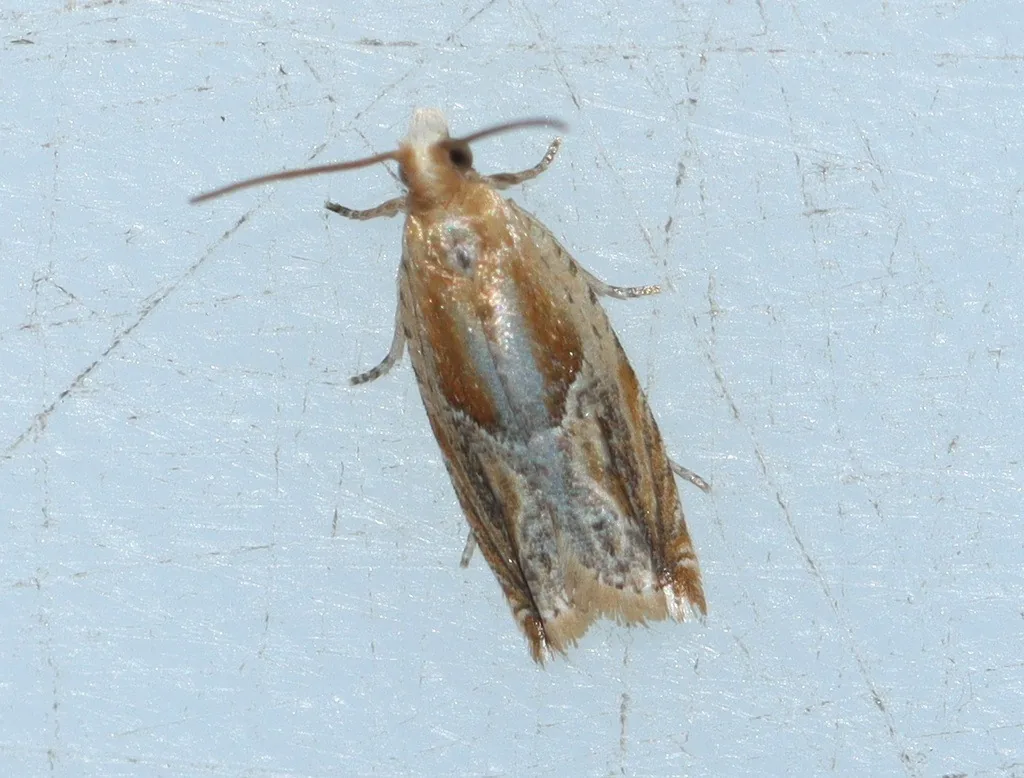
- The adult is a small, bell-shaped reddish-brown or rust-brown moth with distinctive light yellow markings or conspicuous wavy white lines on the forewings and a wingspan of about 11 to 14 mm.[1][3][2]
- Larvae are slender and pale green at first, turning grayish or green-brown as they mature, with a brown head and dark brown markings on the upper side of the tail end; mature larvae are about 12 mm (nearly 1/2 inch) long.[1][2][3]
- Eggs are laid on leaves in clusters, translucent to pale green at first and yellowish near hatching. The larvae roll and tie leaves with silk, produce large amounts of webbing and thrash violently or wiggle backward and drop on a silken thread when disturbed.[1][2]
Look-alikes
| Look-alike | How to tell them apart |
|---|---|
| Garden tortrix | The most common leafroller in California strawberries; its moths are grayish brown with a dark brown spot and diagonal stripe on each wing, and its larvae are grayish green with a small dark spot on each side of the light brown head, unlike the strawberry leafroller's reddish-brown, pale-lined moth and dark-tipped green larva.[2] |
| Orange tortrix | Orange tortrix moths are tan to rusty brown without the strawberry leafroller's pale wavy lines, and the larvae are greenish to bright yellow or straw colored with a golden head and shield.[2] |
Where it lives
Common in the eastern half of the United States and covered as a strawberry pest in the Pacific Northwest and California.[3][1][2]
Biology and life cycle
The strawberry leafroller overwinters as larvae on strawberry plants. Moths appear from early April to May and lay tiny eggs on the foliage, which hatch in about one to two weeks.[1][3]
Larvae complete development in 40 to 59 days, and adults can be seen throughout the growing season because there are several, usually two or three, generations a year.[3][1]
Damage and signs
- Larvae feed on leaves and roll them with silk webbing, continuing to feed inside the rolled leaf; some consume the whole leaf tissue. Heavy leaf feeding can reduce runner formation and interfere with ripening fruit, and the larvae occasionally feed on fruit.[3][2]
- Feeding on buds can damage developing flowers, resulting in deformed fruit.[1]
- Strawberries are quite tolerant of leaf-feeding caterpillars and can support high populations without economic loss; the Pacific Northwest handbook notes that leafrollers are seldom a pest on strawberries and treatment is usually not necessary.[3][1]
Health risk
The sources treat the strawberry leafroller only as a strawberry pest and mention no effect on people.[1][2][3]
Control
Prevention
Inspect leaves for rolled leaves and silken tubes on the undersides; because the plants tolerate the feeding, treatment is usually unnecessary.[1]
Sanitation
Remove dead leaves and trash from the base of the plants in late winter; the larvae overwinter on the strawberry plants.[2][1]
Traps and physical control
Handpick and destroy the caterpillars in their rolled leaves.[2]
Biological control
Parasitic wasps may naturally keep the caterpillars under control.[2]
Pesticides
When populations are high, spot applications of Bacillus thuringiensis or spinosad can be used. For home gardens the Pacific Northwest handbook also lists azadirachtin, horticultural oil, insecticidal soap, pyrethrins, bifenthrin, carbaryl, malathion and permethrin.[2][1]
Common questions
- Do I need to spray strawberries for leafrollers?
- Usually not. Strawberries tolerate heavy leaf feeding without economic loss, and the Pacific Northwest handbook says treatment is usually not necessary; handpicking and cleaning up dead leaves in late winter are the first steps, with spot sprays of Bt or spinosad only when numbers are high.[3][1][2]
- How many generations does the strawberry leafroller have?
- Several, usually two or three a year, so adult moths can be found throughout the growing season.[3][1]
- What does the caterpillar look like?
- A slender green caterpillar with a brown head and dark brown markings at the tail end, about 1/2 inch long when grown, that thrashes and drops on a silk thread when its rolled leaf is opened.[2][1]
Sources
- Pacific Northwest Pest Management Handbooks (Oregon State University, Washington State University and University of Idaho), “Strawberry-Leafroller, Pacific Northwest Insect Management Handbook.” pnwhandbooks.org/insect/small-fruit/strawberry/strawberry-leafroller (accessed 2026-11-10)
- University of California Statewide IPM Program, “Strawberry Leafrollers, Home and Landscape pest page.” ipm.ucanr.edu/home-and-landscape/strawberry-leafrollers/ (accessed 2026-11-10)
- Virginia Tech, Department of Entomology, “Strawberry leafrollers (tortix), Ancylis comptana (Virginia Fruit insect pages).” virginiafruit.ento.vt.edu/StrwTortricid.html (accessed 2026-11-10)
- iNaturalist, “Ancylis comptana taxon page (order and family).” www.inaturalist.org/taxa/213563 (accessed 2026-11-10)