On this page
How to identify it
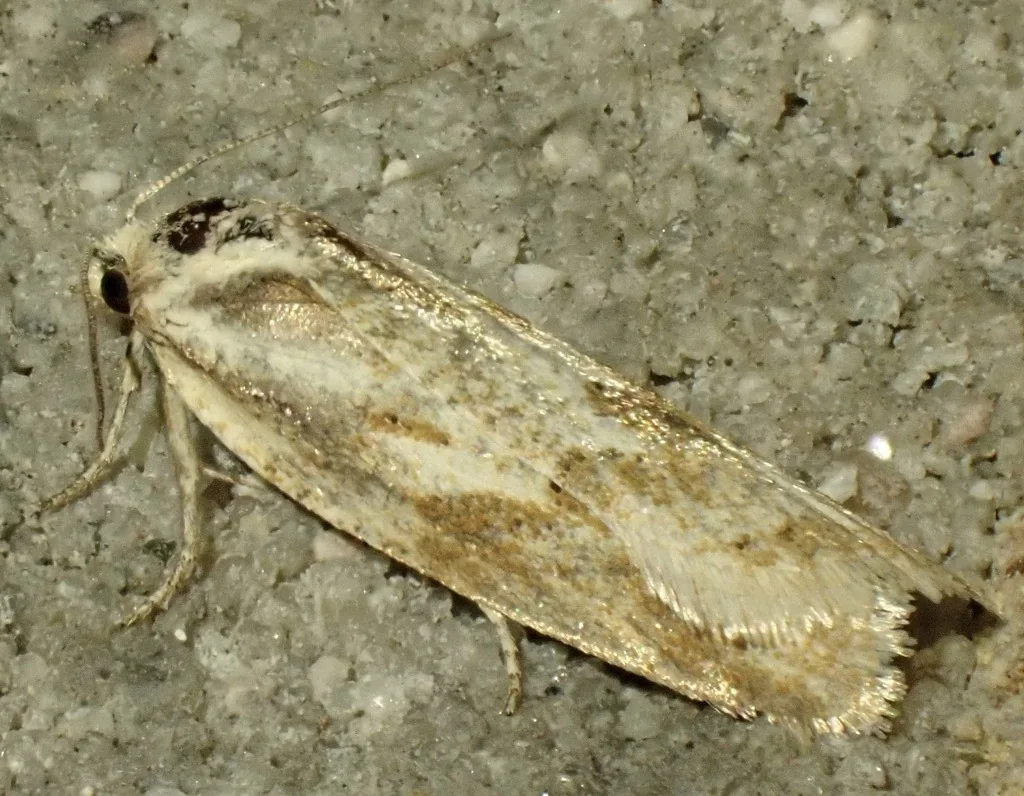
- The moth is slender, about 12 mm (1/2 inch) long, with narrow, elongated, yellowish forewings. Males are a uniform whitish to yellowish brown, while females are marked to varying degrees with light to dark brown.[1][4]
- Full-grown caterpillars are about 5/8 inch (14 to 18 mm) long. Their color varies from dirty white or cream to yellowish, gray or greenish, with a lighter stripe along each side of the back and a tan to brown head.[2][4][1][3]
- Look for leaves and flowers webbed together with silk, and for berries with tunnels that contain the caterpillars' droppings.[1]
Where it lives
Native to Europe, northwestern Africa and Asia, it was introduced into western North America in the late 1920s and now occurs in southern British Columbia, Washington, Oregon and California. In the Pacific Northwest it is most common west of the Cascades.[4][2]
Biology and life cycle
There is one generation a year. Females lay their eggs singly or in small batches in cracks and depressions in tree bark and cover them with bits of debris.[1][4]
The young caterpillars settle into bark crevices or other rough surfaces and spin a silken shelter, where they stay through the rest of the summer and the following winter. They do not spend the winter on strawberry plants.[4][1]
In spring the caterpillars spin silk threads and are carried by the wind to new host plants. They first mine leaves close to the ground, then web together shoots, buds and flowers.[1][4]
The caterpillars feed on herbaceous plants in more than 20 families. Hosts named by the handbook include strawberry, vetch, clover, plantain, hops and Dutch iris, as well as filbert and pear; in Europe it can be a pest of cereal crops.[4][1][2]
In Pacific Northwest strawberry fields, the caterpillars begin webbing leaves and flowers in late April, and the moths appear in June and July. The USDA fact sheet gives an adult season of late March to early July across North America.[1][4]
Damage and signs
- On strawberries, the caterpillars web the leaves and flowers together, then feed on and tunnel into both unripe and ripe berries, leaving droppings in the tunnels. One caterpillar can damage several berries, and the damage often shows on green berries right after fruit set.[1]
- It is a pest of vetch and sometimes attacks wheat heads in fields where vetch grows. In hops, the caterpillars feed on the terminal buds, causing side growth that may mean extra training of the plants.[2][3]
Health risk
The handbook and the USDA fact sheet describe it only as a crop pest; neither mentions any harm to people.[1][4]
Control
Keep them out
In strawberries, floating row covers put on after spring growth begins and taken off once bloom starts keep the wind-borne caterpillars off the plants.[1]
Traps and physical control
Remove webbed leaves and any caterpillars you find.[1]
Pesticides
If you spray strawberries, time it to the first blooms and do not treat while blossoms are open, to avoid poisoning bees. For home gardens the handbook lists carbaryl, when there are more than two caterpillars per plant, and permethrin.[1]
In grain and vetch, damage rarely justifies spraying except in Oregon's Willamette Valley. The options listed there include Bacillus thuringiensis kurstaki, which is OMRI-listed for organic use, and pyrethrins.[2]
Common questions
- How do omnivorous leaftier caterpillars get onto my strawberries?
- They do not overwinter on strawberries. Young caterpillars spend the winter in silk shelters on tree bark and other rough surfaces, then in spring spin silk threads and ride the wind to strawberries and other host plants.[1][4]
- When should I look for omnivorous leaftier in strawberries?
- Watch for webbed leaves and flowers starting in late April. Damage often shows up on green berries right after fruit set.[1]
- Is it the same insect as the strawberry fruitworm?
- The Pacific Northwest handbook's strawberry entry labels Cnephasia longana as the strawberry fruitworm, and the USDA fact sheet notes that it has been reported as a strawberry pest in Oregon and Washington.[1][4]
Sources
- Pacific Northwest Pest Management Handbooks (Oregon State, Washington State and University of Idaho Extension), “Strawberry: Omnivorous leaftier (Pacific Northwest Insect Management Handbook).” pnwhandbooks.org/insect/small-fruit/strawberry/strawberry-omnivorous-leaftier (accessed 2026-11-09)
- Pacific Northwest Pest Management Handbooks (Oregon State, Washington State and University of Idaho Extension), “Small grain: Omnivorous leaftier (Pacific Northwest Insect Management Handbook).” pnwhandbooks.org/insect/agronomic/small-grain/small-grain-omnivorous-leaftier (accessed 2026-11-09)
- Pacific Northwest Pest Management Handbooks (Oregon State, Washington State and University of Idaho Extension), “Hop: Omnivorous leaftier (Pacific Northwest Insect Management Handbook).” pnwhandbooks.org/insect/agronomic/hop/hop-omnivorous-leaftier (accessed 2026-11-09)
- USDA APHIS PPQ Center for Plant Health Science and Technology, with Colorado State University, “Cnephasia longana fact sheet, Tortricids of Agricultural Importance (T. M. Gilligan and M. E. Epstein; last updated August 2014).” idtools.org/id/leps/tortai/Cnephasia_longana.htm (accessed 2026-11-09)
- iNaturalist, “Cnephasia longana taxon page (order and family).” www.inaturalist.org/taxa/424105 (accessed 2026-11-09)