On this page
How to identify it
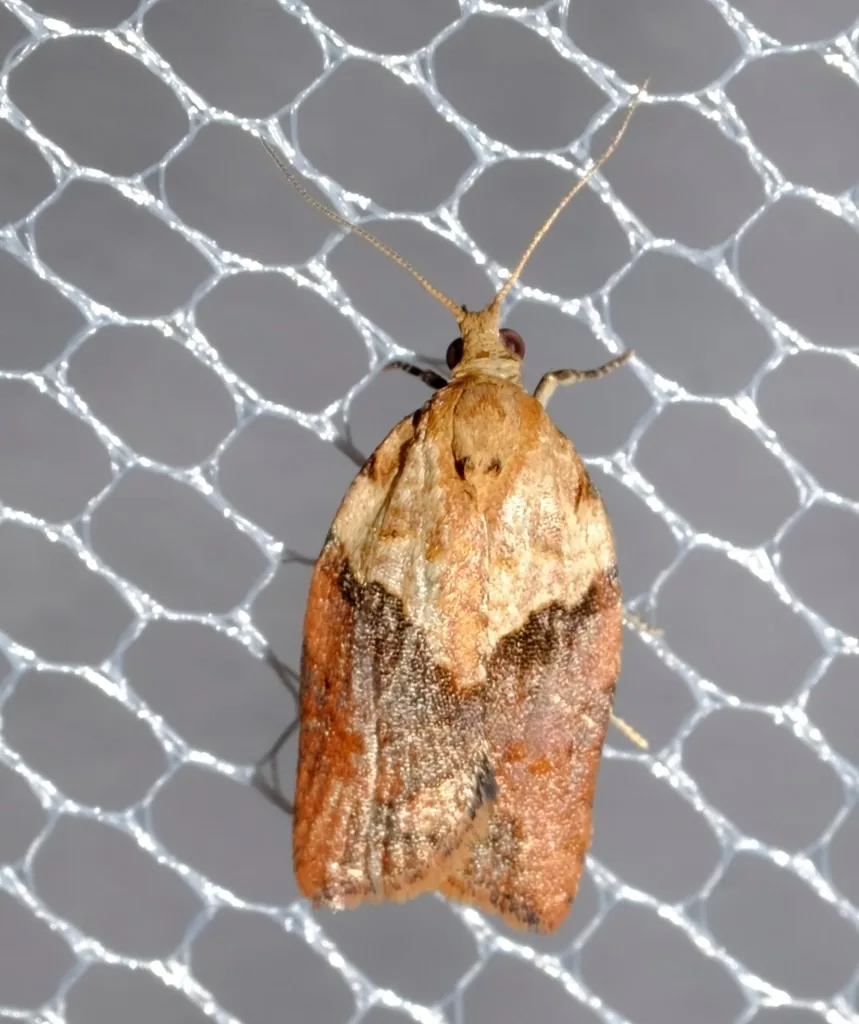
- The moth has a wingspan of about 2 cm (3/4 inch). Its forewings are light brown to pale yellow with brown to dark brown markings. Most males have a lightly marked inner half of the forewing and a well-defined dark band across the middle, while females are more evenly mottled or speckled.[3][1]
- Like other tortricid moths, it rests with its wings held over the abdomen in a bell shape and has mouthparts that stick out like a snout.[2]
- Full-grown larvae are about 1/2 to 3/4 inch (10 to 18 mm) long and pale to medium green, with a light yellowish-tan head and no dark markings on the head or the plate just behind it.[2][1]
- Eggs are laid in flat masses, usually of 20 to 50 eggs, that overlap like fish scales. They are greenish when fresh and darken as they develop.[2][3]
- All life stages look like those of many native leafrollers, so it can be reliably identified only by a trained entomologist, often with a dissection or a molecular test.[3][1][2]
Look-alikes
| Look-alike | How to tell them apart |
|---|---|
| Omnivorous leafroller and orange tortrix | Larvae of these common California leafrollers look similar and feed on grape clusters in much the same way; molecular tests may be needed to identify young larvae.[1][2] |
| Garden tortrix and other Clepsis leafrollers | Males of several Clepsis species share a membranous lobe in the genitalia, but in the light brown apple moth the lobe is much larger and forms a conspicuous notch, a difference that takes a dissection to see.[1] |
Where it lives
Native to Australia, it has been introduced to New Zealand, Hawaii, Great Britain and Ireland. In California it was first found in 2006 and has been detected in coastal areas from Los Angeles to Sonoma counties and in more than 20 counties overall. A single moth was caught in Oregon in 2011, but no established population is known on the U.S. mainland outside California.[1][3][2]
Biology and life cycle
It has two to four generations a year depending on climate, and California populations appear to have at least four, with adults active year-round. In its native range it does poorly in heat and thrives in cooler areas with mild summers, moderate rainfall and moderate to high humidity.[1][2]
There is no winter resting stage. Larvae keep developing slowly through the cool months on weeds and other vegetation, and they can survive up to two months without feeding.[2][1]
Females begin laying eggs two to three days after emerging, on smooth surfaces of leaves, stems or fruit. A female can lay more than 1,000 eggs, though 100 to 500 is more typical, and the eggs hatch in one to two weeks.[3][1][2]
Young larvae feed on the undersides of leaves under a silk shelter. Older larvae fold single leaves, web several leaves into a nest, or web a leaf to a fruit and feed on the fruit's surface. They pupate inside the nest, and adults emerge one to three weeks later.[1][2][3]
It has been recorded on more than 500 plant species in 121 families and prefers herbaceous plants to woody ones. Hosts include apple, pear, peach, cherry, grape, kiwifruit, strawberry, raspberry, blackberry, blueberry, alfalfa, clover, potato, cabbage and its relatives, willow, poplar and young pines.[1][3]
Damage and signs
- Most of the economic damage comes from fruit injury. Larvae feed on the fruit surface under webbed leaves, leaving irregular brown patches and scars that also let rot organisms in.[1][3]
- In vineyards, overwintering larvae feed on buds, which may then fail to develop; larvae feed on flower clusters during bloom; and after veraison their feeding on berries can let rot organisms infect the fruit.[2]
- Feeding can damage or kill seedlings and spoil the look of ornamental plants. In Australia and New Zealand, uncontrolled larvae have damaged as much as 70% of a fruit crop in years of high populations.[3][1]
- Several countries list it as a quarantine pest and Canada lists it as a noxious pest; Oregon's agriculture department notes that its presence there would likely lead to restrictions on shipping plant material.[3]
Health risk
The USDA, UC IPM and Oregon sources describe it only as a plant pest; none mentions any risk to people.[1][2][3]
Control
Sanitation
In vineyards, remove mummified grape clusters when pruning and chop them in the row middles, and mow broad-leaved weeds in and around the vineyard before bud break, to take away places where larvae spend the winter.[2]
Biological control
General predators and spiders feed on the eggs and larvae, many newly hatched larvae die while dispersing, and several parasitic wasps, especially Meteorus species, attack it in California.[2]
Pesticides
A well-timed spray of a selective insecticide may be warranted when moths are caught in pheromone traps inside the vineyard and larvae are seen feeding on clusters; sprays must go on before bunch closure. UC IPM lists Bacillus thuringiensis subsp. kurstaki, chlorantraniliprole, methoxyfenozide, spinetoram and spinosad; Bt and the Entrust formulation of spinosad are acceptable on organic crops.[2]
When to call a professional
In California, take suspect larvae, preferably alive, and any tortricid moths caught in light brown apple moth traps to the county agricultural commissioner's office for identification.[2]
Signs and monitoring
Look for young larvae and webbing at the bases of leaves, small flat egg masses on leaves, leaves rolled and tied with silk, and irregular brown areas on the fruit surface.[3]
Pheromone traps are the most efficient and reliable way to catch male moths, and both sexes come to black-light traps. In vineyards, check shoots in early spring for webbed leaves with larvae inside, and check clusters for webbing and larvae from bloom on.[2][3]
How it spreads
Most interceptions have been linked to international passenger flights. Fresh fruit and vegetables can carry live eggs and larvae, nursery stock can carry egg masses that are especially hard to spot, and moths drawn to lights may travel in aircraft.[3]
Common questions
- Is the light brown apple moth found outside California?
- On the U.S. mainland, an established population is known only from California; a single moth was caught in Oregon in 2011. It has also been introduced into Hawaii.[1][3]
- Can I identify a light brown apple moth myself?
- Not reliably. Its moths and larvae look like many native leafrollers, so identification takes a trained entomologist, often with a dissection or a molecular test. In California, suspect specimens go to the county agricultural commissioner.[3][1][2]
- What plants does the light brown apple moth attack?
- A very wide range: more than 500 plant species, including apple, pear, peach, cherry, grape, kiwifruit, berries, alfalfa, clover, potato and young pines. It prefers herbaceous plants to woody ones.[1][3]
Sources
- USDA APHIS PPQ Center for Plant Health Science and Technology, with Colorado State University, “Epiphyas postvittana fact sheet, Tortricids of Agricultural Importance (T. M. Gilligan and M. E. Epstein; last updated August 2014).” idtools.org/id/leps/tortai/Epiphyas_postvittana.htm (accessed 2026-11-09)
- University of California Statewide IPM Program, “Light brown apple moth, UC IPM Pest Management Guidelines: Grape.” ipm.ucanr.edu/agriculture/grape/light-brown-apple-moth/ (accessed 2026-11-09)
- Oregon Department of Agriculture, Plant Division, “Oregon Insect Pest Alert: Light Brown Apple Moth (revised August 2013).” oregon.gov/oda/Documents/Publications/IPPM/LightBrownAppleMothPestAlert.pdf (accessed 2026-11-09)
- iNaturalist, “Epiphyas postvittana taxon page (order and family).” www.inaturalist.org/taxa/119934 (accessed 2026-11-09)