On this page
How to identify it
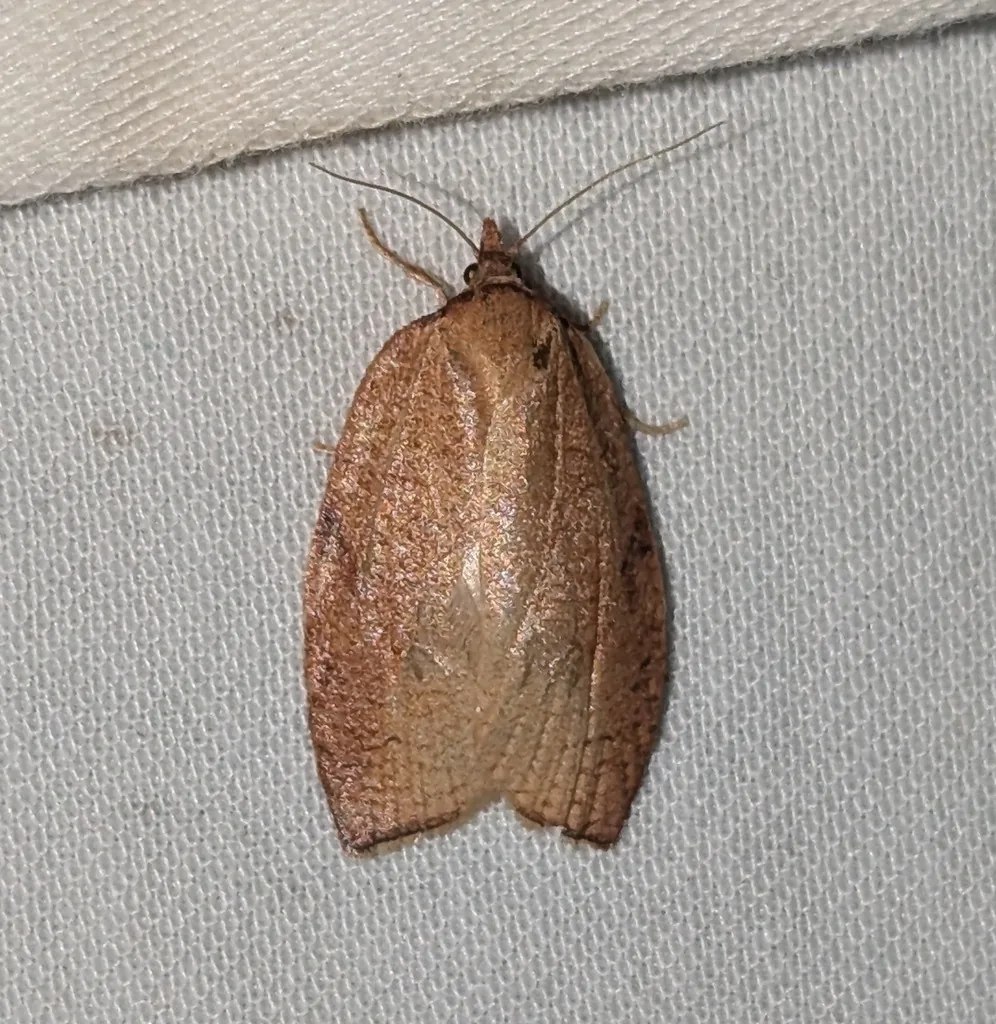
- The adult is a moth about an inch long that looks bell-shaped with its wings folded at rest. The forewings are orangish to tan with dark markings; males range from pale tan to rust to dark gray-brown and often show a dark spot on the front edge, while females are a more even rust or tan.[1][2]
- The caterpillar is yellowish green when young and darker green when grown, reaching 3/4 to 1 inch. Older caterpillars have a short dark line on each side just behind the head, above the first pair of legs; other caterpillars on avocado lack these marks.[1][2]
- Eggs are light green and oval, laid overlapping like shingles in flat masses of about 5 to 100 (25 on average), mostly on the upper side of leaves near the midrib. After hatching, the empty masses look like whitish patches on the leaf.[1]
- Caterpillars wriggle violently and drop to the ground when disturbed.[1]
Look-alikes
| Look-alike | How to tell them apart |
|---|---|
| Orange tortrix | Orange tortrix moths are also bell-shaped at rest but are only about half the size of amorbia moths.[1] |
| Avocado looper | The avocado looper also rolls avocado leaves and webs plant parts together, but its caterpillars lack the short dark line behind the head that older amorbia caterpillars have.[1] |
Where it lives
It is found along the Pacific Coast from southwestern Canada south to Baja California, and east to Arizona and Idaho. It is mainly known as a pest in California avocado groves.[2][1]
Biology and life cycle
Avocado is its main crop host, and it also damages citrus. It feeds on plants in several families, including camphor tree, sweet bay, California laurel, manzanitas, Pacific madrone, toyon, ceanothus, firethorn, grape, American elm and Douglas-fir.[1][2]
A female lives two to three weeks and lays 150 to 200 eggs. The eggs darken and hatch in about two weeks; the caterpillars go through five stages and then pupate for two to three weeks inside rolled leaves. At about 75 F, the whole cycle from egg to adult takes about a month and a half.[1]
The number of generations depends on the climate. Inland from Ventura to San Diego counties there are usually three a year, with moth flights in January to April, May to June and September to October; coastal groves average two. In northern California there are two generations, while in southern California adults have been recorded in every month.[1][2]
The moths fly at night and are drawn to bright lights, laying eggs nearby.[1]
Damage and signs
- Young caterpillars skeletonize leaves, leaving a thin brown membrane or just the veins; older ones eat whole leaves. They often web the leaves at shoot tips together, which shows as the shoots grow and unfold.[1][2]
- Mature trees can lose a lot of leaf area without much effect on growth or yield, but heavy defoliation can lead to sunburned fruit and twigs.[1]
- The real economic damage comes when caterpillars web leaves to fruit or feed between fruit touching in a cluster. In these sheltered spots they chew the fruit skin, and the scars lead to downgrading or culling.[1][2]
Health risk
These sources treat it only as a pest of avocado, citrus and other plants and do not describe any harm to people.[1][2]
Control
Prevention
Avoid broad-spectrum or long-lasting insecticides for any pest in the grove; caterpillar outbreaks often follow malathion sprays, which kill parasites and predators.[1]
Sanitation
Prune so foliage of neighboring trees doesn't touch, clear dead twigs and debris from the canopy, and thin or selectively pick fruit clusters. Remove abandoned citrus nearby, control weeds that host the caterpillars, and keep dust down on grove roads, since dust hampers natural enemies.[1]
Biological control
Natural enemies usually keep it below damaging levels. Tachinid flies are the most important, and their white eggs can sometimes be seen near a caterpillar's head; at least eight wasp species also attack it, including Trichogramma wasps in the eggs (black amorbia eggs are probably parasitized). Birds, spiders, assassin bugs, damsel bugs, lacewings and pirate bugs prey on the caterpillars, and a natural virus kills many when numbers are high.[1]
Where natural parasitism falls short, growers have controlled it by releasing Trichogramma platneri during peak egg laying in late spring, timed by pheromone or black light traps.[1]
Pesticides
If treatment is warranted, Bacillus thuringiensis (Bt) and spinosad are acceptable in organic production. Treat only the most infested spots so natural enemies can move back in from untreated areas.[1]
Pheromone traps
The female sex pheromone has been identified, and synthetic lures caught more males than traps baited with live females. Researchers later found that populations in different parts of southern California respond to different blends: a lure that worked in Orange, Ventura and Riverside counties failed in San Diego and Santa Barbara counties.[3][4]
Monitor during spring and summer, especially after moth flights peak, and include spots near bright outdoor lights, where moths tend to lay eggs.[1]
Common questions
- What is webbing leaves to my avocados and scarring the fruit?
- Western avocado leafroller (amorbia) caterpillars tie leaves to fruit, or feed between fruit touching in a cluster, and chew the skin there. Look for green caterpillars that wriggle and drop when disturbed.[1]
- Should I spray my avocado tree for leafrollers?
- Usually not. Tachinid flies, parasitic wasps and predators normally keep amorbia in check, and broad-spectrum sprays such as malathion often trigger caterpillar outbreaks by killing them. Bt is a selective option if treatment is needed.[1]
Sources
- University of California Statewide IPM Program, “Amorbia (Western Avocado Leafroller) (Avocado Pest Management Guidelines).” ipm.ucanr.edu/agriculture/avocado/amorbia-western-avocado-leafroller (accessed 2026-11-09)
- USDA APHIS PPQ Center for Plant Health Science and Technology, with Colorado State University, “Amorbia cuneana fact sheet, Tortricids of Agricultural Importance (T. M. Gilligan and M. E. Epstein).” idtools.org/id/leps/tortai/Amorbia_cuneana.htm (accessed 2026-11-09)
- Journal of Chemical Ecology (via NCBI PubMed), “Sex pheromone of the avocado pest, Amorbia cuneana (Walsingham): structure and synthesis (L. M. McDonough et al.; Journal of Chemical Ecology 8(1): 255-265, 1982; abstract).” pubmed.ncbi.nlm.nih.gov/24414600/ (accessed 2026-11-09)
- Journal of Chemical Ecology (via NCBI PubMed), “Western avocado leafroller, Amorbia cuneana (Walsingham): discovery of populations utilizing different ratios of sex pheromone components (J. B. Bailey, L. M. McDonough and M. P. Hoffmann; Journal of Chemical Ecology 12(6): 1239-1245, 1986; abstract).” pubmed.ncbi.nlm.nih.gov/24307105/ (accessed 2026-11-09)
- iNaturalist, “Amorbia cuneanum taxon page (order and family).” www.inaturalist.org/taxa/495240 (accessed 2026-11-09)