On this page
How to identify it
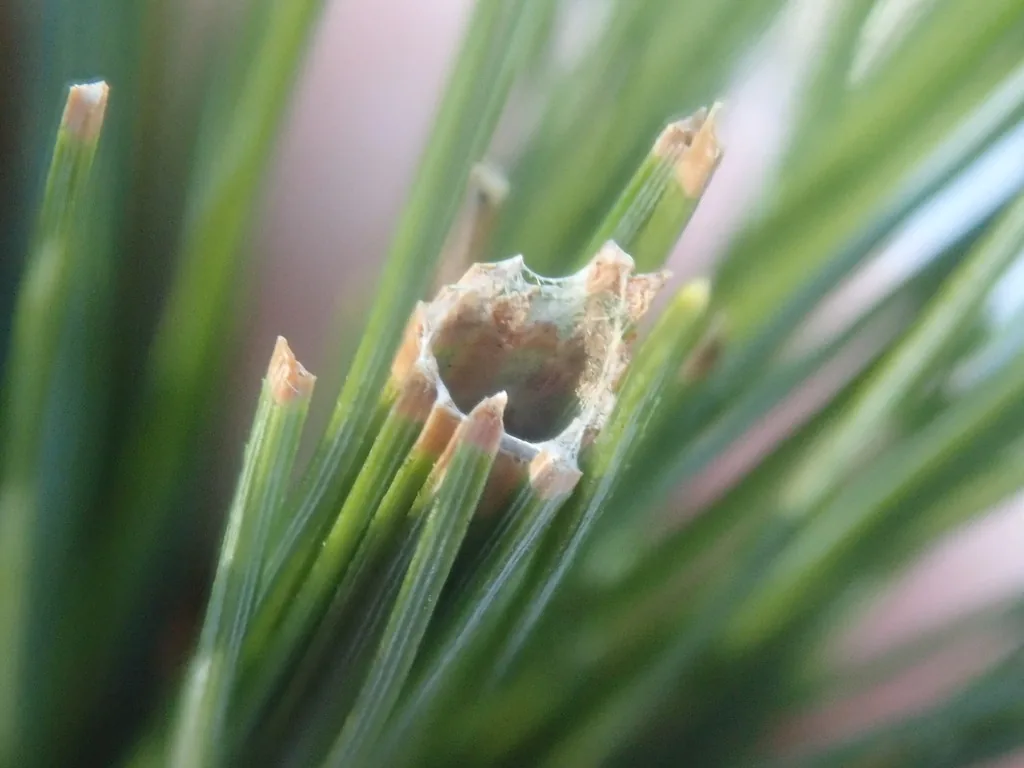
- Look for a tube of up to 20 white pine needles webbed together and lined with silk. The caterpillar eats the end of its own tube, which sets it apart from other caterpillars that make tubes on pines.[1][2]
- The caterpillar is yellowish green with an orange to yellow-brown head marked with dark brown, including a dark spot and a narrow dark bar on the side of the head. It grows to about 15 millimeters (0.6 inch).[2][1]
- The adult is a small moth that appears from about early May.[1]
Look-alikes
Where it lives
It is native and found throughout the range of eastern white pine.[1]
Biology and life cycle
Eastern white pine is the main host and may be the only one, though its full host range is not known. Much of its life cycle is still not well understood.[1]
It spends the winter as a pupa inside its silk-lined needle tube. Adults emerge around early May and lay eggs on the needles, and the young caterpillars feed on the needle tips.[1][2]
There are two generations a year. In southern New England, mature caterpillars are present mainly in June and July and again in September and October; the second generation forms new tubes and overwinters in them.[2][1]
Damage and signs
Health risk
Neither source mentions any harm to people; both describe it only as a needle-feeding caterpillar of pines.[1][2]
Control
Prevention
Management is rarely, if ever, needed. The moth seldom affects the overall health of the tree, and UMass Extension suggests leaving this native insect in the landscape, where it adds to local biodiversity.[1]
Traps and physical control
If control seems necessary on a small tree, pinch the tubes to crush the caterpillars or pupae inside.[1]
Biological control
Predators, parasitoids and possibly diseases are presumed to keep numbers low, although the natural enemies of this species have not been studied in detail.[1]
When to look
Check eastern white pines for tube-making caterpillars in May and June, and again in September and October.[1]
Common questions
- What are the little tubes of webbed needles on my white pine?
- Tubes of up to 20 white pine needles webbed together with silk, with the end of the tube chewed off, are the shelters of pine tube moth caterpillars.[1][2]
- Do I need to spray for pine tube moth?
- Almost never. UMass Extension says chemical control is rarely if ever necessary because the moth seldom reaches outbreak levels and the damage is minor; crushing the tubes on a small tree is enough if you want to act.[1]
Sources
- UMass Extension Landscape, Nursery and Urban Forestry Program (University of Massachusetts Amherst), “Argyrotaenia pinatubana, Landscape Insect & Mite Guide.” www.umass.edu/agriculture-food-environment/landscape/publications-resources/insect-mite-guide/argyrotaenia-pinatubana (accessed 2026-11-09)
- USDA Forest Service FHTET and Connecticut Agricultural Experiment Station (hosted by the University of Georgia Center for Invasive Species and Ecosystem Health), “Pine Tube Moth (Argyrotaenia pinatubana), from Caterpillars on the Foliage of Conifers in the Northeastern United States, FHTET-2004-01 (C. T. Maier et al., 2004), Bugwood wiki archive.” wiki.bugwood.org/Archive:Caterpillars/Pine_Tube_Moth_(Argyrotaenia_pinatubana) (accessed 2026-11-09)
- iNaturalist, “Argyrotaenia pinatubana taxon page (order and family).” www.inaturalist.org/taxa/214161 (accessed 2026-11-09)