On this page
How to identify it
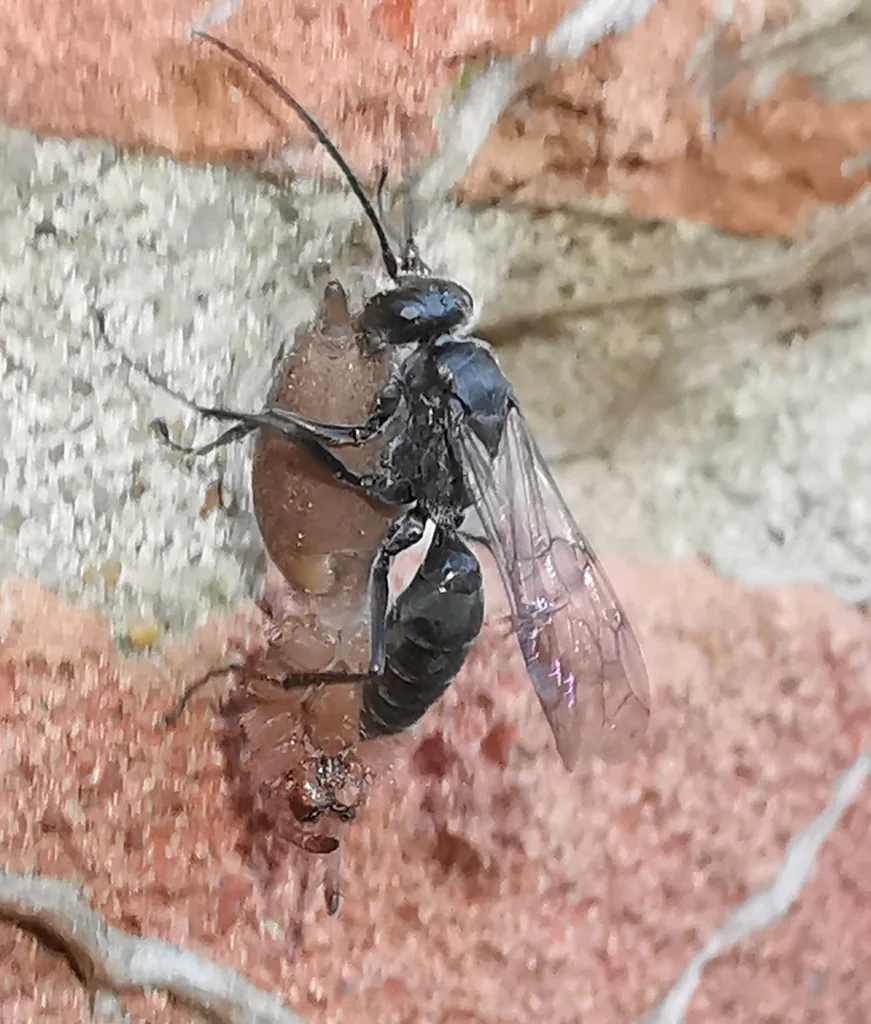
- Small spider wasps, up to about half an inch long, black with a bluish or turquoise sheen.[1]
- Most species have reddish or honey-colored legs; at least three species have all-black legs and are very hard to tell apart.[1]
- A female carrying a spider with its legs cut off is the giveaway; other spider wasps drag whole spiders.[1]
- Hunting females run over the ground flicking their wings nervously, and both sexes visit flowers.[2][1]
Look-alikes
| Look-alike | How to tell them apart |
|---|---|
| Blue-black spider wasps (Anoplius) | Larger blue-black spider wasps that dig burrows for whole wolf and grass spiders; Auplopus builds mud cells and removes the spider's legs.[1] |
| Mud dauber wasps | Listed by the Missouri Department of Conservation as a look-alike because both make mud nests; Auplopus is a spider wasp (family Pompilidae) only about half an inch long that snips the legs off its spider before crafting a mud cell for it.[1] |
| Entypus spider wasps | Much larger blue-black spider wasps with amber-marked smoky wings that haul wolf spiders to borrowed cavities.[1] |
Where it lives
About 10 Auplopus species occur in North America; the Missouri Department of Conservation reports them most common in wooded areas, and Kurczewski and colleagues add host records from the southwestern United States southward.[1][3]
Biology and life cycle
Auplopus wasps usually prey on sac, ground, crab, nursery web or jumping spiders. Like other spider wasps, the female stings and subdues the spider first; she then typically snips off its legs, which makes it easier for a small wasp to carry.[1][2]
Rather than digging a burrow, she crafts a mud cell for each young, lays a single egg on the spider and seals the cell. The larva eats the paralyzed spider, saving the vital organs for last, spins a durable silk cocoon and emerges later the same season or after overwintering.[1][2]
Adults take nectar from flowers, preferring open, disk-type blooms with shallow nectaries.[1][2]
A 2020 compilation of spider wasp prey records added first-time species host records and new host spider families for Auplopus.[3]
Damage and signs
- Auplopus wasps cause no damage. The small mud cells a female sometimes builds in exterior foundation cracks are cosmetic and hold only spiders and a developing wasp.[1]
Health risk
The sources describe Auplopus as small, solitary spider hunters that visit flowers; none of them report stings to people.[1][2]
Control
Prevention
No control is needed. Auplopus spider wasps are solitary, remove sac, crab and jumping spiders from around the home, and visit flowers; if a mud cell on a foundation bothers you, it can simply be scraped off after the wasp has emerged.[1][2]
Common questions
- I saw a small blue-black wasp carrying a spider with no legs. Why?
- That is an Auplopus spider wasp. The female snips the legs off a captured spider so its body is easier to carry to the mud cell where she will lay an egg on it.[1]
- What are the little mud cells in the crack of my foundation?
- Possibly Auplopus nests; the Missouri Department of Conservation notes that females sometimes build their mud cells in exterior cracks of house foundations. Each holds one paralyzed spider and one wasp larva and does no harm.[1]
- Are these the same as mud daubers?
- No. Auplopus wasps are spider wasps in the family Pompilidae, only about half an inch long, that craft a mud cell for each young and provision it with a single spider whose legs have been removed.[1][2]
Sources
- Missouri Department of Conservation, “Auplopus Spider Wasps (Field Guide).” mdc.mo.gov/discover-nature/field-guide/auplopus-spider-wasps (accessed 2026-11-10)
- Washington State University Extension, “Pompilidae: Spider Wasps (Hortsense natural enemy fact sheet).” hortsense.cahnrs.wsu.edu/fact-sheet/pompilidae-spider-wasps/ (accessed 2026-11-10)
- Zootaxa (Magnolia Press), abstract via PubMed, “Kurczewski FE, West RC, Waichert C, Kissane KC, Ubick D, Pitts JP. New and unusual host records for North American and South American spider wasps (Hymenoptera: Pompilidae). Zootaxa 4891(1) (2020).” pubmed.ncbi.nlm.nih.gov/33311100/ (accessed 2026-11-10)
- iNaturalist, “Auplopus taxon page (order and family).” www.inaturalist.org/taxa/250735 (accessed 2026-11-10)