On this page
How to identify it
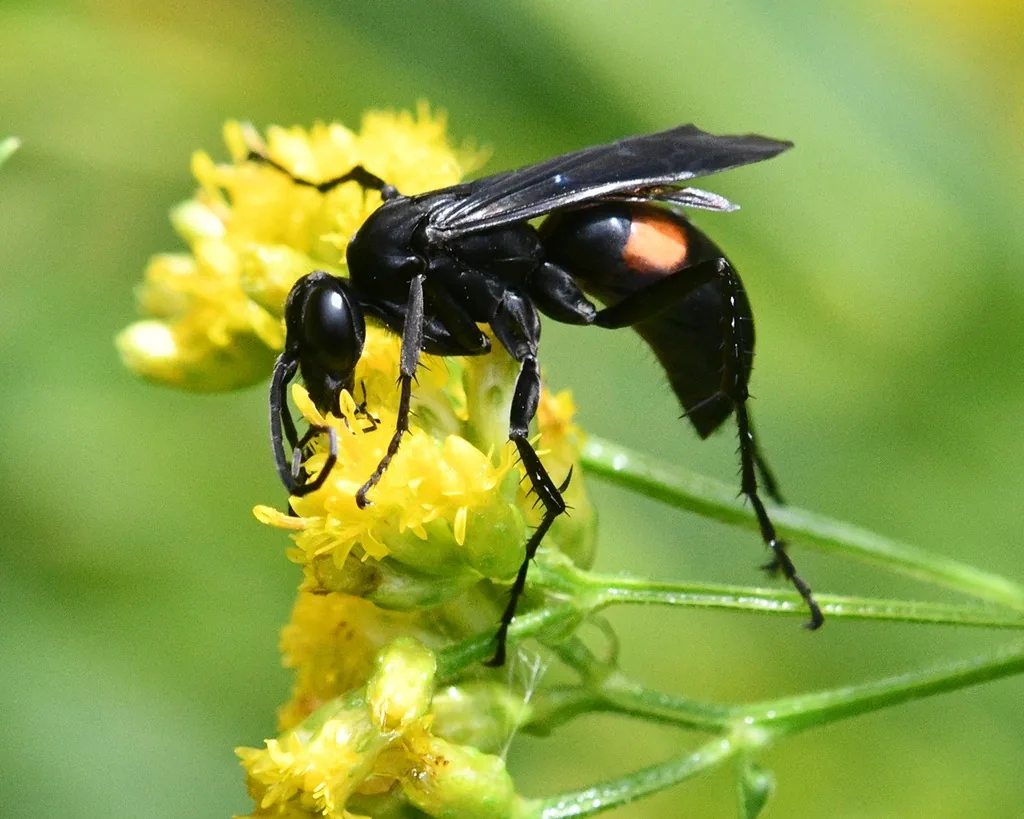
- Entirely black with a bluish sheen in many species, while many others carry an orange marking on the abdomen.[1]
- Long legs with stout spines at the outer tip of the hind tibia, as in other spider wasps.[1]
- Hunting females run over the ground flicking their wings nervously; both sexes are often seen at flowers.[1][2]
- A female dragging a wolf spider or grass spider backward toward a burrow is the typical sighting.[1]
Look-alikes
| Look-alike | How to tell them apart |
|---|---|
| Mydas flies | Harmless flies that mimic the orange-patched blue-black spider wasps so closely that predators avoid them; they cannot sting.[1] |
| Entypus spider wasps | Larger blue-black spider wasps with amber-marked smoky wings and yellow-orange antennae that nest in existing cavities rather than digging burrows.[5][1] |
| Auplopus spider wasps | Small blue-black spider wasps that cut the legs off their spiders and build mud cells instead of burrows.[4][1] |
| Rusty spider wasp and other Pompilidae | The family shares the long spined legs and wing flicking; this page covers only the blue-black Anoplius species.[2] |
Where it lives
Nearly 50 Anoplius species occur in North America; the Missouri Department of Conservation treats them among the state's common spider wasps, and new Anoplius host records come from the southwestern United States and farther south.[1][3]
Biology and life cycle
Females hunt wolf spiders, grass spiders and similar spiders on the ground. Like other spider wasps they capture and subdue the spider first, often propping it up nearby while they excavate a shallow burrow, then drag it underground, lay one egg on its abdomen and close the nest.[1][2]
The larva eats the paralyzed but still-living spider, saving the vital organs for last, then spins a durable silk cocoon and emerges as an adult later the same season or after overwintering.[1][2]
Anoplius depressipes specializes in fishing spiders (Dolomedes). Its flattened, hair-fringed front feet let it walk on water: the female grasps the paralyzed spider with her middle or hind legs, extends her forelegs like water skis and skims across the surface beating her wings, and she sometimes dives after a spider that has fled underwater. This species nests in burrows in stream banks.[1]
The blue-black spider wasps with an orange abdominal patch are apparently the models for Mydas flies, harmless flies whose resemblance to a wasp capable of a painful sting protects them from predators.[1]
A 2020 compilation of spider wasp prey records added first-time species host records and new host spider families for Anoplius.[3]
Damage and signs
Health risk
The Missouri Department of Conservation notes that spider wasps are capable of delivering a painful sting, which is why Mydas flies mimic them; the sources describe them as solitary hunters and do not report them stinging people unprovoked.[1]
Control
Prevention
No control is needed. Blue-black spider wasps are solitary, nest in small burrows in the ground or stream banks, hunt ground spiders and pollinate flowers; keep native flowers and avoid regular broad-spectrum insecticide use if you want them around.[1][2]
Common questions
- A shiny blue-black wasp is dragging a big spider across the ground. Will it sting me?
- It is a female spider wasp provisioning her burrow and has no interest in you; spider wasps can deliver a painful sting if handled, so just leave her alone.[1]
- What is the wasp skimming across the creek with a spider?
- Anoplius depressipes, a blue-black spider wasp that hunts fishing spiders. Its flattened, hair-fringed front feet work like water skis so it can walk on water and tow a paralyzed spider to its burrow in the stream bank.[1]
- Is the orange-and-black 'wasp' on my flowers dangerous?
- Check whether it is a Mydas fly, a harmless mimic of the orange-patched blue-black spider wasps; the real wasps are capable of a painful sting but are solitary spider hunters that spend their time at flowers and on the ground.[1][2]
Sources
- Missouri Department of Conservation, “Blue-Black Spider Wasps (Field Guide).” mdc.mo.gov/discover-nature/field-guide/blue-black-spider-wasps (accessed 2026-11-10)
- Washington State University Extension, “Pompilidae: Spider Wasps (Hortsense natural enemy fact sheet).” hortsense.cahnrs.wsu.edu/fact-sheet/pompilidae-spider-wasps/ (accessed 2026-11-10)
- Zootaxa (Magnolia Press), abstract via PubMed, “Kurczewski FE, West RC, Waichert C, Kissane KC, Ubick D, Pitts JP. New and unusual host records for North American and South American spider wasps (Hymenoptera: Pompilidae). Zootaxa 4891(1) (2020).” pubmed.ncbi.nlm.nih.gov/33311100/ (accessed 2026-11-10)
- Missouri Department of Conservation, “Auplopus Spider Wasps (Field Guide).” mdc.mo.gov/discover-nature/field-guide/auplopus-spider-wasps (accessed 2026-11-10)
- Missouri Department of Conservation, “Entypus Spider Wasps (Field Guide).” mdc.mo.gov/discover-nature/field-guide/entypus-spider-wasps (accessed 2026-11-10)
- iNaturalist, “Anoplius taxon page (order and family).” www.inaturalist.org/taxa/173119 (accessed 2026-11-10)