On this page
How to identify it
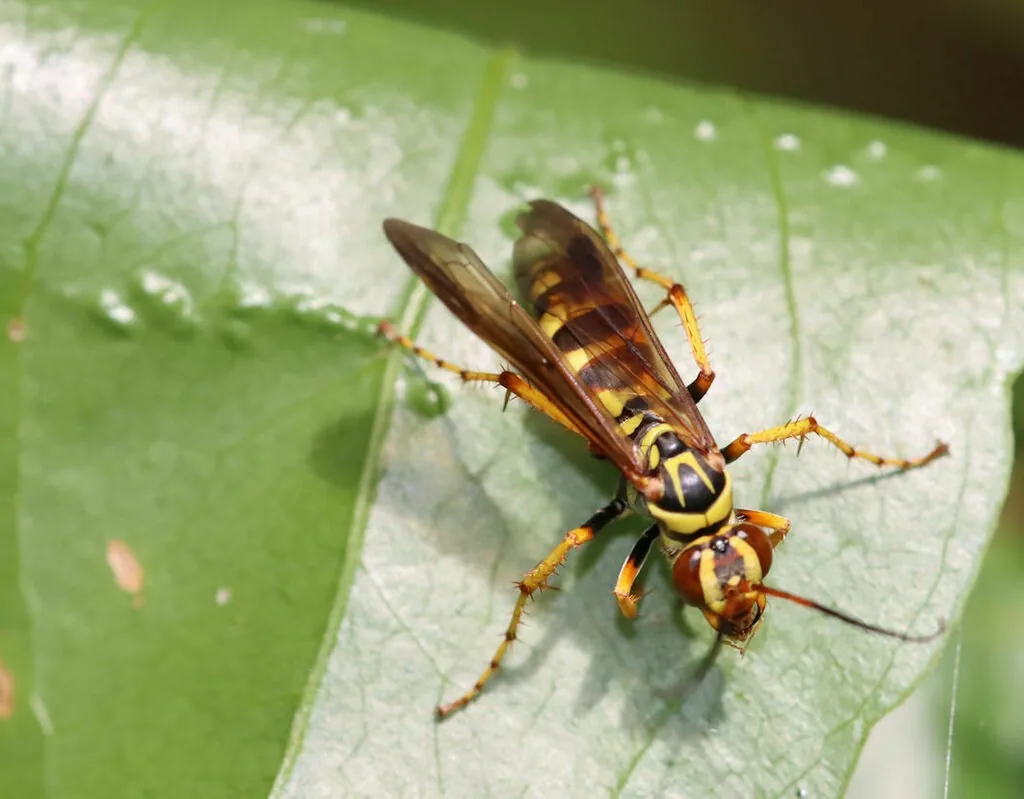
- Color and markings vary greatly across the continent: some populations are banded with yellow and orange, others are mostly black with a patch of orange on the side of the abdomen.[1]
- Hunts and carries orbweaver spiders, a prey choice that sets the genus apart from most other spider wasps, which tend to take jumping, wolf or crab spiders.[1]
- A female is usually seen in open areas, often at flowers, or running over sandy or other workable ground where she digs her burrow; spider wasps characteristically flick their wings while hunting on the ground.[1][2]
- Entomologists separate the species by wing venation, mouthparts, eye shape and leg spines; for everyone else, body shape, color pattern, habitat, behavior and the spider being carried are the clues.[1]
Look-alikes
| Look-alike | How to tell them apart |
|---|---|
| Blue-black spider wasps (Anoplius) | Dark blue-black spider wasps, many with an orange marking on the abdomen; the Missouri Department of Conservation lists them as a similar group, and they hunt wolf spiders, grass spiders and similar ground spiders rather than orbweavers.[1][4] |
| Great golden digger wasp | Listed by the Missouri Department of Conservation as a similar species; it is not a spider wasp, and a Poecilopompilus female is best confirmed by the orbweaver spider she carries.[1] |
| Mydas flies | Harmless flies listed by Missouri as look-alikes; they mimic orange-patched spider wasps closely enough to look intimidating to predators but cannot sting.[1][4] |
| Other spider wasps (Pompilidae) | Some 300 species of spider wasps occur in North America and nearly all hunt spiders; Poecilopompilus is distinguished mainly by its orbweaver prey and its regional banded or orange-patched color forms.[2][1] |
Where it lives
Both Poecilopompilus algidus and P. interruptus are widespread in North America and may occur in Missouri; the 2020 compilation of spider wasp host records, which includes first-time species host records for Poecilopompilus, draws predominantly on the southwestern United States, Mexico, Central America and South America.[1][3]
Biology and life cycle
Females are solitary and dig their own nest burrows in the ground, preferring sandy or other easily worked soils. Each burrow is provisioned with an orbweaver spider.[1][2]
Like other spider wasps, the female captures and subdues the spider before excavating, propping the paralyzed spider nearby while she digs. She then lays a single egg on the spider's abdomen and closes the nest.[2]
The larva eats the spider, saving the vital organs for last, spins a durable silk cocoon and emerges as an adult later the same season or after overwintering.[2]
Adults of both sexes visit flowers for nectar, preferring open, disk-type blooms with shallow nectaries, and are usually seen in open areas.[2][1]
The prevalent color form in any region tends to match the other stinging wasps most common and widespread there. When several venomous animals share the same warning pattern it is called Mullerian mimicry.[1]
A 2020 review of North and South American spider wasp hosts reports first-time species host records for Poecilopompilus.[3]
Damage and signs
Health risk
The sources describe Poecilopompilus as solitary spider hunters usually seen at flowers or at their ground burrows and do not report stings to people. Missouri notes that the genus shares the warning colors of other stinging wasps because both are venomous, so leave a hunting female alone.[1]
Control
Prevention
No control is needed. Poecilopompilus wasps are solitary, nest in sandy soil, prey on spiders and pollinate flowers; native plants and avoiding regular broad-spectrum insecticide use keep them and other beneficial wasps around.[2][1]
Common questions
- A yellow-and-orange banded wasp is dragging a big round-bodied spider across my sandy path. What is it?
- Probably a Poecilopompilus spider wasp. The genus stocks its burrows with orbweaver spiders, digs in sandy or other workable ground, and in many regions is banded yellow and orange.[1]
- Why do these wasps look different in different parts of the country?
- Their color forms vary by region and tend to match the most common stinging wasps in the same area. Because both are venomous, the shared pattern is Mullerian mimicry rather than a harmless copycat.[1]
- Does it sting?
- Spider wasps are venomous, which is why they share warning colors with other stinging wasps, but they are solitary hunters with no nest to defend. None of the sources report Poecilopompilus stinging people; simply let a hunting female finish her work.[1][2]
Sources
- Missouri Department of Conservation, “Poecilopompilus Spider Wasps (Field Guide).” mdc.mo.gov/discover-nature/field-guide/poecilopompilus-spider-wasps (accessed 2026-11-10)
- Washington State University Extension, “Pompilidae: Spider Wasps (Hortsense natural enemy fact sheet).” hortsense.cahnrs.wsu.edu/fact-sheet/pompilidae-spider-wasps/ (accessed 2026-11-10)
- Zootaxa (Magnolia Press), abstract via PubMed, “Kurczewski FE, West RC, Waichert C, Kissane KC, Ubick D, Pitts JP. New and unusual host records for North American and South American spider wasps (Hymenoptera: Pompilidae). Zootaxa 4891(1) (2020).” pubmed.ncbi.nlm.nih.gov/33311100/ (accessed 2026-11-10)
- Missouri Department of Conservation, “Blue-Black Spider Wasps (Field Guide).” mdc.mo.gov/discover-nature/field-guide/blue-black-spider-wasps (accessed 2026-11-10)
- iNaturalist, “Poecilopompilus taxon page (order and family).” www.inaturalist.org/taxa/250745 (accessed 2026-11-10)