On this page
How to identify it
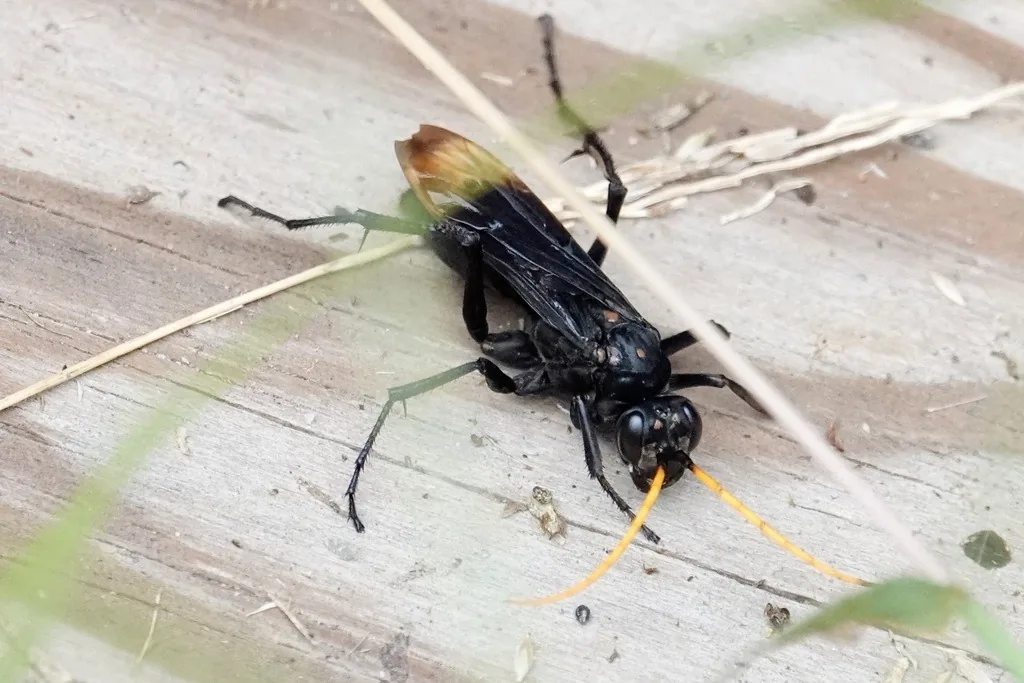
- Quite large for a spider wasp, sometimes reaching nearly 1 1/4 inches in body length, black with a bluish sheen.[1]
- Dark, smoky wings that usually carry some amber coloring: all amber with dark tips in E. aratus, black or dark brown in E. fulvicornis, and dark with a single diffuse amber band or patch near the tip in E. unifasciatus.[1]
- Bright yellow to yellowish-orange antennae in E. fulvicornis and E. unifasciatus.[1]
- Very long, spined legs; a hunting female runs over the ground flicking her wings nervously.[1][2]
- Usually seen only in late summer or early fall, at flowers or hauling a large wolf spider.[1]
Look-alikes
| Look-alike | How to tell them apart |
|---|---|
| Blue-black spider wasps (Anoplius) | Smaller blue-black spider wasps, many with an orange patch on the abdomen, that dig their own burrows for wolf and grass spiders rather than using existing cavities.[4][1] |
| Tarantula hawks (Pepsis) | Spider wasps of the same family whose recorded hosts include large burrowing spiders of the families Dipluridae and Nemesiidae; Entypus takes wolf spiders and has smoky, amber-marked wings.[3][1] |
| Mydas flies | Harmless flies that mimic the blue-black spider wasps with an orange abdominal patch; they look intimidating to predators but cannot sting.[4] |
Where it lives
Seven Entypus species are recorded for North America north of Mexico; the Missouri Department of Conservation describes the genus among the state's spider wasps, and new host records for Entypus come mainly from the southwestern United States, Mexico and Central and South America.[1][3]
Biology and life cycle
Entypus spider wasps typically hunt wolf spiders to feed their larvae. The female stings and subdues the spider first, then moves it to a nest made in a cavity that some other animal created earlier.[1][2]
Like other spider wasps, she lays a single egg on the spider's abdomen and closes the nest. The larva feeds on the paralyzed spider, saving the vital organs such as the heart and central nervous system for last, then spins a durable silk cocoon and emerges as an adult later the same season or after overwintering.[2]
Adults of both sexes visit flowers for nectar to fuel their activity, preferring open, disk-type blooms with shallow nectaries. They are usually seen only in late summer or early fall.[1][2]
A 2020 compilation of spider wasp host records reports first-time species host records and new host spider families for Entypus, including a fishing-spider relative (family Trechaleidae) recorded as prey of Entypus unifasciatus cressoni.[3]
Damage and signs
Health risk
The sources describe Entypus as solitary spider hunters seen at flowers and hauling prey; none of them report stings to people. The related Missouri page on blue-black spider wasps notes that spider wasps are capable of a painful sting, so leave a hunting female alone.[1][2][4]
Control
Prevention
No control is needed. Entypus spider wasps are solitary, hunt wolf spiders, nest in existing cavities rather than in structures, and pollinate flowers; keep native flowers and avoid regular broad-spectrum insecticide use if you want them and other beneficial wasps around.[1][2]
Common questions
- A huge blue-black wasp with orange antennae is dragging a wolf spider across my patio. What is it?
- Most likely an Entypus spider wasp. They are among the largest spider wasps, hunt wolf spiders in late summer and early fall, and carry the paralyzed spider to a cavity where a single egg is laid on it.[1][2]
- Which Entypus species is it?
- Missouri's three common ones are told apart by wings and antennae: E. aratus has all-amber wings with dark tips, E. fulvicornis has dark wings and bright yellow antennae, and E. unifasciatus has yellow antennae and one diffuse amber band near the tip of its smoky wings.[1]
- Will it nest in my house?
- No. Entypus wasps nest in cavities that other animals have already made and are solitary; they are not structural pests.[1]
Sources
- Missouri Department of Conservation, “Entypus Spider Wasps (Field Guide).” mdc.mo.gov/discover-nature/field-guide/entypus-spider-wasps (accessed 2026-11-10)
- Washington State University Extension, “Pompilidae: Spider Wasps (Hortsense natural enemy fact sheet).” hortsense.cahnrs.wsu.edu/fact-sheet/pompilidae-spider-wasps/ (accessed 2026-11-10)
- Zootaxa (Magnolia Press), abstract via PubMed, “Kurczewski FE, West RC, Waichert C, Kissane KC, Ubick D, Pitts JP. New and unusual host records for North American and South American spider wasps (Hymenoptera: Pompilidae). Zootaxa 4891(1) (2020).” pubmed.ncbi.nlm.nih.gov/33311100/ (accessed 2026-11-10)
- Missouri Department of Conservation, “Blue-Black Spider Wasps (Field Guide).” mdc.mo.gov/discover-nature/field-guide/blue-black-spider-wasps (accessed 2026-11-10)
- iNaturalist, “Entypus taxon page (order and family).” www.inaturalist.org/taxa/84673 (accessed 2026-11-10)