On this page
How to identify it
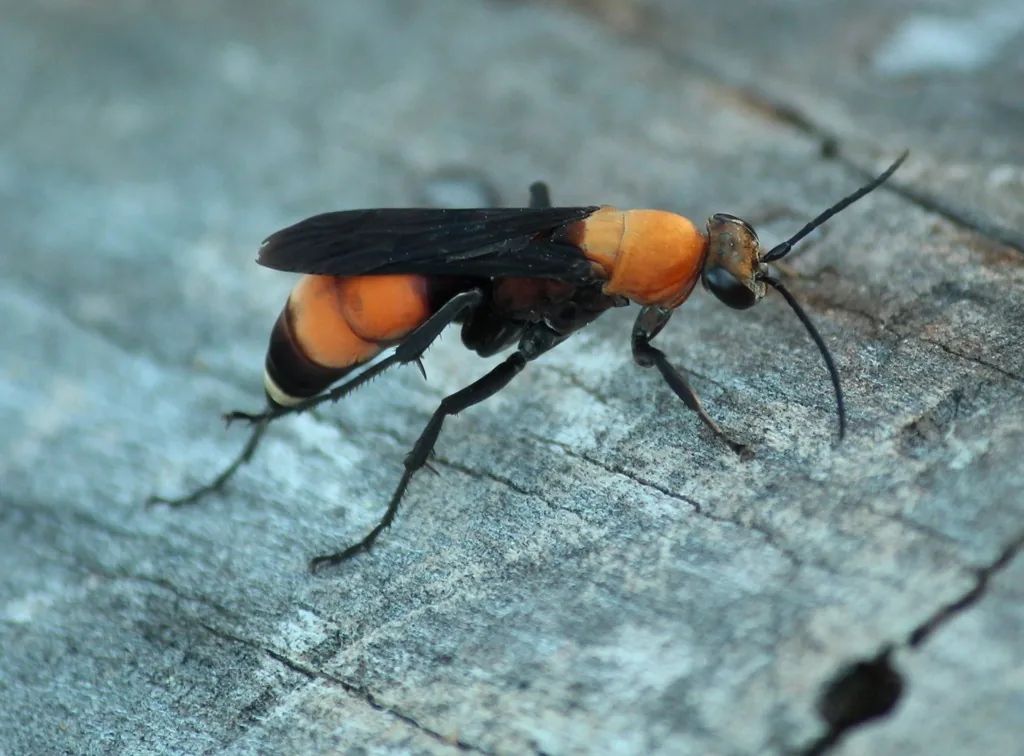
- Looks a great deal like a velvet ant; with its wings it is easily mistaken for a male velvet ant, which also has wings.[1]
- Usually velvety red and black in Missouri's region, matching the typical local velvet ant coloring; in other regions the species may be red, yellow or orange, with black stripes or patterns that also match the local velvet ants.[1]
- A female is usually seen in wooded areas, busily hunting on the ground for spiders; spider wasps characteristically flick their wings nervously as they hunt.[1][2]
- Long legs and the spider-hunting habit mark it as a spider wasp (family Pompilidae), one of about 300 North American species.[2]
Look-alikes
| Look-alike | How to tell them apart |
|---|---|
| Velvet ants (Dasymutilla) | The model for the wasp's colors: both are venomous and share warning patterns region by region, which is Mullerian mimicry rather than a harmless copy. A 2014 study found Psorthaspis fits the Dasymutilla mimicry rings and codiverged with them.[1][3] |
| Blue-black spider wasps (Anoplius) | Spider wasps that are black with a bluish sheen, often with an orange marking on the abdomen, rather than velvety red and black; they hunt wolf spiders, grass spiders and similar spiders on the ground.[4][1] |
| Other spider wasps (Pompilidae) | Nearly all of the roughly 300 North American spider wasps hunt spiders and nest the same way; Psorthaspis is picked out by its velvet ant coloring and its apparent preference for trapdoor spiders.[2][1] |
Where it lives
About 13 Psorthaspis species occur in North America north of Mexico, living within the range of the large Nearctic Dasymutilla velvet ant mimicry complex; the Missouri Department of Conservation treats the genus among the state's spider wasps.[1][3]
Biology and life cycle
Females are usually seen in wooded areas, hunting on the ground for spiders. Trapdoor spiders are apparently their favorite prey.[1]
Like other spider wasps, the female captures and subdues the spider first, props it nearby while she digs a shallow burrow, then lays a single egg on the spider's abdomen and closes the nest. The larva eats the spider, saving its vital organs for last, spins a durable silk cocoon and emerges later the same season or after overwintering.[2]
Adults of both sexes visit flowers, preferring open, disk-type blooms with shallow nectaries.[2]
Biologists have long noted that the color forms of Psorthaspis match the velvet ants (Dasymutilla) of each region: red where the velvet ants are red, yellow or orange where they are yellow or orange, with matching black stripes. Because both groups are venomous, this is Mullerian mimicry.[1]
A 2014 study using measurements, human perception tests, distribution records and dated molecular phylogenies found that Psorthaspis wasps are morphologically similar to the Dasymutilla mimicry rings and that the two groups codiverged to produce their similar color patterns.[3]
Damage and signs
Health risk
Like the velvet ants they mimic, Psorthaspis wasps are said to have a very painful sting. They are not aggressive, however, and will not sting unless they are mishandled or stepped on with bare feet.[1]
Control
Prevention
No control is needed. Leave a hunting female alone, wear shoes where they are active, and keep native plants and avoid routine broad-spectrum insecticides if you want these and other beneficial wasps around.[1][2]
Common questions
- I saw what looked like a flying velvet ant in the woods. Is that possible?
- Male velvet ants do have wings, but a winged, velvety red-and-black insect hunting on the ground may well be a Psorthaspis spider wasp, which Missouri's field guide calls a velvet ant mimic. Both are venomous and share the same warning colors.[1]
- Does a Psorthaspis wasp sting hurt?
- The Missouri Department of Conservation says these wasps, like the velvet ants they mimic, are said to have a very painful sting. They are not aggressive and sting only when mishandled or stepped on with bare feet.[1]
- What do they hunt?
- Spiders, as all spider wasps do; trapdoor spiders are apparently their favorite prey. Each paralyzed spider is placed in a burrow with a single egg, and the larva eats it.[1][2]
Sources
- Missouri Department of Conservation, “Psorthaspis Spider Wasps (Field Guide).” mdc.mo.gov/discover-nature/field-guide/psorthaspis-spider-wasps (accessed 2026-11-10)
- Washington State University Extension, “Pompilidae: Spider Wasps (Hortsense natural enemy fact sheet).” hortsense.cahnrs.wsu.edu/fact-sheet/pompilidae-spider-wasps/ (accessed 2026-11-10)
- PLoS One, abstract via PubMed, “Rodriguez J, Pitts JP, von Dohlen CD, Wilson JS. Mullerian mimicry as a result of codivergence between velvet ants and spider wasps. PLoS One 9(11):e112942 (2014).” doi.org/10.1371/journal.pone.0112942 (accessed 2026-11-10)
- Missouri Department of Conservation, “Blue-Black Spider Wasps (Field Guide).” mdc.mo.gov/discover-nature/field-guide/blue-black-spider-wasps (accessed 2026-11-10)
- iNaturalist, “Psorthaspis taxon page (order and family).” www.inaturalist.org/taxa/250739 (accessed 2026-11-10)