On this page
How to identify it
Where it lives
MDC calls it a common species in Missouri, and genetic studies sampled its populations at 17 sites across Indiana.[1][2]
Biology and life cycle
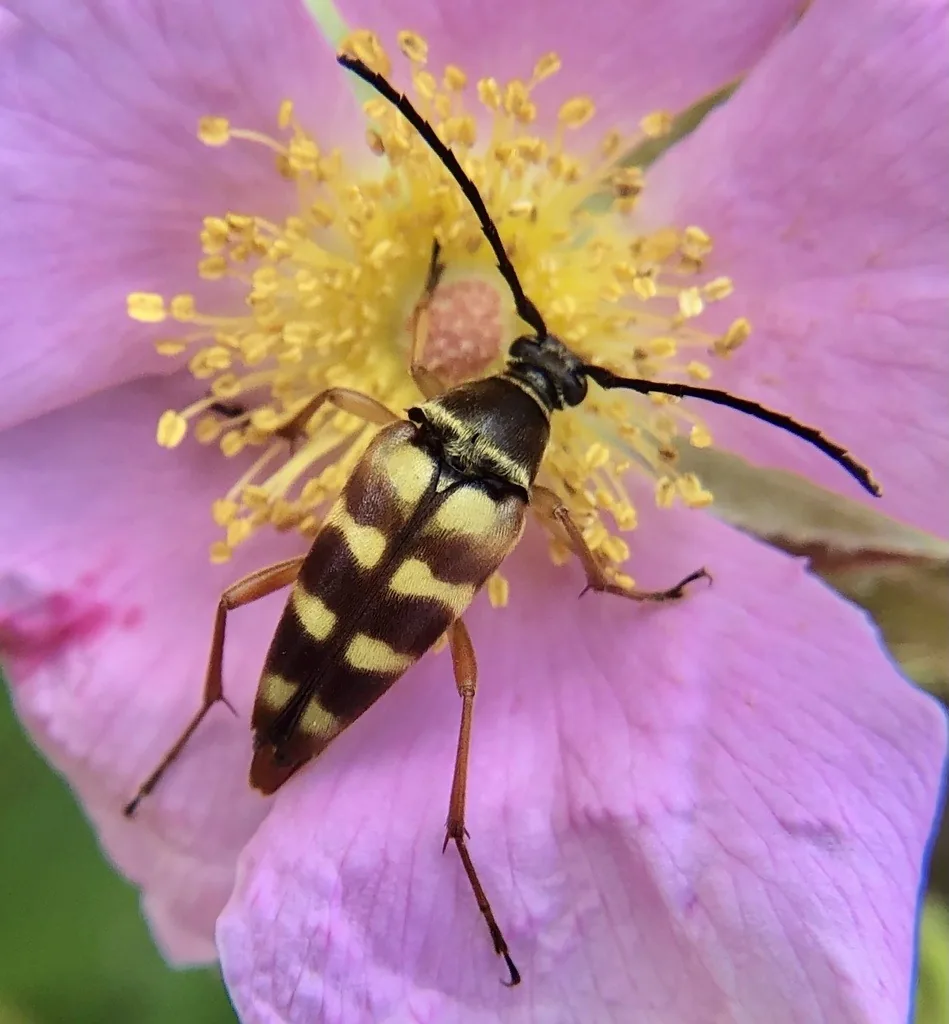
Adults are found in fields and other open places where flowers are blooming, and also around lights at night.[1]
The larvae feed on decaying oak and hickory wood.[1]
To complete its life cycle it needs open flowering habitat, such as shrubland, grassland or pasture, where adults feed and mate, next to woodland that holds dead and decaying wood for the larvae.[3]
In Indiana, genetic differences between its populations were explained far better by how well suitable habitat connects across the landscape than by distance alone.[2][3]
Damage and signs
- The larvae feed on decaying oak and hickory wood, and the adults feed at flowers.[1]
Health risk
It is a flower-visiting beetle, and none of these sources describes any risk to people.[1][2]
Control
Prevention
No control is needed. Adults are flower visitors that researchers treat as pollinators, and the larvae develop in decaying wood.[1][2][3]
Common questions
- Is the banded longhorn a pest of trees?
- MDC says its larvae feed on decaying oak and hickory wood, and researchers describe the species as needing dead and decaying wood for its larvae.[1][3]
- Why do I see banded longhorns on flowers?
- Adults visit flowers for nectar and feed and mate in open flowering habitat. Researchers study the species as a pollinator.[1][3][2]
- Do banded longhorns come to lights?
- Yes. MDC notes that adults turn up around lights at night as well as on flowers.[1]
Sources
- Missouri Department of Conservation, “Banded Longhorn (Field Guide).” mdc.mo.gov/discover-nature/field-guide/banded-longhorn (accessed 2026-11-09)
- Molecular Ecology (Wiley), indexed in PubMed (PMID 27552358), “Abdel Moniem, Schemerhorn, DeWoody and Holland. Landscape genetics of a pollinator longhorn beetle [Typocerus v. velutinus (Olivier)] on a continuous habitat surface. Molecular Ecology 25: 5015-5028 (2016), doi:10.1111/mec.13819 (abstract).” doi.org/10.1111/mec.13819 (accessed 2026-11-09)
- Frontiers in Genetics (Frontiers Media), full text in PubMed Central (PMC7136975), “Borthwick et al. Alternative Quantifications of Landscape Complementation to Model Gene Flow in Banded Longhorn Beetles [Typocerus v. velutinus (Olivier)]. Frontiers in Genetics 11: 307 (2020), doi:10.3389/fgene.2020.00307.” doi.org/10.3389/fgene.2020.00307 (accessed 2026-11-09)
- iNaturalist, “Typocerus velutinus taxon page (order and family).” www.inaturalist.org/taxa/131862 (accessed 2026-11-09)