On this page
How to identify it
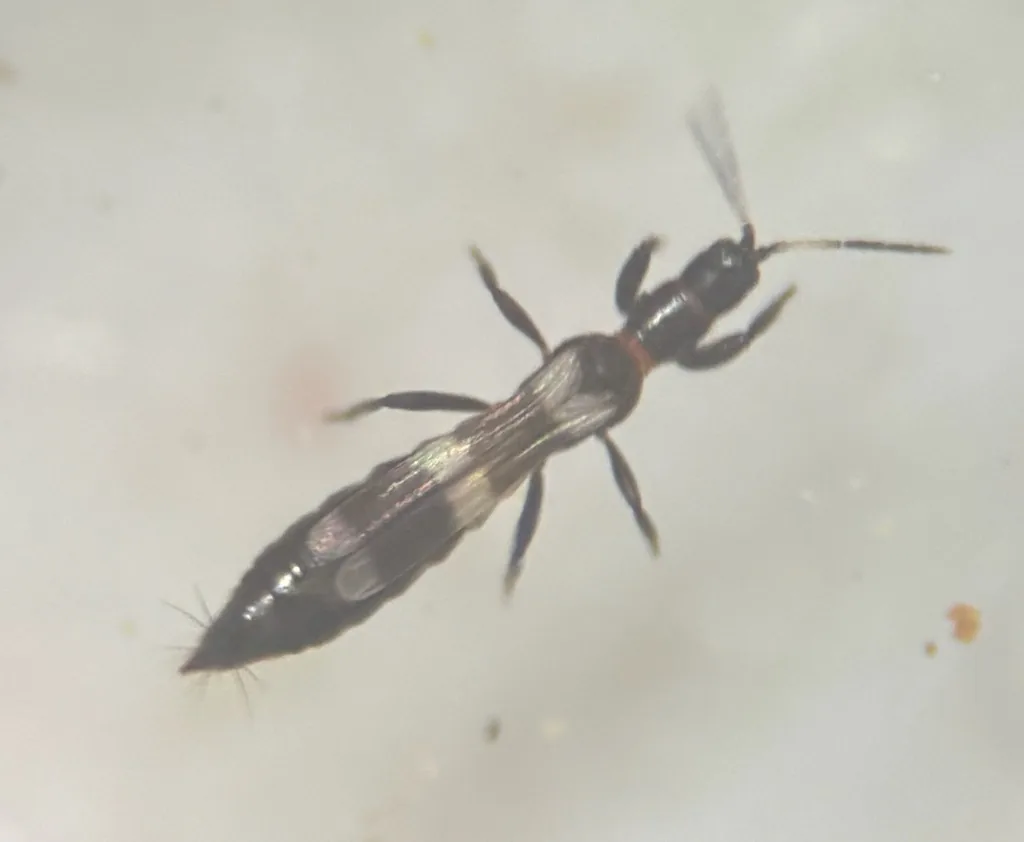
- Adults are dark brown to black and about 1/16 to 1/10 inch (1.5 to 2.5 mm) long. Males, where they exist, are a bit smaller than females.[1]
- Wings are usually broad with rounded tips. In some species the forewings carry white to yellowish cross bands or lengthwise bands, and the banded thrips A. intermedius has black-and-white banded wings. Some species have short wings or none.[1][5]
- Some species have pale segments on an otherwise dark body. Aeolothrips bicolor, common in southern US flowers, looks like a small ant: black with a white midsection.[1][2]
- Several species look alike, and naming one to species takes a prepared specimen and a microscope.[1]
Look-alikes
| Look-alike | How to tell them apart |
|---|---|
| Vespiform thrips | Another predatory thrips in the same family, also with black-and-white banded wings. Females are distinctly ant-shaped, with long legs, a pinched waist and a white band at the base of the abdomen, and the larvae develop bright red bands.[4] |
| Bean thrips | A plant-feeding thrips whose adults are uniformly dark brown. Banded thrips are among its natural enemies.[3] |
Where it lives
Aeolothrips occur wherever their prey are found. At least 22 species are known from California, where A. fasciatus and A. kuwanaii are the most common; A. bicolor is common in the southern US; and one species, A. intermedius, occurs worldwide.[1][2][5]
Biology and life cycle
Females insert eggs singly into plant tissue with a saw-toothed egg-laying tube. The larvae feed through two stages, then spin a silken cocoon and pupate on the plant or in the topsoil.[1][2]
Some species have only one generation a year and are active from late winter to early summer; others, such as A. fasciatus, have several generations a year.[1]
In some species males are unknown, and females of at least some species reproduce without mating.[1]
Many species stick to certain plant types, such as grasses or trees and shrubs, while A. fasciatus turns up on a wide variety of plants. Adults of A. intermedius feed mainly on flowers and pollen, while its larvae hunt more than 44 kinds of thrips.[1][5]
Damage and signs
- Banded thrips are predators, not plant pests. They feed on plant-feeding thrips, spider mites and other small arthropods, and some also feed on pollen.[1][2]
- In lab tests a single larva of A. intermedius, considered the main native predator of onion thrips, killed up to eight adult onion thrips in 12 hours, taking about 26 minutes to subdue each one.[5]
Health risk
The sources describe banded thrips only as predators of small arthropods and as pollen feeders; they mention no harm to people.[1][5]
Control
Prevention
No control is needed. Banded thrips are beneficial predators of pest thrips and spider mites, so leave them alone; UF/IFAS lists them among the natural enemies of bean thrips.[1][3]
Biological control
Researchers consider A. intermedius larvae a promising biological control agent for onion thrips, based on their predation rate.[5]
Common questions
- Are thrips with banded wings pests?
- Not always. Many Aeolothrips, the banded thrips, have banded wings, and they prey on pest thrips and mites. Telling Aeolothrips species apart takes a prepared specimen and a microscope.[1][5]
- What do banded thrips eat?
- Plant-feeding thrips, spider mites and other small arthropods. Some species also eat pollen, aphids and whiteflies.[1]
- Is the black-and-white ant-like insect in my flowers a thrips?
- In the southern US it may be Aeolothrips bicolor, a predatory thrips that mimics ants, is black with a white midsection, and feeds on spider mites in flowers.[2]
Sources
- University of California Statewide IPM Program, “Aeolothrips Predatory Thrips, Natural Enemies Gallery.” ipm.ucanr.edu/natural-enemies/aeolothrips-predatory-thrips/ (accessed 2026-11-09)
- University of Florida IFAS Extension (EDIS), “Thrips of Ornamentals in the Southeastern US, ENY-845 (J. Funderburk, S. Diffie, J. Sharma, A. Hodges and L. Osborne, 2007).” journals.flvc.org/edis/article/view/117083 (accessed 2026-11-09)
- University of Florida IFAS Extension (EDIS), “Bean Thrips, Caliothrips fasciatus (Pergande), Featured Creatures EENY-782.” journals.flvc.org/edis/article/view/127591 (accessed 2026-11-09)
- University of Florida IFAS Extension (EDIS), “Vespiform Thrips, Franklinothrips vespiformis Crawford, Featured Creatures EENY621 (R. Mao, Y. Xiao and S. P. Arthurs).” journals.flvc.org/edis/article/view/132201 (accessed 2026-11-09)
- Insects (MDPI), “Predation Capacity of the Banded Thrips Aeolothrips intermedius for the Biological Control of the Onion Thrips (Insects 2022).” pmc.ncbi.nlm.nih.gov/articles/PMC9409190/ (accessed 2026-11-09)
- iNaturalist, “Aeolothrips taxon page (order and family).” www.inaturalist.org/taxa/252397 (accessed 2026-11-09)