On this page
How to identify it
- The best sign is small holes, about 1/16 inch across, in the lower two to three feet of the trunk, with columns of compressed sawdust, called toothpicks, sticking out of them.[1][2]
- Infested trees often wilt and die back, with dry, dark, blistery bark and oozing sap.[1]
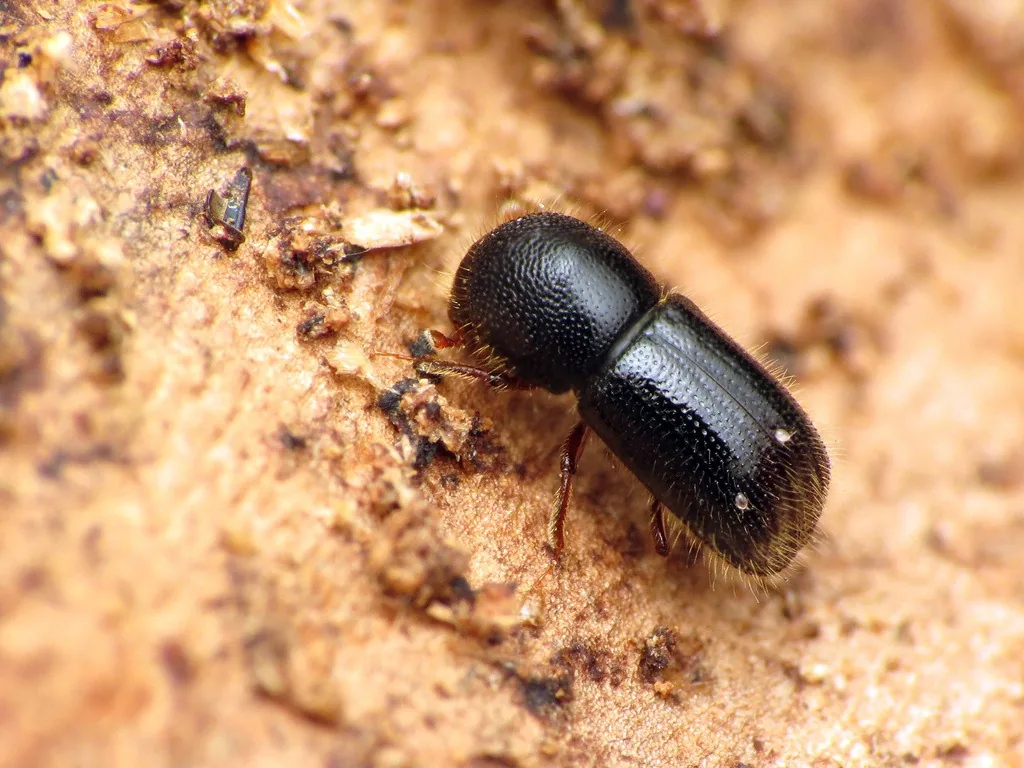
- The beetles are tiny, cylindrical and reddish brown to nearly black; females, the only ones that fly, are shiny black and about 2 to 2.5 mm long, and males are lighter and smaller.[1][2]
- Larvae are small, white, legless grubs living in the tunnels.[1]
Look-alikes
| Look-alike | How to tell them apart |
|---|---|
| Granulate ambrosia beetle | A related ambrosia beetle that also pushes out sawdust toothpicks; confirming the species takes a microscope and training.[1] |
Where it lives
Native to eastern Asia and introduced to central Europe and North America; first found in New York in the 1930s, it has since spread widely, reaching Ontario around 1994 and greater Vancouver in 1995.[1][2]
Biology and life cycle
Adults, mostly females, overwinter in host trees, often in wooded areas, and become active in late April to early May after one or two days at 68 °F or warmer; females can fly more than 330 feet to new trees and prefer trunks three inches or less in diameter.[1]
Females bore tunnels under the bark and lay about one egg a day, up to 18; the larvae develop in about 30 days, new adults appear in July, and a second generation that overwinters appears from late August into September.[1]
Neither adults nor larvae eat the wood: they feed on a fungus the female carries in special pouches and grows in the tunnels.[1][2]
Damage and signs
- Trees stressed by flooding, frost injury or drought give off ethanol and other chemicals that attract the beetles; small-diameter trees can die, and a Fusarium fungus the females may carry can cause cankers and crown dieback.[1][2]
- It attacks more than 200 kinds of trees, including oak, elm, red maple, beech, hickory, chestnut, magnolia, dogwood, black cherry, tupelo and black walnut, as well as fruit trees such as apple, cherry, pear and plum, and it also infests freshly cut logs.[1][2]
Health risk
It attacks trees only; neither source reports any harm to people or pets.[1][2]
Control
Prevention
Keep young trees healthy and avoid stress from drought, flooding and frost injury, since stressed trees attract the beetles.[1]
Ethanol-baited bottle traps hung near sensitive trees, especially next to woods, show when females are flying in spring; check them weekly.[1]
Sanitation
Remove and, where allowed, burn infested parts or trees, since infested wood can be a source of new attacks.[2]
Pesticides
Ambrosia beetles appear resistant to most traditional insecticides, so prevention matters most; ask your county Extension office about timing any trunk treatment to the spring flight.[2][1]
Common questions
- What are the little sawdust sticks coming out of my young tree?
- Columns of compressed sawdust poking out of tiny holes low on the trunk are the classic sign of ambrosia beetles such as the black stem borer.[1][2]
- Why did ambrosia beetles attack my tree?
- They are drawn to trees stressed by drought, flooding or frost, which give off ethanol, and they prefer small trunks three inches across or less.[1]
Sources
- University of Wisconsin-Madison Extension (Wisconsin Horticulture), “Black Stem Borer (Wisconsin Horticulture).” hort.extension.wisc.edu/articles/black-stem-borer/ (accessed 2026-10-17)
- Natural Resources Canada, Canadian Forest Service, “Black stem borer (Trees, insects and diseases of Canada's forests).” tidcf.nrcan.gc.ca/en/insects/factsheet/1000094 (accessed 2026-10-17)
- iNaturalist, “Xylosandrus germanus taxon page (order and family).” www.inaturalist.org/taxa/233855 (accessed 2026-10-06)