On this page
How to identify it
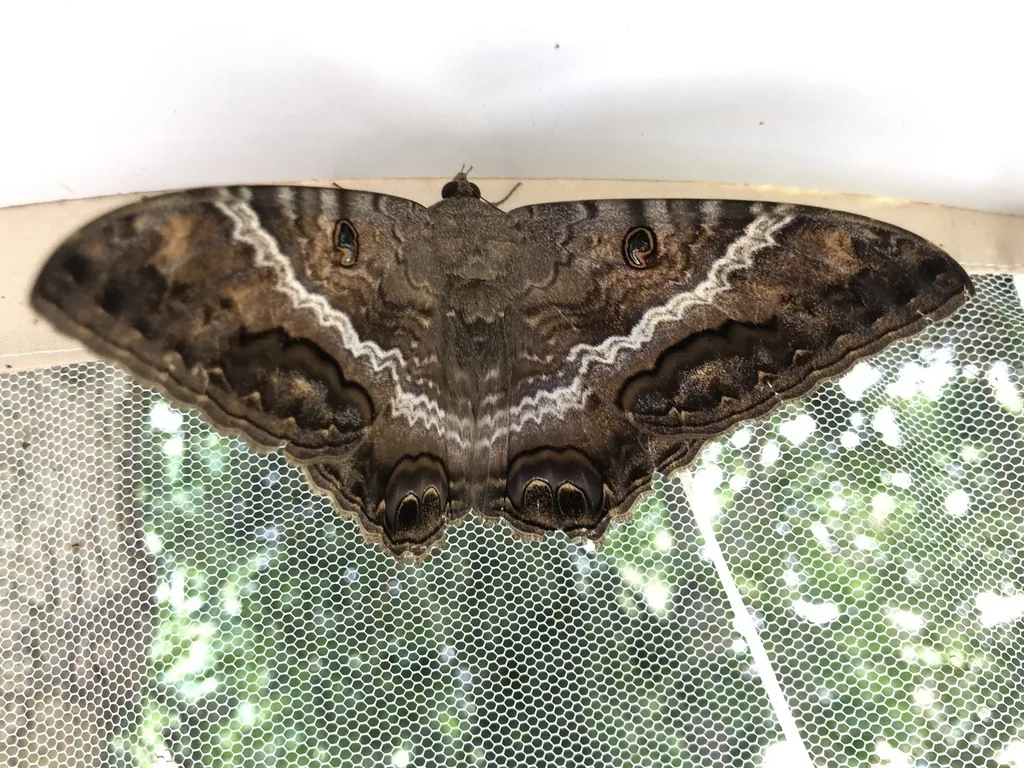
- A very large moth with long forewings. Colorado State University gives the wingspan as 11 to 16 cm (about 4 1/4 to over 6 inches), and the CU Museum of Natural History says it can reach 7 inches.[1][2]
- The wings are dusty, mottled brown with iridescent purple and pink in the pattern and a comma-shaped eyespot on each forewing.[1][2]
- Females have heavier bodies and a pale band, described as pinkish or as a tan scalloped line, across both pairs of wings. Males are darker overall.[1][2]
- Moths found in northern states at the edge of the migration often have tattered wing edges after the long trip.[2]
- The caterpillars are large, grayish and banded.[1]
Look-alikes
| Look-alike | How to tell them apart |
|---|---|
| Bats | Because of its size, dark color, long forewings and night flying, the black witch is easily mistaken for a bat, both in flight and when it rests under eaves or in other sheltered spots by day. A close look shows a moth's patterned wings with a comma-shaped eyespot on each forewing.[1][2] |
| White witch (Thysania agrippina) | The white witch has the largest wingspan of any moth or butterfly, up to about 11 inches, but it is native to South America and is not a migrant that reaches the United States.[1] |
Where it lives
It occurs across a broad area of North and South America, south into Brazil, and is common in the American tropics. In the United States it mostly appears as a migrant from Mexico and Central America, though year-round breeding populations exist in Florida. Strays can turn up far from the tropics: Colorado State University calls it potentially statewide in Colorado and notes that it has occasionally reached Alaska, and the CU Museum of Natural History reports it from each of the Hawaiian Islands.[1][2]
Biology and life cycle
In warm climates it breeds year-round. Northward flights begin with the onset of the rainy season in Mexico, and moths move north from early June through October. Adults live only several weeks, so the trip north is made by successive generations, with the desert Southwest a common stopover.[1][2]
The caterpillars feed at night on the leaves of woody legumes, mainly acacia, mesquite and cassia; Kentucky coffeetree and locust (Robinia) are also reported hosts.[1][2]
The moths are strong fliers that can cross the Gulf of Mexico. They have been found on each of the Hawaiian Islands and on Caribbean islands, and after Hurricane Claudette in 2003 hundreds were found on the Texas coast where the storm's eye had been.[1][2]
Adults fly at night and seek shaded shelter by day.[1]
Damage and signs
Health risk
Neither Colorado State University nor the CU Museum of Natural History mentions any bite, sting or other risk to people.[1][2]
Control
Prevention
Neither source recommends any control. Moths that reach Colorado are migrants that do not reproduce there; they fly at night and seek shade by day.[1][2]
Common questions
- Is there a bat or a moth hanging under my eaves?
- If it is a huge, dark brown moth with patterned wings, it may be a black witch. Both Colorado State University and the CU Museum of Natural History note that it is often mistaken for a bat, and it rests in sheltered, shaded spots by day.[1][2]
- Is a black witch moth a bad omen?
- That idea comes from folklore. In Mexico it is called mariposa de la muerte, the butterfly of death, and since Aztec times some have believed that if one enters a house where someone is ill, that person will die. A similar belief exists in the Lower Rio Grande Valley of southern Texas.[2][1]
- Why did a tropical moth show up in my northern yard?
- Black witches migrate north from Mexico and Central America from early June through October on favorable winds. They do not reproduce in Colorado, for example, so the moths seen there are wanderers, often with tattered wings.[1][2]
Sources
- Colorado State University, Department of Bioagricultural Sciences and Pest Management, “Colorado Insect of Interest: Black Witch (2018).” webdoc.agsci.colostate.edu/bspm/2018/BlackWitch.pdf (accessed 2026-11-09)
- University of Colorado Museum of Natural History, “Black Witch Moth (Wonder of the Week, October 28, 2020).” www.colorado.edu/cumuseum/2020/10/28/black-witch-moth (accessed 2026-11-09)
- iNaturalist, “Ascalapha odorata taxon page (order and family).” www.inaturalist.org/taxa/61503 (accessed 2026-11-09)