On this page
How to identify it
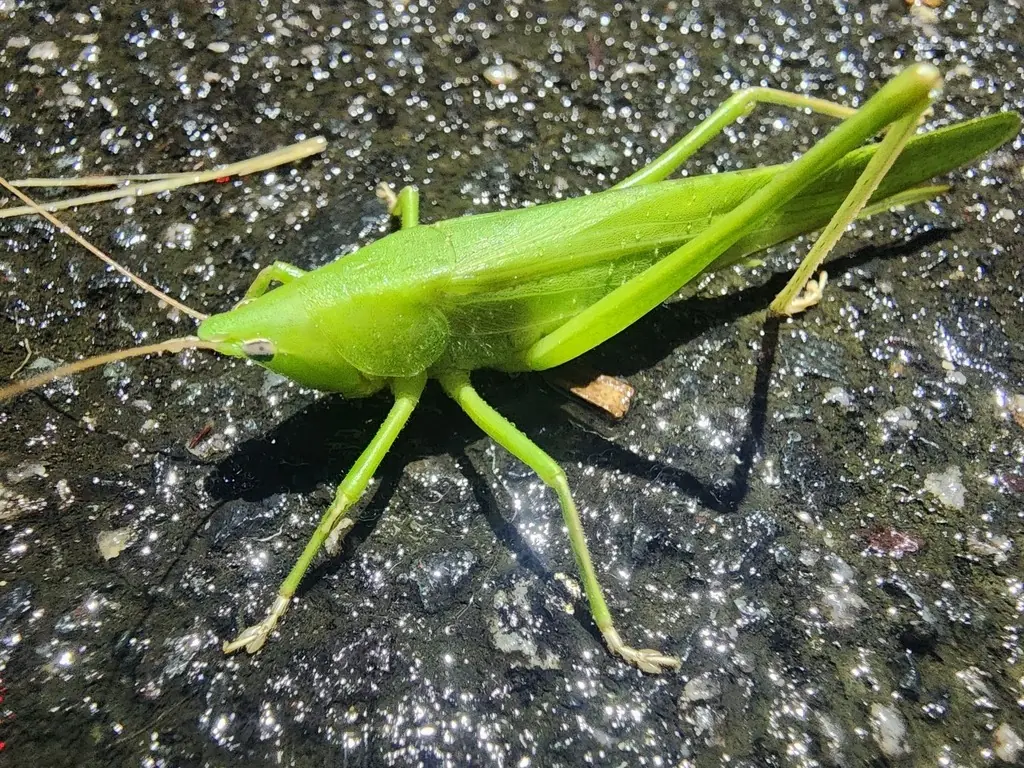
- Like other coneheads it has a cone, the fastigium, projecting from the front of the head beyond the base of the antennae. In this species the cone is wider than it is long, which sets it apart from other coneheads.[1]
- Long, narrow, leathery forewings cover the body, and the jaws are oversized.[1]
- Females are 51 to 67 mm long (about 2 to 2.6 inches) and males 43 to 60 mm (about 1.7 to 2.4 inches). The female's ovipositor is about as long as the hind femur.[1]
- Adults are green or brown. About 95 percent of overwintering males and about 30 percent of overwintering females are brown, compared with about 20 percent of summer adults.[1]
- Young nymphs are light green and wingless, and early instars have a distinct white line from the cone to the tip of the abdomen. Brown color appears only in the later molts, usually the last.[1]
Look-alikes
| Look-alike | How to tell them apart |
|---|---|
| Other coneheads (Neoconocephalus) | Other coneheads have a cone that is longer than it is wide, sometimes sharply pointed, and they spend the winter as eggs, so their adults and calls appear later in the year.[1] |
Where it lives
It has the widest range of any Neoconocephalus, from Peru, Guyana, Panama, the Galapagos and the Caribbean north to the United States. In the United States it occurs across the South from Florida to New Jersey and west to southern California, and has been recorded north to Ohio. Only the spring-singing generation has been noted in Arizona, California, Delaware, Kentucky, New Mexico and Tennessee, while both generations occur throughout Florida, including the Keys.[1][2]
Biology and life cycle
Overwintering adults shelter in thickets and wooded areas and become reproductively active in early spring. According to the University of Florida, their offspring become adults in midsummer or early fall but do not breed until the next spring.[1]
In the northern United States it has one generation a year. In Florida it has been observed with one or two.[1]
Females lay light green, long oval eggs with pointed ends in grasses, between stems and leaf sheaths. Nymphs feed on grass flowers and developing seeds, typically pass through seven instars, and in one study reached adulthood in about seven weeks.[1]
Nymphs and feeding adults favor grasses such as bahiagrass and vaseygrass, where they eat the seeds.[1]
Males call by rubbing their wings together, at night from treetops in late spring and from understory or weedy areas in early spring and summer. The winter and early-spring generation, calling mostly from February to May, gives a continuous call, while summer males call in separate verses and, at the same temperature, at a faster rate. The two generations were once thought to be separate species.[1][3]
Which call a male makes is set during development by day length, and females find both calls about equally attractive. In the tropics, where the species originated, it mates all year and has only one call type.[2][1]
Parasitic tachinid flies locate calling males by their song and kill most of them, so calls may become less frequent after February.[1]
Adults are strong fliers and are drawn to lights. When disturbed, a conehead may fly off or dive into the ground head first, so that its body looks like grass.[1]
Damage and signs
- It has not been reported to damage economically important crops in Florida. It was once classed as potentially harmful to sugarcane in Venezuela but is not currently considered economically injurious.[1]
- Mass outbreaks can happen. In one case in Houston, Texas, swarms drawn to lights flocked to shops and were a nuisance to the public, though they did not damage economically significant crops.[1]
Health risk
The University of Florida describes no risk to people. The problem it records is nuisance swarms at lights during outbreaks.[1]
Control
Prevention
Usually no control is needed: katydids generally do not reach population levels that call for management.[1]
If katydids do become a problem, both nymphs and adults contribute to the damage. UF/IFAS refers readers to the management suggestions in its Featured Creatures article on the oblong-winged katydid.[1]
Common questions
- Why does the broad-tipped conehead call so early in the year?
- It spends the winter as an adult, so its continuous call starts in early spring, at least a month before other coneheads, which overwinter as eggs.[1]
- Why are some broad-tipped coneheads brown and others green?
- Color depends on sex and season. Most overwintering males are brown, and research indicates that day length affects male color, while most summer adults are green.[1]
- Is the broad-tipped conehead a pest?
- Rarely. It has not been reported to damage economically important crops in Florida, but outbreaks such as one in Houston, where swarms came to lights and shops, can be a nuisance.[1]
Sources
- University of Florida IFAS Extension (Featured Creatures), “Broad-Tipped Conehead Katydid (suggested common name) Neoconocephalus triops (Linnaeus, 1758), EENY643 (S. Linn and J. L. Gillett-Kaufman; January 2016).” journals.flvc.org/edis/article/view/132595 (accessed 2026-11-09)
- Biology (MDPI), full text in PubMed Central (PMC11673416), “Beckers and Schul. Geographic Variation in Signal Preferences in the Tropical Katydid Neoconocephalus triops. Biology (Basel) 13: 1026 (2024), doi:10.3390/biology13121026.” doi.org/10.3390/biology13121026 (accessed 2026-11-09)
- Proceedings of the Royal Society B (The Royal Society), in PubMed Central (PMC2602675), “Beckers and Schul. Developmental plasticity of mating calls enables acoustic communication in diverse environments. Proceedings of the Royal Society B 275: 1243-1248 (2008), doi:10.1098/rspb.2007.1765 (abstract).” doi.org/10.1098/rspb.2007.1765 (accessed 2026-11-09)
- iNaturalist, “Neoconocephalus triops taxon page (order and family).” www.inaturalist.org/taxa/225604 (accessed 2026-11-09)