On this page
How to identify it
- The caterpillar is a plump inchworm, usually pale green, with a dark stripe down the middle of the back; Maine describes three pale yellow stripes along each side. It grows to about 3/4 to 1 inch long. In outbreaks many are gray, smoky, brown or black and white, and the head ranges from pale green to shiny black.[2][1]
- Like other inchworms it has only two pairs of fleshy legs near the rear of the abdomen and moves with a looping motion. It often rests on the underside of a leaf with its head curled back.[1][2]
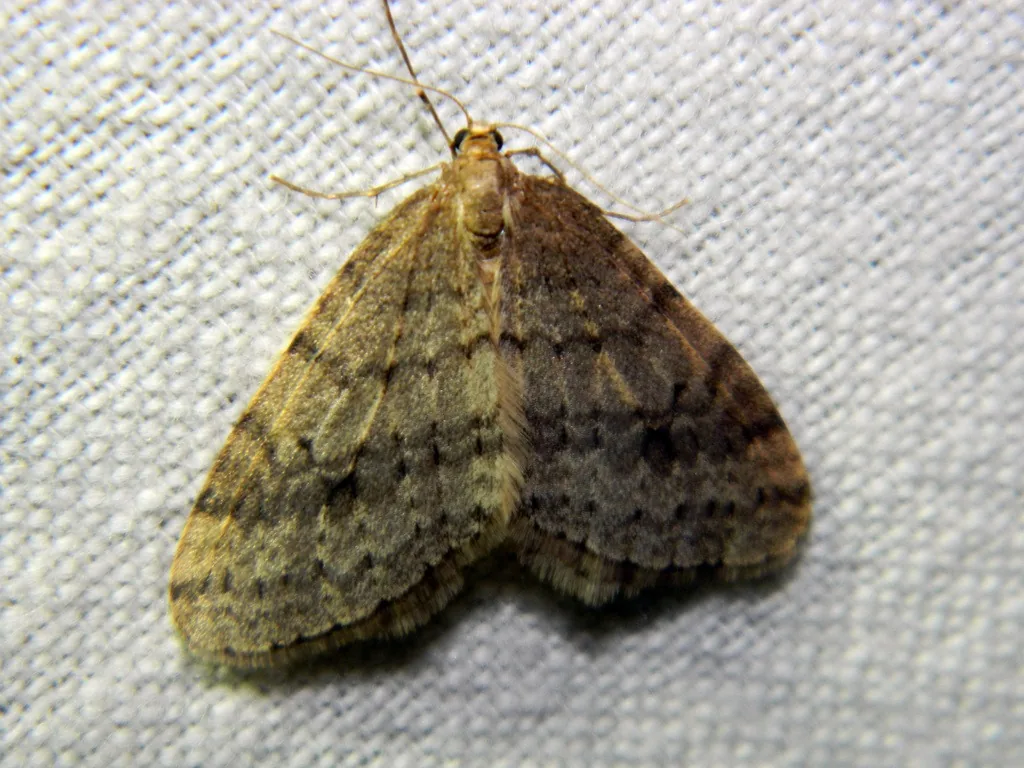
- Moths appear late in the year. Males are light brown with a wingspan of about 1 inch and thin, semitransparent wings crossed by many wavy brown or gray lines. Females are grayish brown and wingless.[1]
- The eggs, laid singly on bark, turn bright orange over the winter.[1][2]
Look-alikes
| Look-alike | How to tell them apart |
|---|---|
| Winter moth | A closely related species in the same genus, introduced and a pest in the Maritime Provinces and along the north Pacific Coast from southern British Columbia to Oregon.[2] |
| Fall cankerworm | Also a green to brownish looper of hardwoods, but it feeds mainly on oak, elm and apple, has three pairs of rear legs, and lays grayish-brown eggs in neat rows on small twigs.[1] |
| Spring cankerworm | Very similar in appearance, but it feeds mainly on elm and apple and lays its eggs in spring in loose clusters on the bark of the trunk and larger branches.[1] |
Where it lives
It ranges from the Pacific Northwest to Nova Scotia and south in the East to Maryland and Missouri. The Maine Forest Service describes it as a periodic defoliator of hardwoods across the northern United States from New England to the Great Lakes.[2][1]
Biology and life cycle
Hosts include maples and poplars, which are preferred in Maine, as well as alder, aspen, beech, birch, cherry, elm, hazelnut, oak, serviceberry, willow and witch-hazel.[1][2]
Moths emerge from the leaf litter in October and November, after the first frost. Males fly even when temperatures drop into the upper 20s °F, while the wingless females crawl up trunks and branches to lay eggs one at a time in bark crevices.[1][2]
The eggs overwinter and hatch in late April or May, just as buds open. Young caterpillars bore into swelling buds and young leaves; over five or six weeks they grow and darken from pale yellow-green to dark green or brown.[1]
Caterpillars can be full grown as early as the first week of June, and by mid- to late June they drop to the ground and pupate in the soil until fall. In Connecticut and Maryland there is one generation a year.[2][1]
Outbreaks usually last three to four years before parasites, predators and disease bring the population down.[1]
Damage and signs
- Damage shows first in early May, when the tiny caterpillars feeding in opening buds and young leaves leave foliage ragged and skeletonized. Older caterpillars eat everything but the midrib and veins.[1]
- In outbreaks, caterpillars can cover entire trees in sheets of silk.[2]
- Two or more years of heavy defoliation can noticeably slow tree growth, especially on weak trees or poor sites, and heavy defoliation of sugar maple may reduce sap flow or sugar content.[1]
Health risk
The sources describe it only as a leaf-feeding caterpillar of hardwoods; they mention no harm to people.[1][2]
Control
Prevention
Control is not usually necessary. Outbreaks are mostly local and natural enemies and disease end them within a few years.[1]
Biological control
If a valued tree needs protection, Bacillus thuringiensis (Bt), a microbial insecticide, is registered for cankerworms in May and June. Spray soon after the caterpillars become active, once leaves are large enough to be covered.[1]
Pesticides
The Maine Forest Service also lists carbaryl and acephate as registered for cankerworms in May or June. Follow the label for timing and use.[1]
Common questions
- What are the moths flying around in November after a frost?
- In hardwood areas of the northern states, they may be male Bruce spanworm moths, which fly very late in the year, even in temperatures in the upper 20s °F. The females have no wings.[2][1]
- Do I need to spray for Bruce spanworm?
- Usually not. Outbreaks tend to be local and collapse on their own after a few years. If a valuable tree is being stripped, Bt or another registered product can be applied when the caterpillars first become active.[1]
Sources
- Maine Forest Service, Maine Department of Agriculture, Conservation and Forestry, “Bruce Spanworm, Operophtera bruceata (Hulst), Forest Pest Index.” www.maine.gov/dacf/mfs/forest_health/insects/bruce_spanworm.htm (accessed 2026-11-09)
- USDA Forest Service, Forest Health Technology Enterprise Team, “Geometroid Caterpillars of Northeastern and Appalachian Forests, FHTET-2001-10 (D. L. Wagner et al., 2001).” archive.org/details/geometroidcaterp00wagn (accessed 2026-11-09)
- iNaturalist, “Operophtera bruceata taxon page (order and family).” www.inaturalist.org/taxa/121236 (accessed 2026-11-09)