On this page
How to identify it
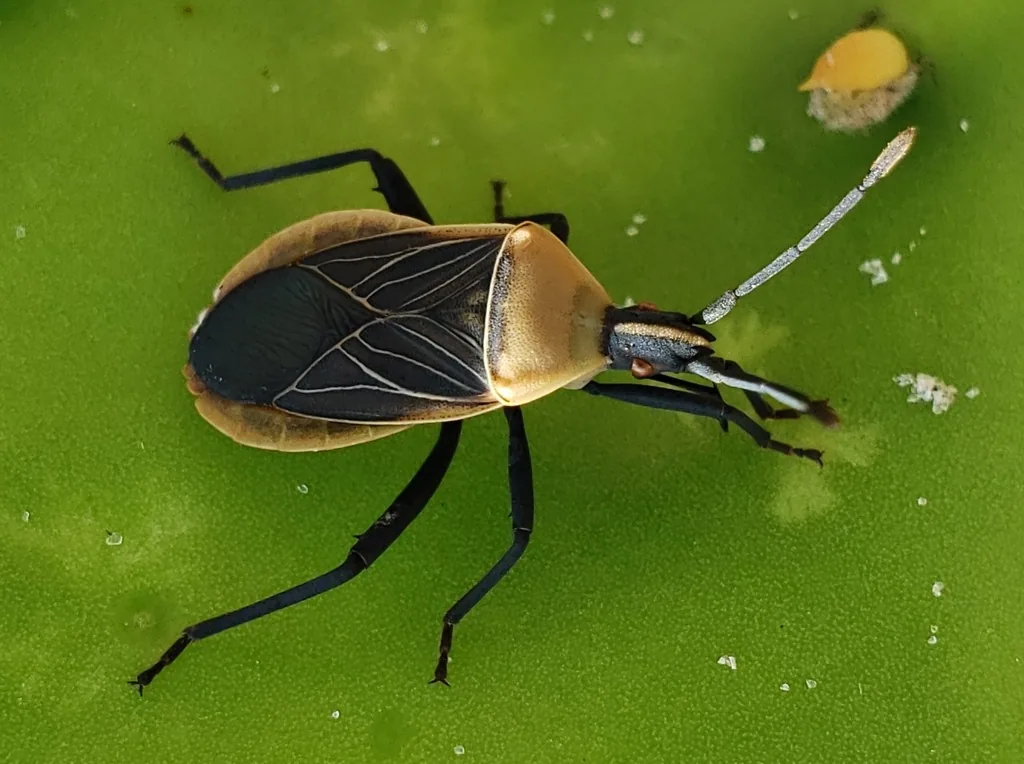
- Adults are shield-shaped bugs about 10 to 13.5 mm (roughly 1/2 inch) long, with piercing-sucking mouthparts.[1][2]
- Color varies. Texas A&M describes them as most commonly red; Florida specimens are mostly dark brown to blackish, with a yellow stripe on the head, a nearly solid yellow pronotum (the shield behind the head) and yellow veins on the forewings.[2][1]
- The antennae are distinctive: the second and third segments are three-sided, so they look triangular in cross section. Older nymphs have the same feature.[1][2]
- Nymphs have no wings and are sometimes mistaken for weevils. Eggs are laid lengthwise on the undersides of cactus spines.[2][1]
Look-alikes
| Look-alike | How to tell them apart |
|---|---|
| Squash bugs | Squash bugs look similar overall but lack the cactus bug's extensive yellow pronotum and the yellowish wing veins that contrast with its dark wings.[1] |
| Weevils | Wingless cactus bug nymphs are sometimes mistaken for weevils. Look for piercing-sucking mouthparts and, on older nymphs, the three-sided antennae.[2][1] |
Where it lives
In its various forms the species ranges from California to Virginia, north to Montana and south into northern Mexico. Only the subspecies aequoris occurs in Florida and the other southeastern states, with central Florida as its southeastern limit.[1]
Biology and life cycle
All stages live on cacti, mainly prickly pears (Opuntia subgenus Platyopuntia). Adults and nymphs feed in colonies, chiefly on the outer pads but also on fruit and older pads.[1][2]
In Florida the first eggs are laid in March, lengthwise on the undersides of prickly pear spines. Egg laying in each generation stretches over two to three months, there are five nymphal stages, and adults live 9 to 12 months in the field, so several stages can be present at once in warm weather.[1]
Estimates of generations per year range from four or five down to two for the southeastern subspecies, and one has been reported for the form in southern California.[1]
Winter is spent mostly as adults, sometimes as large nymphs, from early December to mid-March in Florida, hidden under debris at the base of the plant or under pads lying on the ground. The bugs are sluggish, as cactus-feeding insects tend to be.[1]
Damage and signs
- Feeding first shows as lighter, round spots on the pads, and white excrement may coat the surface. Left unchecked, the spots enlarge and merge until the whole pad is yellowish, deadened and pitted.[1][2]
- Fungi that invade the damaged tissue cause large black spots; the infected areas can drop out, leaving round holes through the pad, or whole pads may fall.[1]
- UF cites the view that these bugs hold back the cactus's growth and fruiting more than they destroy pads. Whether that matters depends on the plant: an ornamental, a forage reserve, a host for cochineal scales or a weedy stand.[1]
Health risk
It is a plant feeder; neither source mentions any risk to people or pets.[1][2]
Control
Traps and physical control
If you need to manage them, start with the least toxic options: blast them off with a strong spray of water, hand-pick or squish them, or vacuum them off the plants.[2]
In cold weather, check for inactive bugs under debris at the base of the cactus and under pads lying on the ground, where they can be picked off.[1][2]
Pesticides
Insecticidal soap works on small nymphs but may not work as well on larger nymphs and adults. A contact insecticide, natural or synthetic, is another option. If you eat the fruit or pads, avoid systemic products, which are taken up into the plant.[2]
Cactus bugs and weedy prickly pears
Prickly pear insects have been studied for about a century as possible controls for cacti that become weeds; in Australia, dense stands of introduced prickly pear once made more than 30 million acres of pasture useless. The cactus bug was tried as a control agent but was ineffective in Australia and on Santa Cruz Island, California.[1]
In most of North America a whole complex of insects, of which the cactus bug is a minor part, keeps prickly pears from becoming a problem.[1]
Common questions
- What are the round yellow spots on my prickly pear pads?
- Round, yellowish spots are often the first sign of cactus bug feeding. Check the pads for groups of shield-shaped bugs and wingless nymphs, and look for eggs lined up under the spines.[2][1]
- How do I get rid of cactus bugs without harsh chemicals?
- Wash them off with a strong water spray, hand-pick or squish them, or vacuum them up. Insecticidal soap helps against small nymphs.[2]
- Can I spray a cactus I plan to eat?
- Texas A&M advises avoiding systemic insecticides on plants whose fruit or pads you eat, because systemic products are taken up into the plant tissue.[2]
Sources
- University of Florida IFAS Extension (Featured Creatures), “Cactus Bug, Chelinidea vittiger aequoris McAtee, EENY-208 (F. W. Mead and J. L. Herring, 2001, revised 2003; archival copy).” journals.flvc.org/edis/article/view/112506 (accessed 2026-11-09)
- Texas A&M AgriLife Extension Service, “Cactus Bugs (W. Brown, Urban Programs Travis County blog).” travis-tx.tamu.edu/?p=15764 (accessed 2026-11-09)
- iNaturalist, “Chelinidea vittiger taxon page (order and family).” www.inaturalist.org/taxa/216651 (accessed 2026-11-09)