On this page
How to identify it
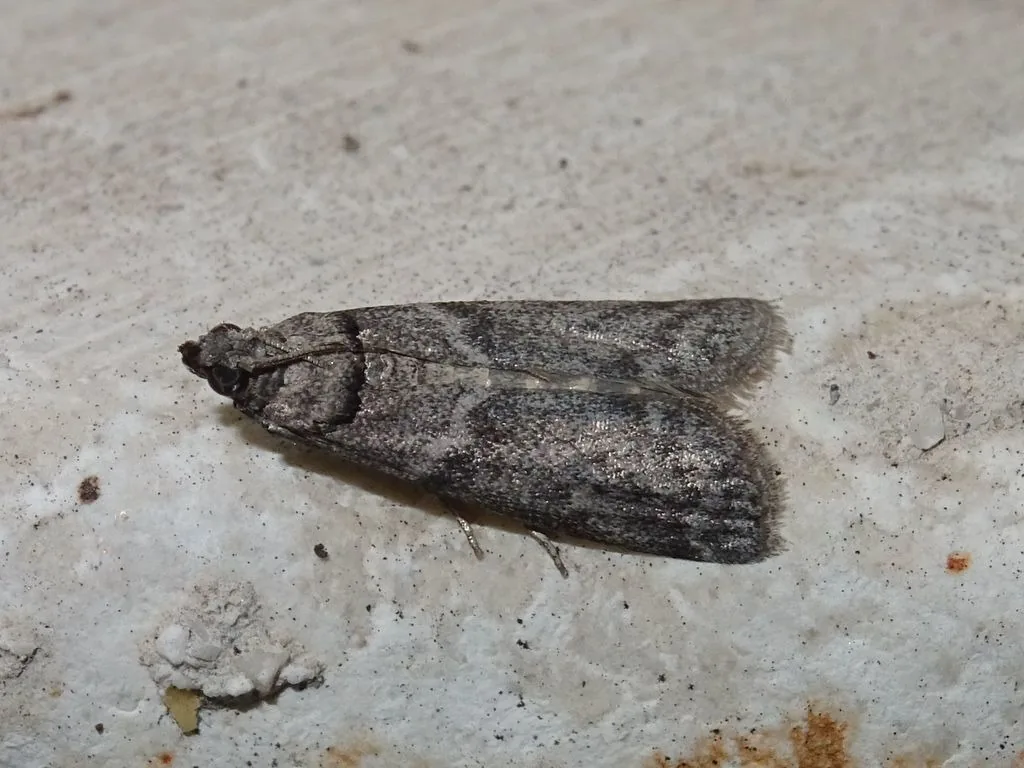
- Adults are 8 to 10 millimeters (1/3 to 2/5 inch) long with a wingspan of 22 to 24 millimeters, colored anywhere from brown to gray to whitish, with two bands across the rear part of the wings. They hold their palps forward in a snoutlike point on the front of the head.[1]
- Larvae are pink with a dark brown head and grow to about 15 millimeters (3/5 inch). They have a dark ridge near the head and paired short spines on each abdominal segment.[1]
- Eggs are oval, about 0.75 millimeter long and opaque white; fertilized eggs turn pink as they develop.[1]
- Infested dates are filled with silk and frass, often with black fungi, and the larva spins a silk tube to the stem (calyx) end of the date for the adult to exit through.[1]
Look-alikes
| Look-alike | How to tell them apart |
|---|---|
| Navel orangeworm | Some carob moth larvae have a crescent-shaped mark on the second segment behind the head like navel orangeworm larvae, but it is less distinct.[1] |
Where it lives
It damages high-value crops in many parts of the world, including pomegranates and pistachios. In the United States it is a pest of dates in the desert date-growing areas of California and Arizona.[5][4][1][2]
Biology and life cycle
Females hide in date fronds and leaf axils by day and lay eggs at night in folds and cracks and under the calyx of date fruits, and also deep inside dates that have come loose from the strand. A female lays 100 to 200 eggs.[1]
Eggs hatch in 3 to 4 days and the larvae bore into the fruit, where they are protected from insecticides and natural enemies. Several small larvae may enter one date, but usually only one reaches maturity. The larvae pass through five stages and pupate inside the fruit.[1]
Development from egg to adult takes 1 to 3 months depending on temperature and fruit quality, and the insect spends the winter in poor-quality dates left on the ground. In the California and Arizona deserts there are 4 to 5 generations a year.[1]
Females prefer to lay eggs in green and yellow dates that drop during the June and August fruit drops and get stuck in the bunches.[1]
Damage and signs
Health risk
The sources treat it only as a pest of fruit and nuts; they describe no risk to people.[1][4]
Control
Keep them out
Mesh bags over the fruit bunches are highly effective and recommended as standard practice. In trials, polyester mesh bags had lower carob moth infestation than paper wraps and raised marketable fruit by 21 to 46 percent, partly by keeping dates from falling to the ground.[1][3]
Sanitation
In winter, disc between rows and across the trees to bury fallen fruit that may harbor overwintering larvae. During the season, remove dropped dates caught in the bunches, using bunch-cleaning tools or by shaking bunches hard before covering them.[1]
Traps and physical control
Pheromone traps can monitor adult moths starting in May. Research on California dates developed a sampling plan based on checking 100 dropped brown dates for larvae and pupae.[1][2]
Biological control
Natural enemies have been reported attacking the eggs, larvae and pupae, but they have not yet been used successfully in California and Arizona date orchards. Larvae in fruit lying exposed on the ground are killed by hot soil and by ants.[1]
Pesticides
For commercial date growers, UC IPM calls for an insecticide when traps catch 10 or more moths in 7 days, with all treatments finished before bunches are bagged. In orchards that cannot be bagged and have a history of damage, a spray may be applied during egg hatch, before the larvae enter the fruit.[1]
When to call a professional
After harvest, larvae in dates can be killed by freezing or cold storage held long enough to bring the inside of the bins or pallets to a lethal temperature.[1]
Common questions
- What are the pink worms inside my dates?
- In California and Arizona date-growing areas, pink caterpillars with a dark brown head inside dates are likely carob moth larvae. They fill the fruit with silk and frass.[1]
- How do date growers keep carob moth out of the fruit?
- Mostly by sanitation and mesh bags: removing dropped and stuck dates, burying fallen fruit in winter, and enclosing bunches in mesh bags, which cut infestation compared with paper wraps.[1][3]
Sources
- University of California Statewide IPM Program, “Carob Moth (Pest Management Guidelines: Date).” ipm.ucanr.edu/agriculture/date/carob-moth/ (accessed 2026-11-09)
- Journal of Economic Entomology (via NCBI PubMed), “Development of a binomial sampling plan for the carob moth, a pest of California dates (J. J. Park and T. M. Perring; Journal of Economic Entomology 103(4), 2010; abstract).” pubmed.ncbi.nlm.nih.gov/20857763/ (accessed 2026-11-09)
- Journal of Economic Entomology (via NCBI PubMed), “Evaluation of Bunch Protectors for Preventing Insect Infestation and Preserving Yield and Fruit Quality of Dates (T. M. Perring and J. E. Nay; Journal of Economic Entomology 108(2), 2015; abstract).” pubmed.ncbi.nlm.nih.gov/26470176/ (accessed 2026-11-09)
- Environmental Entomology (via NCBI PubMed), “Tritrophic effects mediate host suitability for two parasitoids of the carob moth infesting pistachio (F. Baghery et al.; Environmental Entomology 53(1), 2024; abstract).” pubmed.ncbi.nlm.nih.gov/38244224/ (accessed 2026-11-09)
- Journal of Economic Entomology (via NCBI PubMed), “Field Attraction of Carob Moth to Host Plants and Conspecific Females (S. A. Hosseini et al.; Journal of Economic Entomology 110(5), 2017; abstract).” pubmed.ncbi.nlm.nih.gov/28961988/ (accessed 2026-11-09)
- iNaturalist, “Ectomyelois ceratoniae taxon page (order and family).” www.inaturalist.org/taxa/953134 (accessed 2026-11-09)