On this page
How to identify it
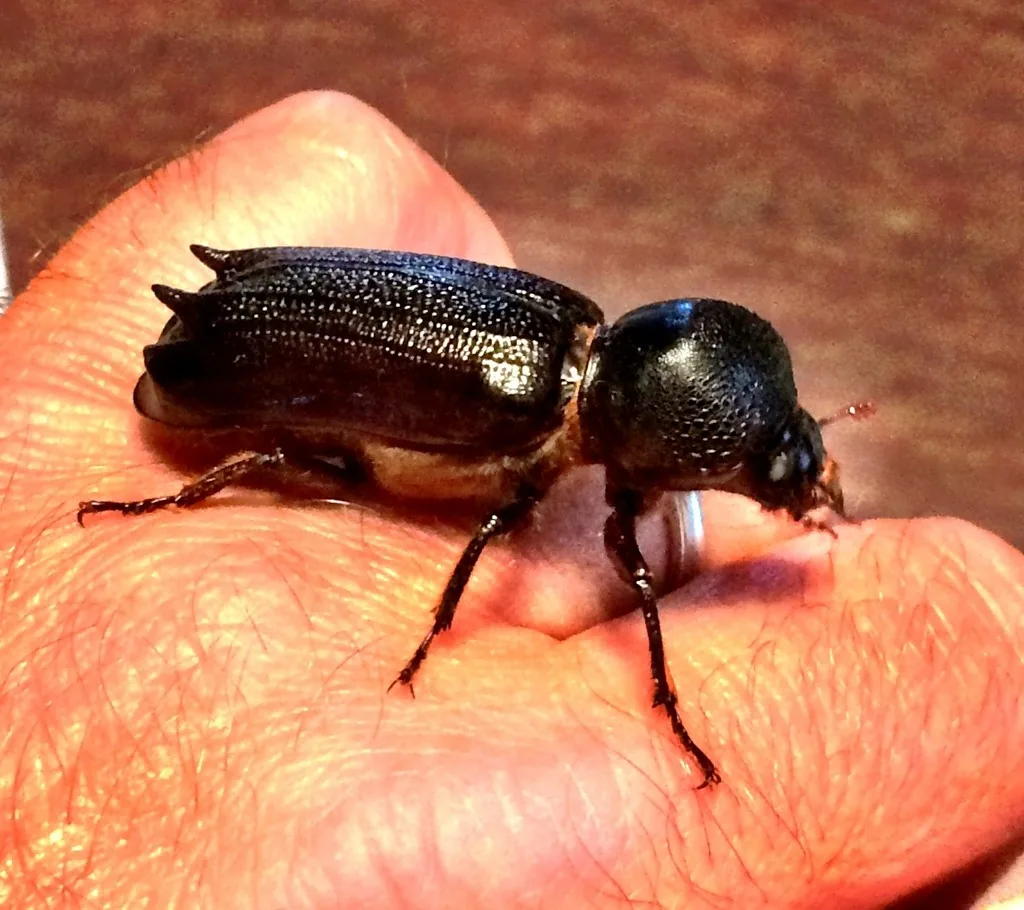
- Adults are blackish to dark reddish-brown beetles up to 2 inches long. As in other members of their family (Bostrichidae), the head points sharply downward, so from above it looks bulbous and the mouthparts are hidden.[1]
- Larvae are stout, yellowish grubs up to 2 1/2 inches long that curl into a C shape when exposed. They stay hidden inside the trunk.[1]
- Exit holes about half an inch across in the trunk mark where adults have emerged.[1]
- Near the base of the leaf crown, the female's chamber fills partly with a soft, thick, moist mass of chewed fiber, droppings and sap.[1]
Where it lives
It is a pest of native desert palms in California and Arizona. Arizona Extension notes that wild palms carry the beetle, which can spread to nearby landscape palms or arrive on palms dug from the wild. A 2016 record from an oasis in Baja California Sur, Mexico, extended its known range.[3][2][1]
Biology and life cycle
The female chews an entrance tunnel and a chamber beneath the leaf crown, where males join her to mate. She lays up to about 500 oval, white to yellowish eggs about 1/16 inch long.[1]
Larvae bore into the soft tissue of the leaf bases and then through the trunk, feeding on the inner stem for about 3 to 9 years if the palm lives that long.[1][2]
Mature larvae pupate just under the trunk surface around April and May, and adults chew out about two months later. Adults fly mostly in summer and either infest other palms or reinfest the one they fed in as larvae.[1]
One generation takes at least several years. Generations overlap, so every life stage can be found in a palm during much of the year.[1]
Damage and signs
- Larvae carve a maze of tunnels up and down the trunk. Arizona Extension mentions reports of audible chewing and snapping trunk fibers in heavily infested palms.[1][2]
- Fronds on infested palms turn yellow, and the palms commonly die early. Weakened trunks may fall over in the wind.[1]
- It is a secondary pest: it attacks palms that are already dead, dying or severely stressed, and it is not the original cause of a palm's decline.[1]
Health risk
It feeds inside palm trunks, and UC IPM and Arizona Extension mention no risk to people or pets. UC IPM does note that weakened palms may fall over in the wind.[1]
Control
Prevention
Keep palms healthy with good growing conditions and proper care; Arizona Extension notes that appropriate cultural care may reduce attacks. UC IPM knows of no control other than this kind of preventive care.[1][2]
Palms transplanted from the wild can carry the beetle directly into a landscape, and infested wild palms can be a source for landscape palms next to them.[2]
Sanitation
Remove and dispose of dead and dying palms, since the beetles breed in them.[1]
Biological control
Birds, including the common flicker and woodpeckers, feed on the beetle.[2]
Common questions
- Can I spray to save a palm infested with giant palm borer?
- No control other than preventive care is known. Arizona Extension reports no reliable way to detect infestations, and UC IPM lists good preventive care and removal of dead and dying palms as the only management.[2][1]
- Will giant palm borers attack my healthy palm?
- They attack palms that are dead, dying or severely stressed, such as from transplanting. Adults that emerge can infest other palms or reinfest the same one.[1]
- What are the half-inch holes in my palm trunk?
- Holes about 1/2 inch across in the trunks of fan or date palms can be exit holes left by adult giant palm borers.[1]
Sources
- University of California Statewide IPM Program, “Giant Palm Borer (Home and Landscape).” ipm.ucanr.edu/PMG/GARDEN/PLANTS/INVERT/giantpalmborer.html (accessed 2026-11-08)
- University of Arizona Cooperative Extension, “Arizona Landscape Palms and their Management, AZ2021 (U. K. Schuch and T. M. Quist, January 2023).” extension.arizona.edu/sites/extension.arizona.edu/files/pubs/az2021-2023.pdf (accessed 2026-11-08)
- Instituto de Ecologia, A.C. (Acta Zoologica Mexicana), “Ampliacion de la distribucion de Dinapate wrightii Horn (Coleoptera: Bostrichidae) en Baja California Sur, Mexico (A. Falcon-Brindis, C. Palacios-Cardiel and M. L. Jimenez Jimenez; Acta Zoologica Mexicana, 2016; English abstract).” publicaciones.inecol.mx/Record/azm-article-980/Description?lng=en (accessed 2026-11-08)
- iNaturalist, “Dinapate wrightii taxon page (order and family).” www.inaturalist.org/taxa/218466 (accessed 2026-11-08)