On this page
How to identify it
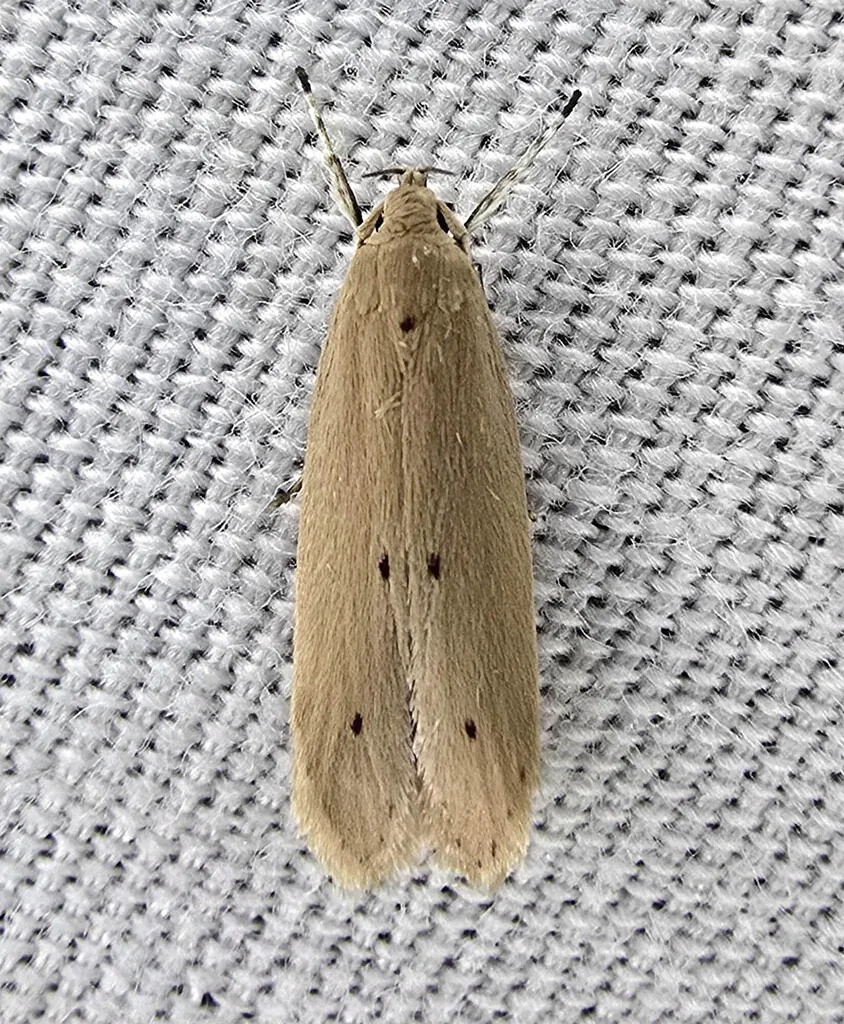
- The moth is silvery light brown or beige, with a black spot on the thorax and two black spots on each wing. At rest it is slender, a little more than three times as long as it is wide, and about 5/8 inch long.[1]
- The caterpillars are almost colorless apart from a brown head and a brown patch on the thorax.[1]
- The giveaway is on the leaf: young caterpillars build dense clusters of silken tubes, dark brown with frass, and older ones feed together under a shared silk mat covered with frass, on both the upper and lower surfaces of older fronds.[1]
Where it lives
It is native to the southern United States and is fairly abundant in Florida. It also lives on dwarf palmetto in Louisiana, where its ecology was studied in the Sherburne Wildlife Management Area.[1][2]
Biology and life cycle
It feeds only on palms, including cabbage palmetto, sabal palm, Canary Island date palm, coconut palm, Latan palms, Puerto Rico hat palm and more than 70 other palm species.[1]
Females lay groups of about three dozen eggs on older palm leaves and cover them with a brown, papery material.[1]
The caterpillars feed in groups of up to 100. Their silk tubes and mats probably shelter them from the weather and perhaps from some predators. They pupate under the webbing, and the new moths emerge to mate.[1]
There are up to five generations a year, and it has no resting (diapause) stage.[1]
In a Louisiana study on dwarf palmetto, tall plants were about 2.5 times more likely to be colonized than short ones, numbers were higher in dry habitats than wet ones, and an open understory doubled colonization. The moth proved a strong flier, and local populations on infested palmettos are likely well connected by dispersal.[2]
Damage and signs
Health risk
NC State's factsheet treats it only as a pest of palms and does not mention any harm to people.[1]
Control
Sanitation
Where large numbers of palms are damaged, cutting off and burning infested leaves is reported to work well.[1]
Traps and physical control
On specimen palms, wash the infested part of the leaf with a sponge, or on tough palms spray it with high-pressure water, to remove the silk mat and knock off the fairly fragile caterpillars.[1]
Biological control
Ground beetles prey on the caterpillars, and tachinid flies and small parasitic wasps parasitize them, though these natural enemies sometimes don't prevent unsightly damage.[1]
Pesticides
In Florida, where the pest is fairly abundant, insecticides have often not reduced palm leaf skeletonizers because the silk webbing protects the caterpillars.[1]
Common questions
- What is the brown, webby crust on the underside of my palm fronds?
- It may be palm leaf skeletonizer. Its caterpillars feed in groups under silk tubes and mats covered with their dark droppings on older palm leaves.[1]
- Why didn't spraying work on my palm?
- The caterpillars are protected by their silk webbing, and in Florida insecticides have often failed to reduce them. Washing off the mats or cutting out badly infested leaves works better.[1]
Sources
- NC State Extension, “Palm Leaf Skeletonizer (PDIC factsheet; J. Baker).” content.ces.ncsu.edu/palm-leaf-skeletonizer (accessed 2026-11-09)
- PLoS ONE (via NCBI PubMed), “Spatial ecology of the palm-leaf skeletonizer, Homaledra sabalella (Lepidoptera: Coleophoridae) (J. T. Cronin; PLoS ONE 6(7): e22331, 2011; abstract).” pubmed.ncbi.nlm.nih.gov/21799826/ (accessed 2026-11-09)
- iNaturalist, “Homaledra sabalella taxon page (order and family).” www.inaturalist.org/taxa/483779 (accessed 2026-11-09)