On this page
How to identify it
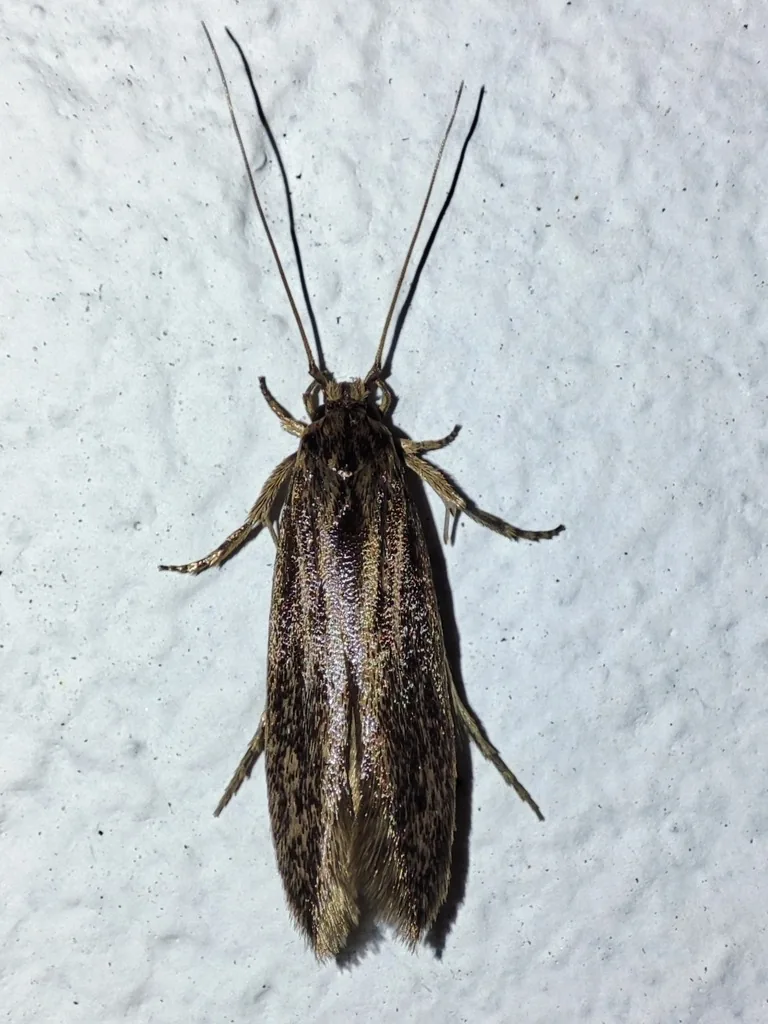
- The adult is about 1/2 inch long with a wingspan of about 4/5 inch. Its forewings are dark grayish or yellowish brown, each with one black spot, and its hind wings are silvery with a dense fringe of hairlike scales.[1]
- The caterpillar is translucent, pale green or whitish with a brown head and blackish to brown spots on the back and sides, and grows to about 1-1/8 inches long.[1]
- Masses of reddish brown frass mark where larvae have fed. Pupae are oblong, pale at first and then dark brown, about 1/2 inch long, and sometimes stick partway out of tunnel entrances before the moths emerge.[1]
- Eggs are oval, about 1/30 inch (0.8 millimeter) long, translucent to whitish or pale yellow, and laid in groups in crevices near or on wounds.[1]
Look-alikes
| Look-alike | How to tell them apart |
|---|---|
| Pink rot of palms | Palm infestations are generally associated with this disease, and pink rot can also enter through banana moth damage. Look for tunnel entrances, dark granular frass or oozing at the base of the palm and around the growing point, which point to the caterpillars.[1] |
Where it lives
It is a pest of crops in many tropical areas and is a quarantine pest in several countries. In Brazil it is a serious pest of bananas in the south of the country and does not occur in regions with warmer climates. In California it occasionally infests landscape palms in Southern California and prefers nursery stock.[3][2][1]
Biology and life cycle
The larvae are mainly scavengers on decaying organic matter of virtually any plant, and they attack living plants that are stressed or wounded.[1]
Females lay eggs on stressed plants and on decaying or dead tissue: in fresh wounds such as cut petioles or leaf bases of recently pruned palms, in crevices, behind leaf bases or flower bracts, among leaf-base fibers, and at the base of the plant, where larvae bore into the roots. Each female lays about 50 to 200 eggs.[1]
In laboratory work, development was best at 25 degrees C (77 degrees F), and above 30 degrees C (86 degrees F) no stage survived.[2]
In Southern California it has infested bamboo palms (Chamaedorea), Chinese windmill palm, majesty palm and queen palm, and it can attack Dracaena and many other palms.[1]
Damage and signs
- Larvae feeding around the leaf bases bore into the palm's growing point (apical meristem), damaging or killing it and letting in diseases such as pink rot. Together the tunneling and pink rot can kill parts of the plant and eventually the whole palm.[1]
- The first sign is usually damaged or dead new leaves. A palm that recovers puts out several abnormally small leaves, and some infestations show no leaf symptoms at all.[1]
- Larvae can also tunnel in frond petioles, stems and roots. Feeding at the base of the stem, where new roots grow, can make the trunk tip over, sometimes the first sign of an infestation.[1]
Health risk
The sources describe it only as a plant pest; they mention no harm to people.[1][2]
Control
Prevention
Inspect palms before buying them, especially around the base where new roots grow and around the growing point. Reject plants with tunnel entrances, dark granular frass or oozing.[1]
Keeping palms healthy may be the only effective management: water adequately in the dry season, fertilize periodically with a palm fertilizer, inspect valued palms often and avoid excessive pruning, since the moths seek out stressed and wounded plants.[1]
Traps and physical control
A synthetic female sex attractant has been identified; sticky traps baited with it caught as many males as traps baited with live females and can be used to monitor populations.[3]
Pesticides
Where banana moth is known to occur, UC IPM suggests considering treating freshly cut palm surfaces with a systemic insecticide such as acephate or imidacloprid, if the product is labeled for that use.[1]
When to call a professional
For shipped commodities, irradiation research found that a minimum dose of 150 gray should sterilize immature banana moths.[4]
Common questions
- What is killing the center leaves of my palm?
- One possibility is banana moth: its caterpillars bore into the palm's growing point, and the first sign is usually damaged or dead new leaves. Check the base and the leaf bases for tunnels and reddish brown frass.[1]
- Which plants does banana moth attack?
- In California it is mainly a palm pest, especially of queen palm, and it can attack Dracaena. Elsewhere it feeds on many crops and is a serious banana pest in southern Brazil.[1][2]
Sources
- University of California Statewide IPM Program, “Banana Moth (Home and Landscape).” ipm.ucanr.edu/PMG/GARDEN/PLANTS/INVERT/bananamoth.html (accessed 2026-11-09)
- Journal of Economic Entomology (via NCBI PubMed), “Biology at Different Temperatures, Thermal Requirements, and Ecological Zoning of Opogona sacchari (L. F. Lacerda et al.; Journal of Economic Entomology 112(4), 2019; abstract).” pubmed.ncbi.nlm.nih.gov/31089724/ (accessed 2026-11-09)
- Pest Management Science (via NCBI PubMed), “Sex attractant for the banana moth, Opogona sacchari: provisional identification and field evaluation (E. B. Jang et al.; Pest Management Science 66(4), 2010; abstract).” pubmed.ncbi.nlm.nih.gov/20146254/ (accessed 2026-11-09)
- Journal of Economic Entomology (via NCBI PubMed), “Ionizing radiation for quarantine control of Opogona sacchari (R. G. Hollingsworth and P. A. Follett; Journal of Economic Entomology 100(5), 2007; abstract).” pubmed.ncbi.nlm.nih.gov/17972628/ (accessed 2026-11-09)
- iNaturalist, “Opogona sacchari taxon page (order and family).” www.inaturalist.org/taxa/342200 (accessed 2026-11-09)