On this page
How to identify it
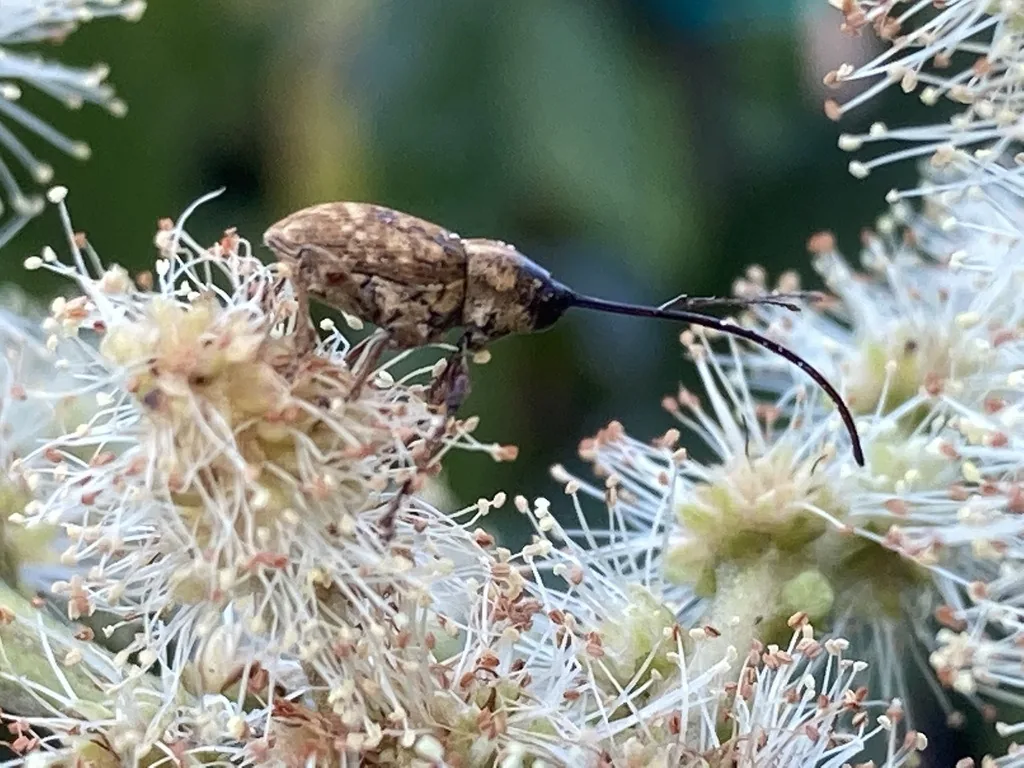
- The lesser chestnut weevil is about 1/4 inch long and the more common of the two in Kentucky. The larger chestnut weevil is about 3/8 inch not counting the snout; the female's beak is 5/8 inch long, the male's 1/4 inch.[1]
- The grubs are found inside the nut, several to a single chestnut in heavy infestations, and each chews a round exit hole in the side of the shell: the larger weevil's grubs usually leave before the nuts fall, the lesser weevil's soon after the nut is on the ground.[1][3]
- Adults can be detected the way pecan weevils are: jar the limbs over a sheet and the weevils drop and lie still for a short time. The 2022 phenology study found pyramid traps the most effective way to catch lesser chestnut weevil adults, with numbers peaking in mid-October in the northern United States.[1][2]
Look-alikes
| Look-alike | How to tell them apart |
|---|---|
| Pecan weevil (Curculio caryae) | A reddish-brown weevil of pecan and hickory, about 3/8 inch, with a different host; the chestnut weevils breed only in chinquapin and American and Chinese chestnuts.[1] |
Where it lives
Both species were common when the American chestnut dominated eastern forests and became much less common after the blight. The lesser chestnut weevil is now resurging in commercial chestnut plantings, with bivoltine populations in the southern United States and univoltine populations in the north. The greater chestnut weevil, not observed for over two decades by the early 21st century and widely presumed extinct, was rediscovered through iNaturalist records from pathogen-resistant hybrid chestnut plantings and native Allegheny chinquapin in the eastern United States, with genomic analyses and field surveys confirming the identification and active reproduction.[1][3][4]
Biology and life cycle
Lesser chestnut weevil: adults emerge from the ground from late May to July, about when the chestnuts bloom, but do not lay eggs until fall, starting when the nuts are nearly mature and mostly after the burr begins to open. Eggs usually go into the downy inner lining of the brown shell and hatch in about 10 days, and the larva finishes feeding two to three weeks later. Soon after the nut falls, the grub chews a circular hole in the side and enters the soil. Most spend the first winter as grubs, pupate the following fall and pass the next winter as adults; some stay grubs for two winters and adults for a third, so the life cycle takes two to three years.[1]
In the northern United States the 2022 study found a single generation a year with adult numbers peaking in mid-October, later than reported from Missouri, and suggested that one generation may keep emerging over several subsequent years.[2]
Larger chestnut weevil: adults emerge in late July and August and begin laying at once, ahead of the lesser weevil. Eggs hatch in five to seven days and the larvae feed two to three weeks, then chew out of the nut and drop to the ground, usually before the nuts fall. They overwinter in earthen cells, pupate and emerge the following summer, a few waiting a second year; the life cycle takes one to two years.[1]
Damage and signs
- The grubs eat the kernel while the nut is still on the tree, and the problem usually goes unnoticed until the nuts are harvested and opened. A nut can hold several larvae, larvae keep emerging from nuts several weeks after harvest, and the nut keeps losing weight even after the grubs have left. Secondary pathogens can follow the damage. Grubs are occasionally found in homes or wherever nuts are stored.[1][3]
- Infestation rates of 50 to 75 percent were considered normal in the early 1900s and 100 percent was reported, with governments seizing wormy chestnuts; in today's orchards an infestation can surge from zero to close to 100 percent in two years. Larvae emerging on a kitchen counter at home are a blow to consumer confidence in chestnuts.[2][3]
Health risk
Nut-feeding weevils; the sources describe losses to the crop and grubs turning up in stored nuts, not any risk to people.[1][3]
Control
Prevention
Jar the trees over a sheet to find out whether adults are present. For the lesser weevil, pyramid traps were the most effective monitoring tool in the 2022 study.[1][2]
Sanitation
Pick up chestnuts daily, and collect and destroy fallen nuts before the larvae escape into the soil, where the next generations develop for a year or more.[1]
Traps and physical control
After curing, heat the nuts to 140 F for 30 minutes to kill larvae inside. Holding nuts at 0 F for four days may also work but may affect flavor.[1]
Biological control
In the 2022 trials, applications of entomopathogenic fungi reduced the chance of a chestnut being infested, and certain entomopathogenic nematode strains increased the mortality of lesser chestnut weevil larvae.[3]
Common questions
- Worms crawled out of chestnuts I bought weeks ago. What are they?
- Chestnut weevil grubs. The larvae keep emerging from nuts for several weeks after harvest, chewing a round hole in the shell on their way to the soil.[1][3]
- Can I eat chestnuts from an infested tree?
- The sources address the crop, not food safety; heating cured nuts to 140 F for 30 minutes kills the larvae inside, but nuts that have already been eaten out lose weight and may carry secondary pathogens.[1][3]
- Which chestnut weevil do I have?
- Size and timing: the lesser weevil is about 1/4 inch and its grubs leave the nut after it falls; the larger weevil is about 3/8 inch, the female with a 5/8 inch beak, and its grubs usually drop out before the nuts fall. Only the lesser weevil's adults are out from late May; the larger emerges in late July and August.[1]
Sources
- University of Kentucky College of Agriculture, Food and Environment, Entomology, “Nut Weevils, Entfact-206 (Bessin; revised 2017).” entomology.ca.uky.edu/files/ef206.pdf (accessed 2026-11-10)
- Insects (MDPI), “Phenology and Monitoring of the Lesser Chestnut Weevil (Curculio sayi). Insects 13(8): 713 (2022), PMC9409741.” pmc.ncbi.nlm.nih.gov/articles/PMC9409741/ (accessed 2026-11-10)
- Insects (MDPI), “The Lesser Chestnut Weevil (Curculio sayi): Damage and Management with Biological Control Using Entomopathogenic Fungi and Nematodes. Insects 13(12): 1140 (2022), PMC9788462.” pmc.ncbi.nlm.nih.gov/articles/PMC9788462/ (accessed 2026-11-10)
- Current Biology (Elsevier), “Charles et al. Rediscovery of the greater chestnut weevil highlights the power of digital platforms in biodiversity research and conservation. Current Biology 35(24): 6172-6179 (2025), PMID 41308651.” pubmed.ncbi.nlm.nih.gov/41308651/ (accessed 2026-11-10)
- iNaturalist, “Curculio sayi taxon page (order and family).” www.inaturalist.org/taxa/217934 (accessed 2026-11-10)