On this page
How to identify it
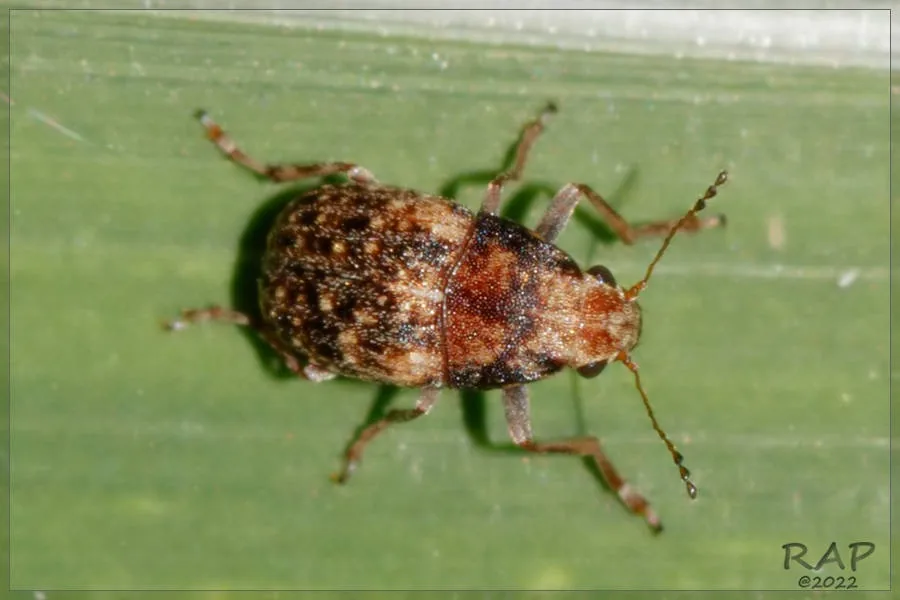
- Adults are 2 to 5 mm long, dark brown and mottled with whitish to yellowish scale-like hairs.[2]
- It has a short, broad snout and long antennae ending in a three-segmented club.[2][1]
- The wing covers stop short of the tip of the abdomen, leaving the last segment exposed.[1]
- Adults jump or tumble when disturbed and often play dead for a moment.[2]
- Larvae are white, legless grubs that live inside the seed, bean or fruit they feed on.[2][1]
Where it lives
Found worldwide in the tropics and subtropics and, in temperate regions, only in heated buildings. In the U.S. it has been reported from Florida, Ohio, New Jersey, the District of Columbia, Alabama, Mississippi, Texas and North Carolina, and it is probably established in Los Angeles and Orange counties in California.[1]
Biology and life cycle
A female lays up to 60 eggs. Larvae hatch in 5 to 20 days, and the full life cycle takes anywhere from 21 to 80 days depending on conditions. Florida's circular puts it at about 45 days in general.[1][2]
It does most of its damage above 28 C (82 F) and cannot develop from egg to adult below 22 C (72 F).[1]
Adults live for several months, feed on fungi such as Penicillium mold, and do little or no damage themselves. They are strong fliers.[2][1]
Damage and signs
- Almost 100 hosts have been recorded, nearly all of them dry seeds or stored products. They include coffee, cocoa, nutmeg, rice, sunflower seed, beans, peanuts, dried fruit, nuts, mushrooms, herbs and spices.[2][1]
- The grubs bore into seeds or beans and hollow out a cavity. Several larvae may feed in one bean, and infested coffee beans rot.[1]
- It also attacks soft fruit on living plants, including papaya and citrus. In 1971 a heavy infestation in a Lake County, Florida, orange grove caused fruit drop, with larvae tunneling in the peel.[1][2]
Health risk
The Florida and California reports describe it only as a pest of stored products and fruit and list no health risk to people.[2][1]
Control
Prevention
Buy dry foods in amounts you will use soon, check packages before buying, and store food in tightly closed glass, metal or heavy plastic containers.[3]
Sanitation
For pantry beetles in general, throw heavily infested food away outdoors in a sealed bag, then empty and vacuum the shelves, paying attention to cracks and corners, and empty the vacuum afterward.[3]
Traps and physical control
Lightly infested food can be saved by freezing it at 27 F or colder for 3 to 7 days, or heating it in a 140 F oven for an hour.[3]
Pesticides
Insecticides are not recommended for pantry pests. Control only lasts if the infested food is found and removed.[3]
Common questions
- What family is the coffee bean weevil in?
- It belongs to the beetle family Anthribidae and has the short, broad snout typical of that family.[2]
- What foods does it infest?
- Almost any stored food that is not too dry, including coffee beans, cocoa, nutmeg, beans, nuts, dried fruit, herbs and spices.[1][2]
- Can it live outdoors where I am?
- It is a warm-climate insect. It cannot complete development below 22 C (72 F), and in temperate regions it has been reported only in heated buildings.[1]
Sources
- California Department of Food and Agriculture, “Araecerus fasciculatus: Coffee bean weevil (California Pest Rating Proposal).” blogs.cdfa.ca.gov/Section3162/?p=3155 (accessed 2026-11-10)
- Florida Department of Agriculture and Consumer Services, Division of Plant Industry, “The coffee bean weevil, Araecerus fasciculatus (DeGeer), a potential new pest of citrus in Florida (Entomology Circular 117, 1972).” thefsca.org/wp-content/uploads/2025/02/ent117.pdf (accessed 2026-11-10)
- University of Illinois Extension, “Common Pantry Pests.” extension.illinois.edu/sites/default/files/common_pantry_pests.pdf (accessed 2026-11-10)
- iNaturalist, “Araecerus fasciculatus taxon page (order and family).” www.inaturalist.org/taxa/214056 (accessed 2026-11-10)