On this page
How to identify it
- Adult females are 1.4 to 1.7 mm long (about 1/16 inch); males are much smaller. Newly emerged adults have a blackish-brown abdomen with a lighter brown pronotum and darken to black as they mature.[1]
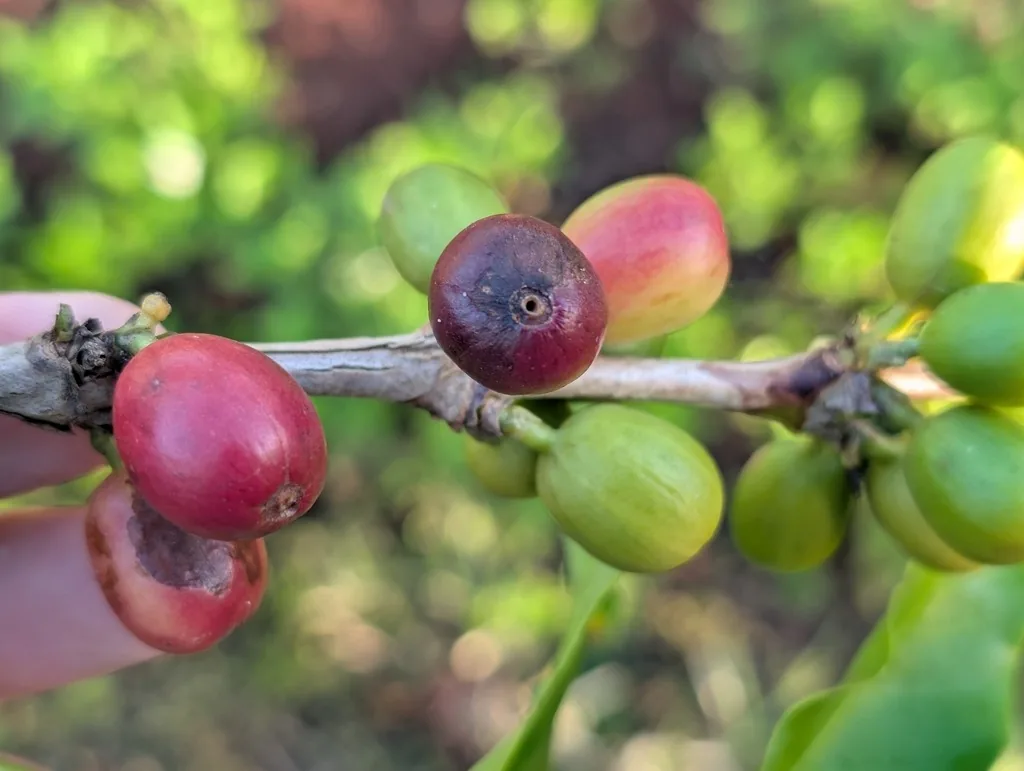
- The entry hole is the field clue. The coffee berry borer bores in through the scar at the blossom end of the berry. The tropical nut borer and the black twig borer, which also occur on Hawaii coffee and look nearly identical, may enter from the sides, and the black twig borer also attacks branches while the coffee berry borer attacks only berries. Telling the three apart by the beetle itself takes a microscope and often an expert.[1]
- Researchers describe two stages of attack. In the AB position the beetle has just perforated the skin and flesh and part of its body is still visible; it can stay there 30 to 90 days until the bean inside drops below 20 percent moisture. In the CD position it has reached and damaged the seed, and the female and her progeny are protected from sprays.[2]
Look-alikes
| Look-alike | How to tell them apart |
|---|---|
| Black twig borer (Xylosandrus compactus) | On Hawaii coffee for over 50 years; nearly identical to the eye, but it readily infests branches and may enter berries from the side, while the coffee berry borer attacks only berries and enters through the blossom-end scar.[1] |
| Tropical nut borer (Hypothenemus obscurus) | Also found on coffee plants in Hawaii and extremely similar in appearance; it may enter a berry from the side rather than through the blossom scar.[1] |
Where it lives
Native to Central Africa and now in every coffee-producing region except Nepal and Papua New Guinea. In the United States it reached Puerto Rico in 2007 and Hawaii in 2010 (Kona district first, then Ka'u, Puna and Hamakua in 2011 to 2013), followed by Oahu in 2014, Maui in 2016, and Kauai and Lanai in 2020. Hawaii has quarantine rules on moving green coffee beans, plants, used bags and harvesting equipment between islands.[1][2][3]
Biology and life cycle
The female bores into a mature or immature berry still on the tree, builds galleries and lays her eggs there; the larvae eat through the berry and into the bean. Egg to adult takes 28 to 34 days (about 4 days as an egg, 15 as a larva and 7 as a pupa), and a female can live five to six months. She stays in the berry after laying, and her offspring leave to find new berries. Breeding continues in berries that have fallen to the ground.[1]
Preferred hosts are Coffea arabica and C. canephora, though the beetle has been recorded on other plants, including Ixora, passionflower, blackberry, corn, hibiscus, Acacia, shower tree, Leucaena and sleeping grass.[1]
On commercial farms in Kona and Ka'u, trap catches peak early in the season while berries are developing (February to May) and again in the late harvest season (November to January). Old berries left on the trees, called raisins, served as reservoirs for up to six months after the final harvest.[2]
Damage and signs
- Feeding damage is compounded by secondary fungal and bacterial infection and further insect attack inside the berry; together they reduce yield, lower quality and can destroy the whole bean. In some producing regions the beetle has cut coffee yields by up to 90 percent.[1]
- Hawaii and Puerto Rico have reported some of the highest infestation levels anywhere, sometimes above 85 percent of berries. Infestation above 20 percent of berries means heavy losses in processed coffee. Before the beetle arrived, about a quarter of the Kona crop graded Extra Fancy; from 2011 to 2013 no Hawaii coffee was certified Extra Fancy or Fancy.[2]
Health risk
A coffee pest only. The Hawaii advisory describes damage to berries and beans, not to people.[1]
Control
Prevention
Monitor rather than spray on a calendar. Funnel traps baited with a 3:1 methanol:ethanol lure show flight peaks and hotspots within a field, and a 30-tree berry-sampling plan, developed in Colombia and introduced to Hawaii in 2012, estimates infestation. Few growers use either, and many still spray monthly regardless of infestation.[2]
Keep them out
Hawaii's interisland rules restrict movement of green (unroasted) coffee beans, coffee plants and plant parts, used coffee bags and harvesting equipment, and quarantine restrictions were extended to Maui in 2017. Infested berry samples can be submitted to the department.[3]
Sanitation
Frequent, efficient harvesting and a post-harvest strip-pick, which removes every remaining green, ripe and over-ripe berry, are the most important cultural practices because they take away the beetle's reservoir. Strip-picking is recommended as a critical part of the Hawaii program; farms in Ka'u and at high elevation in Kona, where harvest runs six to nine months, do sanitation picks instead. The Hawaii advisory also notes that sanitation, though labor-intensive, may be the best option for small producers.[2][1]
Biological control
Commercial Beauveria bassiana sprays are part of the Hawaii program, timed with monitoring so they reach beetles still in the exposed AB position; a state subsidy for the product exists but few farms use it. Flat bark beetles (Cathartus quadricollis and Leptophloeus species) and several ants prey on the borer, and USDA-ARS built predator breeding stations for growers. The parasitoid wasp Phymastichus coffea is being considered for introduction.[2]
Pesticides
The Hawaii Department of Agriculture states that no chemical insecticides available in Hawaii effectively control the coffee berry borer, because it spends most of its life inside the fruit. Once a female is in the CD position, she and her brood are protected from both insecticides and the fungus.[1][2]
Common questions
- How do I know the hole in my coffee berry is from this beetle?
- Look at where the hole is. The coffee berry borer enters through the scar at the blossom end; the two look-alike beetles on Hawaii coffee may enter from the side, and the black twig borer also bores into branches, which the coffee berry borer never does.[1]
- Why doesn't spraying fix it?
- Because the beetle lives inside the berry. Hawaii's agriculture department says no insecticide available there controls it effectively, and once the female has reached the seed she and her offspring are shielded from sprays and from Beauveria.[1][2]
- What has actually lowered infestations in Hawaii?
- The integrated program: monitoring with traps and berry sampling, frequent harvest and strip-picking to remove reservoirs, Beauveria bassiana applications timed to monitoring, and conserving predators. Infestations in Kona and Ka'u have fallen over the past decade and yields and quality have risen.[2]
Sources
- Hawaii Department of Agriculture, Plant Pest Control Branch, “New Pest Advisory No. 10-01: Coffee Berry Borer, Hypothenemus hampei (Ferrari) (issued September 22, 2010; updated December 9, 2014).” dab.hawaii.gov/pi/files/2013/01/Hypothenemus-hampei-NPA-MASTER.pdf (accessed 2026-11-10)
- Insects (MDPI), open access via PubMed Central, “Johnson, Manoukis and colleagues (USDA-ARS Daniel K. Inouye U.S. Pacific Basin Agricultural Research Center, University of Hawaii, University of Puerto Rico). Establishing an Integrated Pest Management Program for Coffee Berry Borer (Hypothenemus hampei) in Hawaii and Puerto Rico Coffee Agroecosystems. Insects 14 (2023) 603, PMC10380356.” pmc.ncbi.nlm.nih.gov/articles/PMC10380356/ (accessed 2026-11-10)
- Hawaii Department of Agriculture, Plant Industry Division, “Coffee Berry Borer Information Page.” hdoa.hawaii.gov/pi/ppc/cbbinfo/ (accessed 2026-11-10)
- iNaturalist, “Hypothenemus hampei taxon page (order and family).” www.inaturalist.org/taxa/53425 (accessed 2026-11-10)