On this page
How to identify it
- The caterpillar is pale green with prominent yellow stripes running along each side of the back. The back itself is plain pale green or marked with wine-red and yellow spots.[1]
- The head is flattened, with conspicuous antennae and often black lines on its sides. The abdomen tapers toward the rear, and the last segment is compressed.[1]
- Male moths have a wide mouth slit and a greatly enlarged gut lining, which the Science study describes as specializations for puddling.[2]
Where it lives
The USDA Forest Service includes it in its guide to the caterpillars of eastern forests.[1]
Biology and life cycle
The caterpillars feed on poplars and can be found from June to October. There are two generations a year.[1]
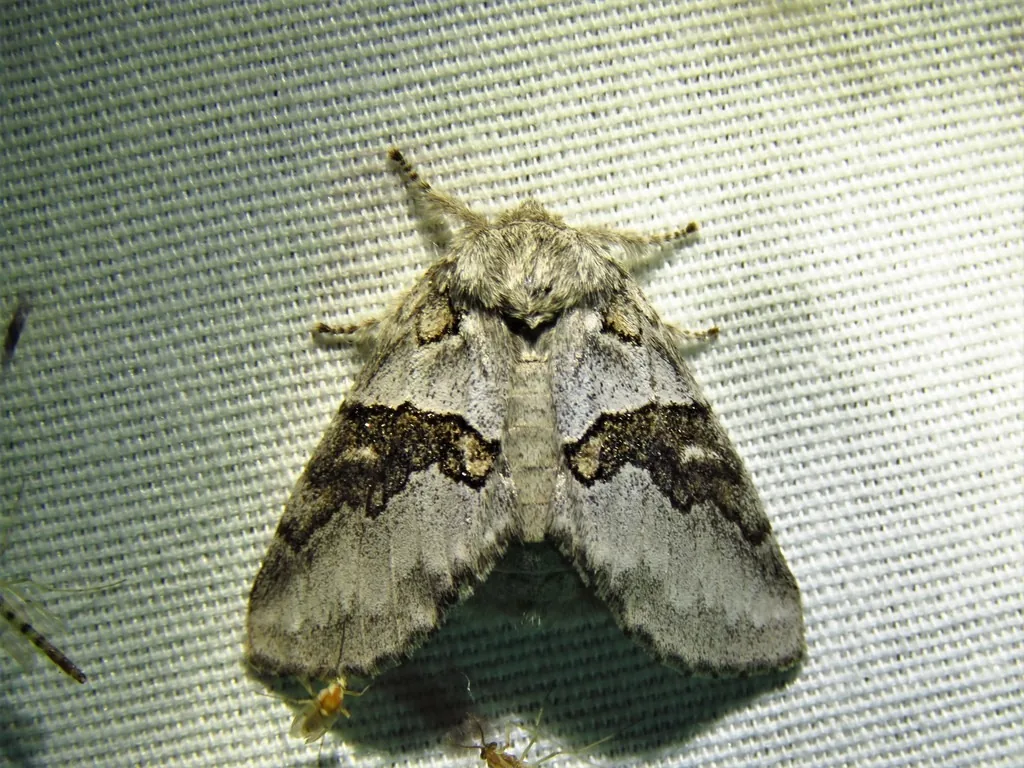
Males puddle routinely and for hours, drinking hundreds of gut-loads of water and squirting the fluid back out from the rear end in repeated jets. They come away with a net gain of sodium, which the caterpillars' poplar diet supplies very little of.[2][3][1]
At mating a male passes the female about 10 micrograms of sodium, more than half of the sodium in his body, probably in the sperm packet. She puts much of it into her eggs: eggs fathered by puddling males held two to four times as much sodium as eggs from the study's control males, starting with eggs laid the night after mating.[3]
The authors note that a father supplying his offspring with sodium had not been shown before in an insect, as far as they knew, and that getting sodium may be the main reason butterflies and moths puddle.[3][2]
It belongs to the prominent family, whose caterpillars tend to stay on the foliage by day and mostly specialize on particular food plants.[1]
Damage and signs
Health risk
Neither the USDA Forest Service guide nor the two studies mention any bite, sting or other risk to people.[1][2][3]
Control
Prevention
Neither the USDA Forest Service guide nor the studies recommend any control.[1][2]
Common questions
- Why do some moths sit at mud puddles?
- Males of this moth drink from puddles to collect sodium. They swallow water for hours, squirt it back out, and keep the sodium, which they later pass to the female at mating.[2][3]
- Why would a moth need extra sodium?
- Its caterpillars eat poplar leaves, which are extremely low in sodium. The sodium a male gathers ends up largely in the eggs, so the next generation starts with more of it.[3][2]
- What does the common gluphisia caterpillar look like?
- A pale green caterpillar with bold yellow stripes along the back, sometimes with wine-red and yellow spots, a flattened head and a body that tapers to the rear. Look for it on poplars from June to October.[1]
Sources
- USDA Forest Service, Forest Health Technology Enterprise Team, “Caterpillars of Eastern Forests, FHTET-96-34 (D. L. Wagner, V. Giles, R. C. Reardon and M. L. McManus, November 1997; scanned copy).” archive.org/details/caterpillarsofea001997 (accessed 2026-11-09)
- Science (via NCBI PubMed), “Sodium uptake by puddling in a moth (S. R. Smedley and T. Eisner; Science 270(5243): 1816-1818, 1995; abstract).” pubmed.ncbi.nlm.nih.gov/8525374/ (accessed 2026-11-09)
- Proceedings of the National Academy of Sciences (via NCBI PubMed), “Sodium: a male moth's gift to its offspring (S. R. Smedley and T. Eisner; Proceedings of the National Academy of Sciences 93(2): 809-813, 1996; abstract).” pubmed.ncbi.nlm.nih.gov/11607627/ (accessed 2026-11-09)
- iNaturalist, “Gluphisia septentrionis taxon page (order and family).” www.inaturalist.org/taxa/143274 (accessed 2026-11-09)