On this page
How to identify it
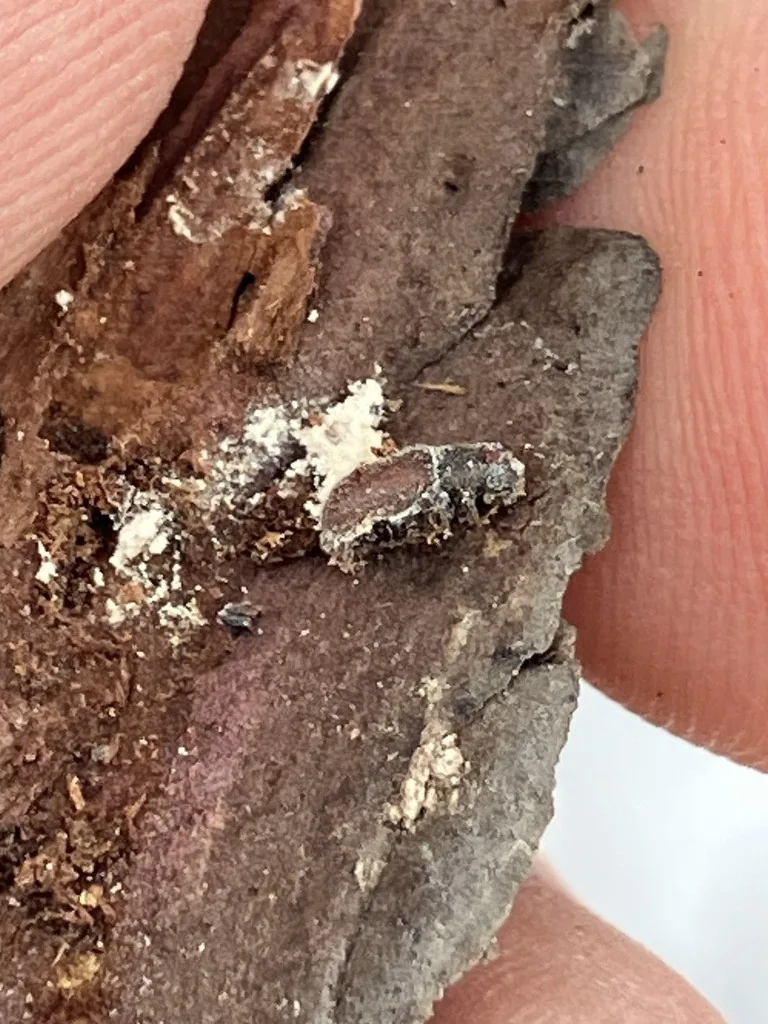
- Adults are small bark beetles, light to dark brown and about 4 mm long.[2]
- Under the bark of attacked trees are vertical egg galleries with many side tunnels branching off at right angles.[2]
- Infested tamarack often looks reddish in late winter, because woodpeckers strip the outer bark to reach larvae in the reddish inner bark. Foliage on attacked trees may yellow in late July or early August.[2]
Look-alikes
| Look-alike | How to tell them apart |
|---|---|
| Other bark beetles and wood borers in tamarack | Eastern larch beetle galleries run vertically under the bark with many side tunnels at right angles, and attacked trunks turn reddish where woodpeckers strip the bark. Under normal conditions the beetle only uses recently dead or weakened trees, so check for these signs before blaming it for a single declining tree.[2][4] |
Where it lives
Found wherever tamarack grows across the northern United States and Canada. The current outbreak has damaged large areas of tamarack in the Great Lakes region of both countries, including more than 460,000 hectares in Minnesota.[1][4]
Biology and life cycle
Adults come out of winter dormancy in late spring and bore into the trunk to feed, mate and lay eggs. The larvae tunnel through the phloem, the inner bark layer that carries water and nutrients.[2]
A male and female pair build each egg gallery. After raising a first brood over about a month, the adults leave to start a second, 'sister' brood in more, often poorer, host material. Beetles of the first brood come out in late summer and early fall and walk down the trunk to spend the winter.[4]
The beetle has long been described as having one generation a year. Researchers think longer growing seasons now allow an extra summer generation and better survival, which helps explain the size of the current outbreak.[4][1]
Females starting a gallery give off several pheromone compounds, including frontalin. Within about a day of a male joining her, she largely stops producing two of them but keeps producing frontalin.[5]
Damage and signs
- Larval galleries cut off the flow of water and nutrients in the inner bark, which eventually kills the tree.[2]
- At normal, low numbers the beetle lives in recently dead or weakened trees. During outbreaks it attacks healthy trees and kills large areas of tamarack. Larger outbreaks in Alaska and eastern Canada in the 1970s revealed this more aggressive behavior, including mass attacks on healthy trees.[4][6]
Health risk
The sources describe it only as a pest of tamarack; they mention no harm to people.[1][6]
Control
Prevention
For timber, regenerate mature or nearly mature tamarack stands before beetles infest them, and keep a mix of tree species. The beetle generally does not attack small seedlings and saplings.[3]
Sanitation
If you do not want to harvest a whole infested stand, cut all visibly infested tamaracks plus strips of healthy tamarack next to them, at least 200 feet wide. Cut while the ground is frozen and remove the wood, or process it into lumber or chips, before spring.[3]
In small harvests on private land, keep cut logs away from standing trees that are not infested.[3]
Common questions
- Why are the tamaracks near me turning red or yellow and dying?
- In the northern Great Lakes states, eastern larch beetle is a likely cause. Look for reddish trunks where woodpeckers have stripped the bark in late winter, yellowing needles in late July or August, and branching galleries under the bark.[2][1]
- Can an eastern larch beetle outbreak be stopped?
- The Minnesota DNR says the current outbreak cannot be managed across the landscape and there is no indication it can be managed at the stand level. Its advice centers on regenerating tamarack before it is attacked and, where infested trees are cut, cutting in winter and removing the wood before spring.[3]
- Is the eastern larch beetle an invasive species?
- No. It is native to North America and lives wherever tamarack grows. Outbreaks have become larger and longer as growing seasons have lengthened.[1]
Sources
- Minnesota Department of Natural Resources, “Eastern larch beetle.” www.dnr.state.mn.us/treecare/forest_health/elb/index.html (accessed 2026-11-09)
- Minnesota Department of Natural Resources, “Eastern larch beetle identification.” www.dnr.state.mn.us/treecare/forest_health/elb/id.html (accessed 2026-11-09)
- Minnesota Department of Natural Resources, “Eastern larch beetle management.” www.dnr.state.mn.us/treecare/forest_health/elb/management.html (accessed 2026-11-09)
- Ecological Applications (Ecological Society of America), “Tree defenses, host choice, and reproductive success of a native bark beetle under novel outbreak conditions (Ecological Applications, 2026).” pmc.ncbi.nlm.nih.gov/articles/PMC12800731/ (accessed 2026-11-09)
- Journal of Chemical Ecology, “Pheromone composition of the eastern larch beetle Dendroctonus simplex (Althoff, Aukema and Sullivan 2025, Journal of Chemical Ecology 51:18), abstract.” pubmed.ncbi.nlm.nih.gov/39903374/ (accessed 2026-11-09)
- Bulletin of Entomological Research, “The symbiotic complex of Dendroctonus simplex (Durand et al. 2019, Bulletin of Entomological Research 109:723-732), abstract.” pubmed.ncbi.nlm.nih.gov/30806338/ (accessed 2026-11-09)
- iNaturalist, “Dendroctonus simplex taxon page (order and family).” www.inaturalist.org/taxa/202845 (accessed 2026-11-09)