On this page
How to identify it
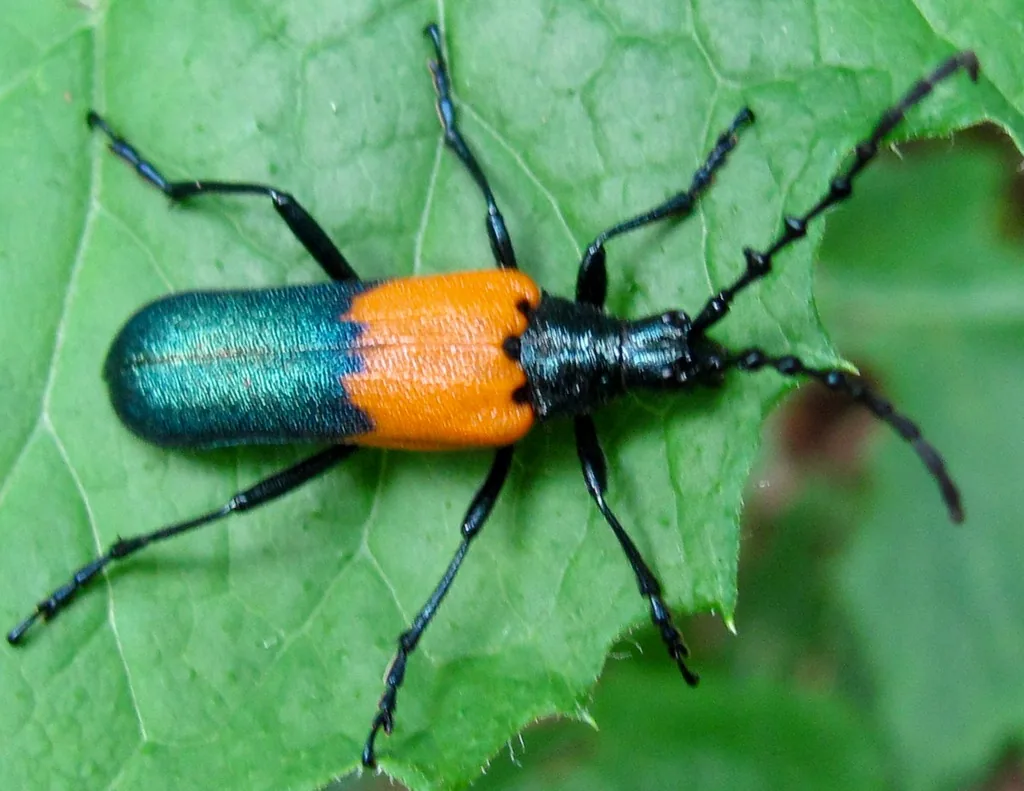
- A robust longhorn beetle 18 to 27 mm long (about 3/4 to 1 inch), bright metallic blue or violet, with the front third to half of the wing covers yellow to yellowish orange except for two small black spots along their base.[1]
- The antennae reach about the middle of the wing covers in females and a little farther in males.[1]
- The larva is creamy white and shiny, with a brown head and black mandibles, and grows to about 25 mm (1 inch). Eggs are yellowish brown, spindle-shaped, about 3 mm long and wrinkled lengthwise.[1]
Look-alikes
| Look-alike | How to tell them apart |
|---|---|
| California elder borer (Desmocerus californicus) | A related elder borer of northern and central California whose only recorded host is blue elder. It is blue-black and red-orange, with males 13 to 20 mm and females 18 to 25 mm long.[1] |
Where it lives
Throughout the eastern and central United States, west to Kansas and north into Ontario.[1]
Biology and life cycle
Adults emerge from April to June, around the time elderberry blooms, and feed on the leaves and flowers through July. Females lay eggs on the bark, and some reportedly on the foliage.[1][2]
The larvae bore into the pith of the stems, tunneling and feeding in galleries 12 to 20 cm (about 5 to 8 inches) long and 8 to 10 mm across, packed first with fine and later with coarse, fibrous frass. Mature larvae tunnel down into the roots, then usually turn around and pupate in their galleries at or just below the soil surface.[1]
Pupation takes place in April and May. The life cycle takes one year in the Deep South and two or three years elsewhere. Nothing is known of its natural enemies.[1]
Virginia Tech notes that its numbers have declined and that it has been listed as a species of Special Concern in Massachusetts.[2]
Damage and signs
- Look for large amounts of coarse, fibrous frass pushed out at the base of infested stems and for exit holes near the base of stems, up to 15 to 20 cm (6 to 8 inches) above the soil line. Infested stems have frass-packed tunnels inside, and heavily infested plants die back and may die.[1]
- The tunneling can badly mar the shape and beauty of ornamental elders. Some people, on the other hand, consider the borer useful because they regard wild elder as a troublesome plant.[1]
Health risk
It is a wood-boring beetle of elder, and neither the Forest Service handbook nor Virginia Tech describes any risk to people.[1][2]
Control
Pesticides
Controls may be needed to protect ornamental elders. The Forest Service handbook, citing work from 1923, says fumigants applied in April, or insecticides aimed at the adults on the foliage and stems in May and June, can help limit losses.[1]
Common questions
- What is the blue and orange beetle on my elderberry?
- A bright metallic blue or violet longhorn beetle with the front of its wing covers yellow to yellowish orange matches the elderberry borer. Adults appear from April to June and feed on elder leaves and flowers.[1]
- How do I know if elderberry borers are in my plants?
- Look for piles of coarse, fibrous frass at the base of the stems and exit holes near the base, up to 6 to 8 inches above the soil. Infested stems have frass-packed tunnels inside, and heavily infested plants die back.[1]
- Is the elderberry borer rare?
- Virginia Tech notes that its numbers have declined and that Massachusetts has listed it as a species of Special Concern.[2]
Sources
- USDA Forest Service, “Guide to Insect Borers in North American Broadleaf Trees and Shrubs, Agriculture Handbook AH-706 (J. D. Solomon, 1995), elder borer and California elder borer accounts, pp. 402-404.” research.fs.usda.gov/treesearch/22150 (accessed 2026-11-09)
- Virginia Tech Department of Entomology, “Elderberry borers (D. G. Pfeiffer), Virginia Fruit small fruit pages.” virginiafruit.ento.vt.edu/Elderberryborer.html (accessed 2026-11-09)
- iNaturalist, “Desmocerus palliatus taxon page (order and family).” www.inaturalist.org/taxa/47962 (accessed 2026-11-09)