On this page
How to identify it
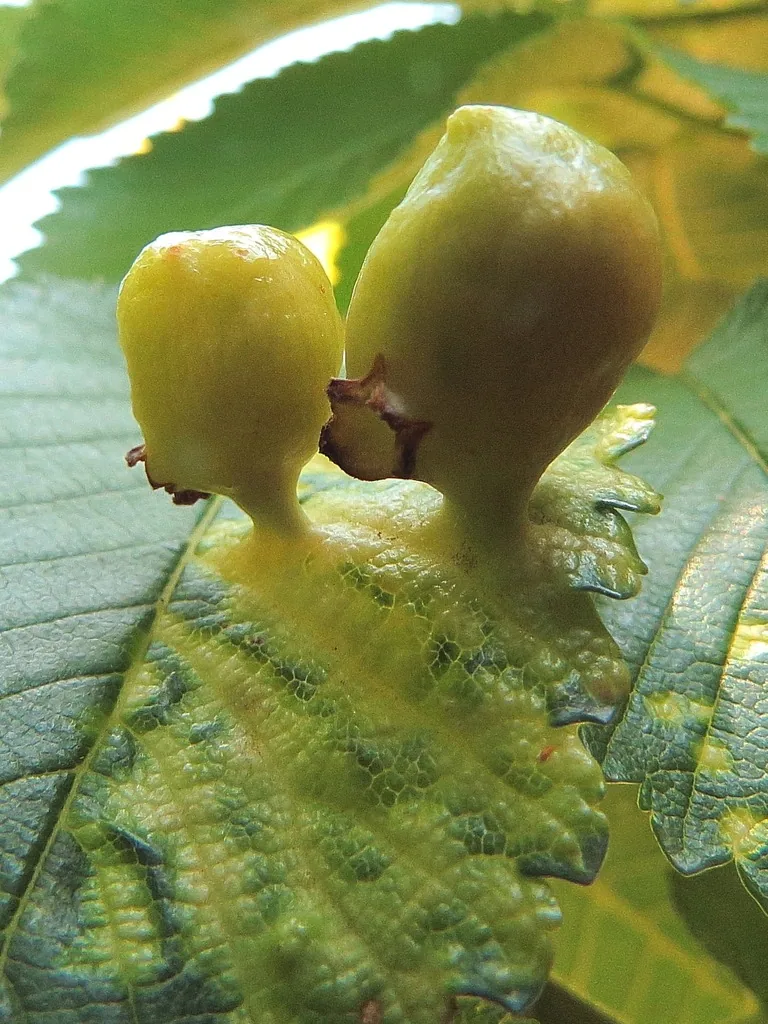
- The galls are stalked, hollow sacks about 3/8 inch tall on new elm leaves. They are shiny green or yellow-green at first and eventually turn red.[1]
- The aphid that starts each gall (the fundatrix) is dark green with crosswise bands of light wax across the abdomen and thorax.[1]
- Winged aphids that leave the galls in June and July are 3/32 to 1/8 inch long and shiny black with a dark gray abdomen.[1]
- On grass roots, the aphids look nothing like those on elm: they are fat, wingless and reddish orange, with very short siphunculi (tailpipes) set close to the tail.[1]
Look-alikes
| Look-alike | How to tell them apart |
|---|---|
| Other elm gall aphids | Eriosoma and Colopha aphids also gall elm leaves, and each species forms a distinct kind of gall.[5] |
Where it lives
It has been recorded from nine species of elm and several grasses; Russian elm (Ulmus laevis) may not be a host. NC State Extension gives recommendations for elms galled by it, and in Europe researchers have studied a population living in ant nests in the Netherlands.[1][2]
Biology and life cycle
Eggs spend the winter on elm bark and hatch in spring. Each young nymph matures over 3 to 4 weeks into a fundatrix, whose feeding on a new leaf forms a sack gall. Inside, she gives birth to live young, and the next generation develops wings; one gall can hold up to 85 aphids.[1]
In June and July the galls crack open and the winged aphids fly to grasses, burrow down and feed on the roots, usually tended by moisture ants (Lasius).[1]
In September winged forms fly back to elm and produce nymphs that feed on the bark and mature into wingless males and females. Each fertilized female lays a single egg.[1]
Some aphids skip the return trip and keep feeding on grass roots through the winter under ant care. Most ant-tended aphids are adults, and the ants are thought to eat newborn aphids.[1]
In a Dutch study of root aphids kept by the ant Lasius flavus, these aphids reproduced mostly or entirely without mating, winged forms were rare, and more than half of the ant mounds held just one aphid species, often a single clone that persisted from year to year.[2][3]
Damage and signs
Health risk
The sources treat it only as a plant-feeding aphid; none mentions bites or any risk to people or pets.[1]
Control
Biological control
Minute pirate bugs, hover fly maggots, predatory caterpillars and birds feed on the aphids overwintering on elm bark.[1]
Pesticides
By the time sack galls are noticed it is usually too late for a pesticide to undo them. For a specimen elm that is heavily infested year after year, a systemic insecticide such as imidacloprid can be applied in winter to prevent galls the next spring, or a small tree can be sprayed with a systemic while the galls are new.[1]
Common questions
- What are the little bags on my elm leaves?
- Stalked, hollow sacks about 3/8 inch tall that start green and turn red are likely galls of the elm-grass root aphid. Each holds a founding aphid and her offspring.[1]
- Do these aphids hurt my lawn?
- Their summer generations feed on grass roots, usually tended by ants. NC State's fact sheet does not describe damage to grasses; its advice deals only with galls on elm.[1]
- Is it worth spraying galled elms?
- Once the galls are visible, a spray will not undo them. NC State suggests a systemic treatment only for an important elm that is heavily infested year after year, applied in winter or, on a small tree, while the galls are new.[1]
Sources
- NC State Extension, “Elm-Grass Root Aphid (PDIC Factsheet).” content.ces.ncsu.edu/elm-grass-root-aphid (accessed 2026-11-09)
- Wiley (Molecular Ecology), “Reproduction and dispersal in an ant-associated root aphid community (Ivens et al. 2012, Molecular Ecology 21:4257-4269).” doi.org/10.1111/j.1365-294X.2012.05701.x (accessed 2026-11-09)
- BioMed Central (BMC Evolutionary Biology), “Ants farm subterranean aphids mostly in single clone groups: an example of prudent husbandry for carbohydrates and proteins? (Ivens et al. 2012, BMC Evolutionary Biology 12:106).” doi.org/10.1186/1471-2148-12-106 (accessed 2026-11-09)
- Entomological Society of America / Oxford University Press (Environmental Entomology), “Tetraneura ulmi (Hemiptera: Eriosomatinae) Induces Oxidative Stress and Alters Antioxidant Enzyme Activities in Elm Leaves (Kmiec et al. 2018, Environmental Entomology 47:840-847).” doi.org/10.1093/ee/nvy055 (accessed 2026-11-09)
- MDPI (Plants), “The Variation of Selected Physiological Parameters in Elm Leaves (Ulmus glabra Huds.) Infested by Gall Inducing Aphids (Kmiec et al. 2022, Plants 11:244).” doi.org/10.3390/plants11030244 (accessed 2026-11-09)
- iNaturalist, “Tetraneura ulmi taxon page (order and family).” www.inaturalist.org/taxa/127163 (accessed 2026-11-09)