On this page
How to identify it
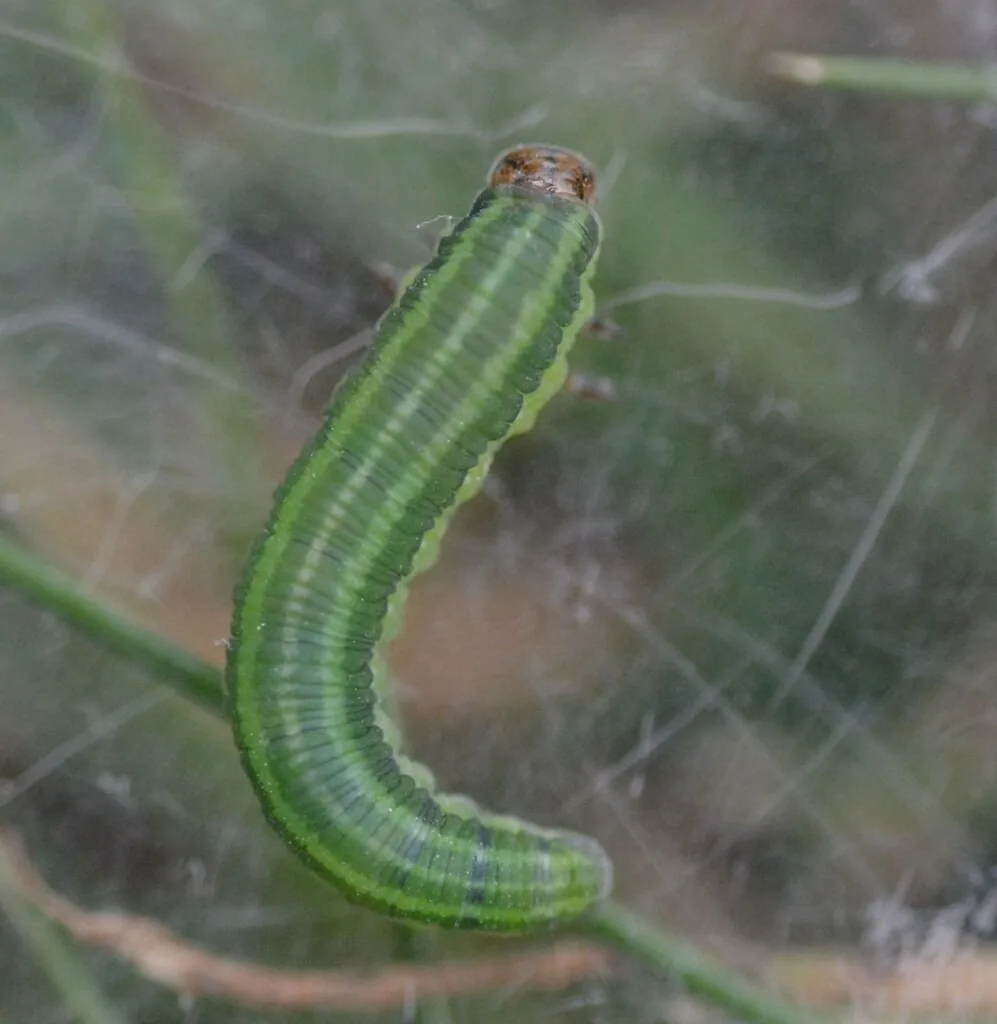
- Larvae are the stage most people notice. They start pale yellow and become dark green with five lengthwise white stripes as they mature, reaching 15 to 20 mm (about 0.6 to 0.8 inch). The head is black in young larvae and brown in older ones.[1]
- Larvae feed on one- to three-year-old needles rather than the new growth, so damage shows first in the lower crown and at stand edges, along with large, bright green frass pellets caught in the foliage or on the ground.[1][2]
- Eggs are pale green, 0.5 to 1.9 mm long, laid singly inside one-year-old needles.[1]
- Adults are black with yellow markings and 4.0 to 9.6 mm long. Almost all are females; the species is largely parthenogenetic, with roughly one male per 1,200 females.[1][2]
Look-alikes
| Look-alike | How to tell them apart |
|---|---|
| Yellowheaded spruce sawfly | If you find sawfly larvae on spruce, check these traits: European spruce sawfly larvae are dark green with five white lengthwise stripes, have a black (young) to brown (older) head, and feed on one- to three-year-old needles rather than the new growth.[1] |
| Eastern spruce budworm | The sawfly is told by its five white stripes and its habit of eating older needles first, starting in the lower crown. Aerial sprays aimed at spruce budworm in the 1970s killed the sawfly's introduced parasitoids and let it resurge briefly in New Brunswick.[1] |
| Introduced pine sawfly | A related introduced diprionid sawfly. The European spruce sawfly is the one on spruce: it feeds on most spruce species, with white and black spruce most affected in Canada.[1] |
Where it lives
Native to central and northern Europe and northern Asia as far east as Korea and Japan. In Canada it is recorded from Manitoba east through the Atlantic provinces, including Newfoundland and Labrador, and may occur in British Columbia and Alberta. In the United States it is recorded from Maine south to South Carolina and Georgia, and in Michigan, Minnesota and Washington.[1]
Biology and life cycle
It feeds on most spruce species. In Canada, black spruce and white spruce are most affected, with white spruce the preferred host; red, Colorado and Sitka spruce are also recorded hosts, and Norway spruce is the main host in its native range.[1][2]
There are one to three generations a year in North America, two being usual in Canada. The first generation emerges from May to June and lays eggs singly in needles; eggs hatch in about 10 days and larvae need about 40 days to finish feeding before dropping to the ground to pupate in the soil. A second generation emerges in July and August, so generations overlap.[1][2]
It overwinters as a prepupa in a cocoon in the litter or soil at the base of trees and can survive temperatures as low as -27 C. Some individuals stay underground through a second summer and emerge in the third year.[1][2]
Females lay about 35 to 60 eggs each in mature needles, and larvae pass through five instars. Reared larvae refused newly flushed Norway spruce needles entirely, probably because of their high quinic acid content, and fed only on old needles.[2][3]
Damage and signs
- Larvae strip old needles, which spruce cannot replace, reducing the tree's photosynthetic capacity. Young trees with little old foliage are most vulnerable; older trees can withstand significant defoliation every year for many years before dying, though height growth may be reduced for years afterward.[1]
- When old needles run out, larvae also eat new foliage, especially on white spruce, and heavily defoliated trees can be finished off by secondary pests such as bark beetles.[1]
- On Norway spruce in its native range the impact is minimal because only older needles are attacked; outbreaks have occurred on non-native hosts such as white spruce and Sitka spruce.[2]
Health risk
The sources describe the European spruce sawfly only as a spruce defoliator; none mentions any effect on people or pets.[1][2]
Control
Prevention
Outbreaks are now rare and short-lived, and most trees can sustain the defoliation for several years without dying, so in most cases no treatment is needed.[1]
Keep them out
The sawfly spreads on spruce plants for planting and in the soil and litter that comes with them, as well as by flight. Nursery stock is the most likely way it reached North America, so inspect new spruce for striped larvae and cocoons in the root zone.[2][1]
Traps and physical control
On small trees, pick the larvae off by hand.[1]
Biological control
Populations are regulated by a viral disease (a nuclear polyhedrosis virus) together with a parasitic fly and a parasitic wasp introduced during the 1930s biological control program, which released 26 predator and parasitoid species in Canada. Birds, small mammals and other invertebrate predators also take larvae and cocoons.[1][2]
Pesticides
Avoid broad-spectrum sprays that kill the parasitoids: when 1970s aerial spray programs for spruce budworm killed the two introduced parasites, the sawfly resurged temporarily in New Brunswick until the virus ended the outbreak.[1]
Common questions
- Are these the same as spruce budworm?
- No. Spruce budworm is a moth caterpillar that feeds on new shoots. European spruce sawfly larvae are dark green with five white stripes and eat one- to three-year-old needles, starting low in the crown.[1]
- Should I spray?
- Natural Resources Canada says outbreaks are rare and short-lived and most trees survive several years of feeding. Hand-removal works on small trees. Natural enemies, including a virus, keep the sawfly in check.[1][2]
- Why is my spruce losing old needles but keeping the tips green?
- The sawfly prefers older needles and leaves current growth alone unless the tree is heavily defoliated, so trees keep green tips while the interior thins.[1][2]
Sources
- Natural Resources Canada, Canadian Forest Service, “European spruce sawfly (C.J.K. MacQuarrie, 2025), Trees, insects, mites, and diseases of Canada's forests.” tidcf.nrcan.gc.ca/en/insects/factsheet/6555 (accessed 2026-11-10)
- European Food Safety Authority (EFSA Journal), “Pest categorisation of Gilpinia hercyniae (EFSA Panel on Plant Health, 2017, EFSA Journal 15(12):e05108).” doi.org/10.2903/j.efsa.2017.5108 (accessed 2026-11-10)
- Springer (Oecologia), “Variability of Norway spruce needles; performance of spruce sawflies, Gilpinia hercyniae (Jensen 1988, Oecologia 77:313-320).” doi.org/10.1007/BF00378036 (accessed 2026-11-10)
- iNaturalist, “Gilpinia hercyniae taxon page (order and family).” www.inaturalist.org/taxa/371190 (accessed 2026-11-10)