On this page
How to identify it
- Adults are shiny black beetles about 0.2 inch (4 mm) long. Seen from the side, the rear end curves inward and has a small central bump, larger in males.[1]
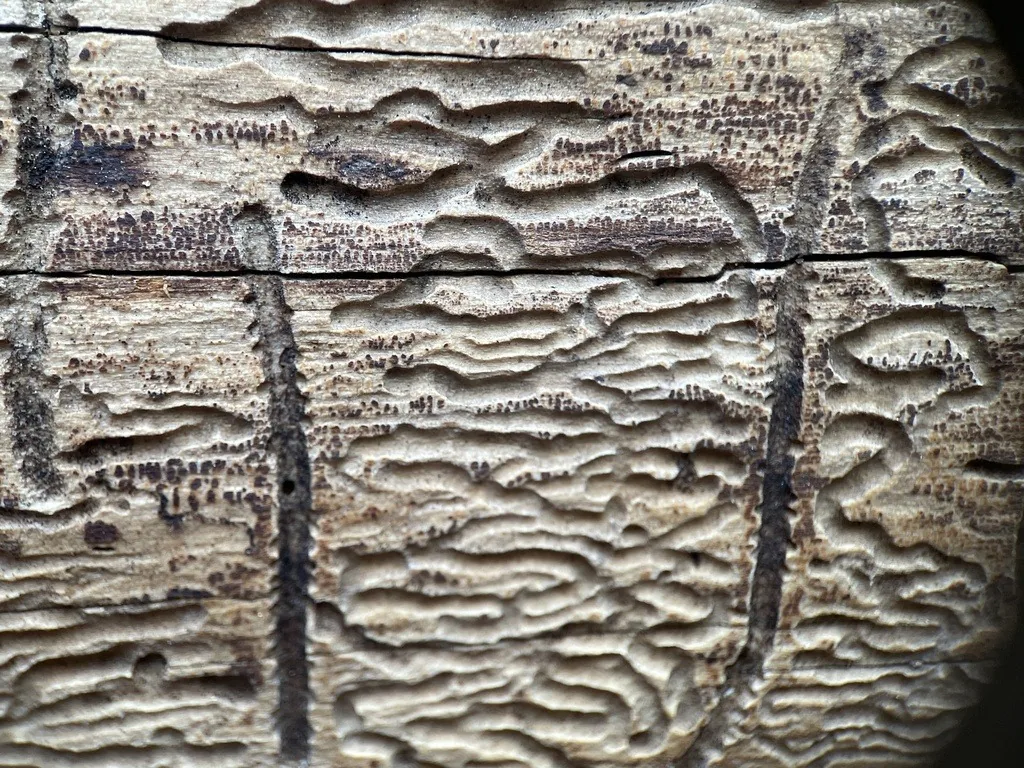
- Under the bark, the egg gallery runs across the grain, deeply engraving the sapwood with two arms from a central chamber, and the larval tunnels run up and down along the grain at right angles to it.[1][2]
- Entrance holes about 2 mm across appear along the main stem, usually where it is more than 4 inches thick, often in bark crevices or where branches meet the trunk. Look for reddish-brown or white boring dust in crevices and cobwebs and streams of clear pitch running down from the holes; firs don't form the creamy pitch tubes seen on attacked pines.[1]
- The first easily seen sign is 'flagging': yellow or red branches scattered through a green crown. A yellowish-brown stain spreads around each gallery from a fungus the beetles carry.[1]
Look-alikes
| Look-alike | How to tell them apart |
|---|---|
| Roundheaded and flatheaded fir borers | These wood borers often attack the same trees, but their winding larval galleries are mostly in the lower, thick-barked part of the trunk; the fir engraver's egg galleries run across the grain.[1] |
Where it lives
Found from British Columbia south to Baja California and east to the Rocky Mountains, matching the range of white, grand and red fir. In California landscapes UC IPM notes it attacks white and red fir at high elevations.[1][2]
Biology and life cycle
Hosts are mainly white fir, grand fir and red fir; it occasionally attacks Douglas-fir, subalpine fir, mountain hemlock and Engelmann spruce, as well as freshly cut logs and recently windthrown trees.[1][2]
Adults fly from June to September, mostly in July and August. If the first beetles bore in without being drowned in pitch, they release an attractant that draws many more. Such mass attacks are most likely on trees already stressed by drought, defoliation, crowding, dwarf mistletoe or root disease, and they kill the tree.[1]
The female enters first and, after mating, cuts an egg gallery 4 to 12 inches long, laying 100 to 300 eggs in niches along it over 5 to 7 weeks. Eggs hatch in 9 to 14 days, and the larvae molt six times.[1]
Winter is spent mainly as young or mature larvae under the bark. In spring they feed briefly, pupate for 7 to 14 days, and the adults emerge about 2 weeks later.[1][2]
Usually there is one generation a year. Warm sites can have one plus a partial second, and cool sites, such as north-facing slopes above 6,000 feet in the Sierra Nevada, need 2 years.[1][2]
Clerid beetles, a braconid wasp, a mite, a nematode and woodpeckers feed on the brood and sometimes destroy much of it, but they don't prevent outbreaks.[1]
Damage and signs
- Attacks in the crown girdle branches and kill them. Many attacks over part or all of the trunk can kill the top or the whole tree in a single summer, and the foliage turns yellow and then red over the 3 to 6 months after the attack.[1]
- Sometimes only strips or patches of the trunk are attacked. Such trees can recover, and top-killed trees can grow new leaders; a brown pitch pocket, roughened bark, or scattered dead branches girdled at the base mark the old injuries.[1]
- Outbreaks come at irregular intervals, some during droughts and others after defoliating insects. In 1977-78 the fir engraver killed an estimated 1.2 million trees on national forests in northern California.[1]
Health risk
The Forest Service and UC IPM describe it only as a pest of firs; neither mentions any risk to people or pets.[1][2]
Control
Prevention
Keep firs vigorous: irrigate properly to avoid drought stress, avoid compacting soil or injuring roots and trunks, and thin dense groups of trees so the remaining ones compete less.[2][1]
Sanitation
Remove diseased, injured or declining trees, and remove windthrown trees and cut logs within the year, before beetles can produce new broods in them.[1]
Traps and physical control
The brood in an individual infested tree can be destroyed by felling it and burning or peeling and burning the bark, by leaving the limbed logs in full sun and rolling them every few days, or by submerging the logs in water for at least 6 weeks.[1]
Pesticides
The Forest Service also lists felling an infested tree and spraying the trunk with insecticide using a low-pressure sprayer. UC IPM notes that insecticides won't save heavily infested trees.[1][2]
Common questions
- Why does my white fir have scattered red branches?
- Red or yellow 'flags' in a green crown are the first easily seen sign of fir engraver attack; the beetle's galleries girdle the branches.[1]
- Will my fir die?
- Not always. Trees attacked only in strips or patches can recover, and top-killed trees can grow new leaders, but heavy attacks can kill a stressed tree in one summer.[1]
- When do the beetles fly?
- From June to September, mostly in July and August.[1]
Sources
- USDA Forest Service, “Fir Engraver (Forest Insect & Disease Leaflet 13).” www.fs.usda.gov/foresthealth/docs/fidls/FIDL-13-FirEngraver.pdf (accessed 2026-11-08)
- University of California Statewide IPM Program, “Pest Notes: Bark Beetles (Publication 7421).” ipm.ucanr.edu/PMG/PESTNOTES/pn7421.html (accessed 2026-11-08)
- iNaturalist, “Scolytus ventralis taxon page (order and family).” www.inaturalist.org/taxa/194135 (accessed 2026-11-08)