On this page
How to identify it
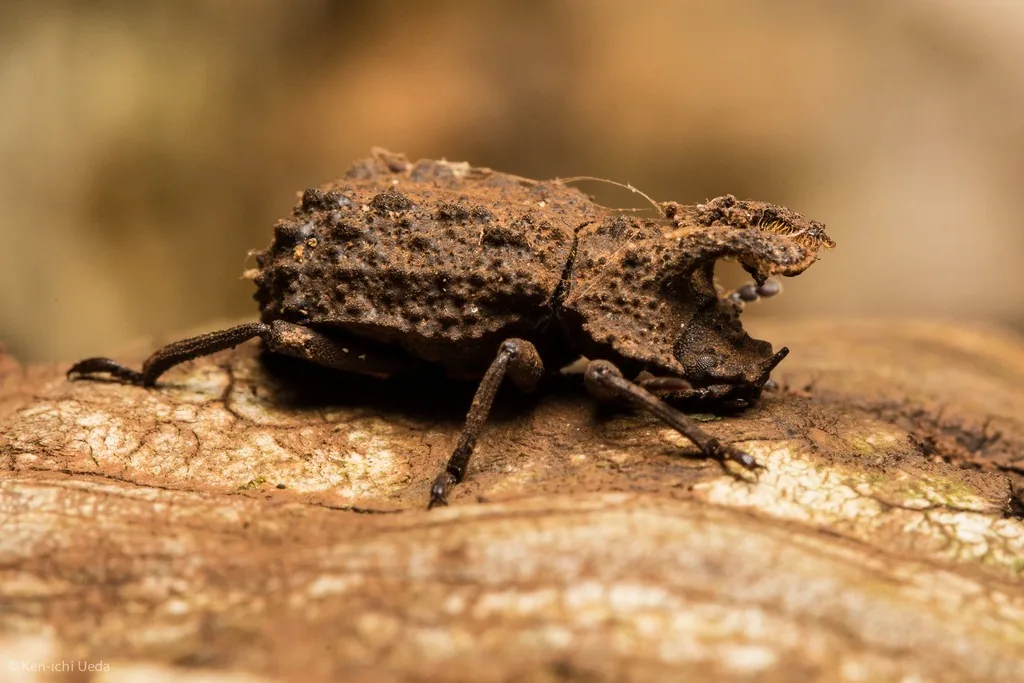
- Adults are 10 to 12 mm long (about 3/8 to 1/2 inch) and 3.5 to 4 mm wide, dull black to brown, with an elongate body that is rectangular in cross section.[1]
- The pronotum is roughly sculptured with rounded bumps, and the wing covers have rows of large and small irregular tubercles.[1]
- Males have two horns projecting forward from the pronotum, ending in a brushlike tip and lined underneath with dense yellow to orange hairs, plus a pair of smaller horns on the front of the head. Females have no horns, only two small bumps on the pronotum.[1][2]
- The larvae are white and cylindrical, with fine transparent hairs and a darker, rounded head.[1]
Where it lives
It is native to eastern North America. UF/IFAS lists records from New York, Connecticut, Massachusetts, Michigan, Ohio, Indiana, Wisconsin and Florida, extending into eastern Canada.[1][2]
Biology and life cycle
Adults and larvae live on three main shelf fungi that grow on decaying deciduous trees: Ganoderma applanatum, Ganoderma tsugae and Fomes fomentarius. They feed on the tissue and spores of the fungus.[2][1]
Females lay single eggs on the fungus and cover each with a dark secretion. The eggs hatch in about 16 days, and the larvae tunnel into the fungus, where they feed and later pupate.[1][2]
Larvae often spend the winter inside the fungus and become adults the next summer; some adults emerge in late summer and overwinter in the fungus or under bark. Females lay eggs in summer.[1]
Adults can live up to eight years and may stay on the fungus brackets of the same tree for many of those years.[1][2]
By day adults hide under bark or inside the bracket. They are most active at dusk and in early morning, and feeding and mating take place on the surface of the bracket, mostly at night.[1][2]
A courting male climbs onto a female's back facing the opposite way, and rival males use their horns to pry him off. Horn length does not seem to help a male hold food or breeding sites, but it does increase his mating success.[1]
Because its populations depend on decaying logs that carry its host fungi, the beetle has been used to study the effects of habitat fragmentation.[1]
Damage and signs
Health risk
When poked, adults play dead. When exposed to the breath of a mammal, they raise the abdomen and release irritating chemicals from abdominal glands; one researcher described the secretion as having a pungent odor and a burning, bitter, nauseating taste.[1]
Control
Prevention
No control is needed: it lives on shelf fungi growing on decaying logs, and its populations rise and fall with the logs and fungi it depends on.[1][2]
Common questions
- What are the forked fungus beetle's horns for?
- Males use them in competition over females. A rival male uses his horns like a wedge or bottle opener to pry a courting or mating male off a female, and males with longer horns have greater mating success.[1]
- How long does a forked fungus beetle live?
- A long time for an insect: adults can live up to eight years, often staying on the brackets of one tree.[1][2]
- Where can I find forked fungus beetles?
- Look on shelf fungi such as Ganoderma and Fomes growing on decaying deciduous logs, especially at dusk or early morning. During the day they hide under bark or inside the bracket.[2][1]
Sources
- University of Florida IFAS Extension (Featured Creatures), “Forked Fungus Beetle (suggested common name) Bolitotherus cornutus (Panzer) 1794, EENY-698 (U. Somjee and A. Lucky; December 2017).” journals.flvc.org/edis/article/view/105377 (accessed 2026-11-09)
- Ecology and Evolution (Wiley), full text in PubMed Central (PMC12353013), “Jiron et al. Male Mating Preference for Larger Females Does Not Vary Among Age Classes in the Long-Lived Beetle Bolitotherus cornutus. Ecology and Evolution 15: e71958 (2025), doi:10.1002/ece3.71958.” doi.org/10.1002/ece3.71958 (accessed 2026-11-09)
- iNaturalist, “Bolitotherus cornutus taxon page (order and family).” www.inaturalist.org/taxa/53814 (accessed 2026-11-09)