On this page
How to identify it
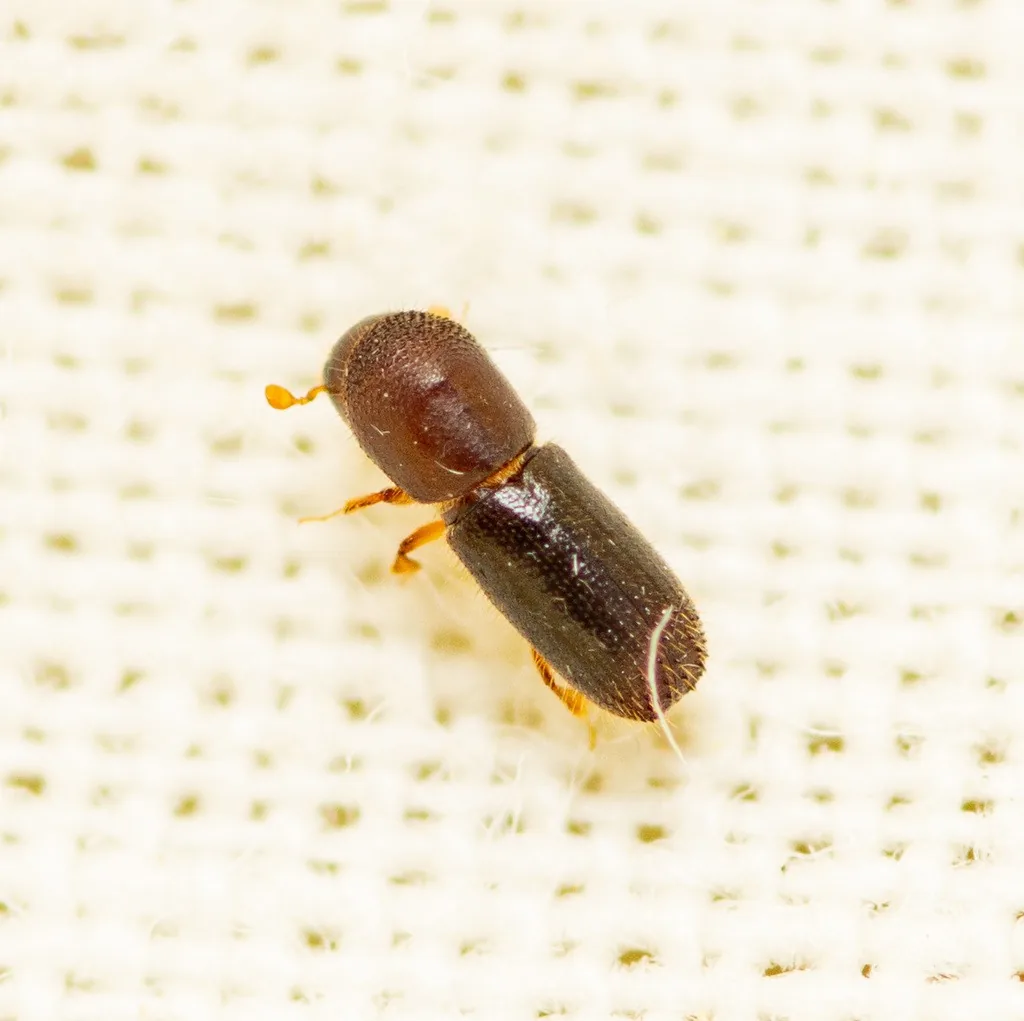
- Females are 1.9 to 2.4 mm long and reddish-brown to black, with small spines on the sloping rear of the wing covers and a cone-shaped, hairy scutellum (the small triangle between the wing covers).[1]
- The body is thinly covered in hairs. Males are smaller, 1.6 to 1.8 mm, cannot fly and are much rarer than females.[2]
- Adults are cylindrical, and the head is tucked under the thorax so it is hard to see from above.[3]
- As the beetles bore in, their frass sticks out of the trunk like little toothpicks.[3]
Look-alikes
| Look-alike | How to tell them apart |
|---|---|
| Granulate ambrosia beetle (Xylosandrus crassiusculus) | Larger, about 3 mm, with a hairy, dull, bumpy rear slope on the wing covers and front leg bases set apart instead of touching.[1] |
| Black stem borer and other Xylosandrus ambrosia beetles | Separated by microscope features such as the front leg bases, the rear slope of the wing covers and the scutellum; UGA's field guide illustrates each species.[1] |
Where it lives
Originally from Europe, it is now recorded across Eurasia and in Australia, South America and Canada (British Columbia and Ontario). It has been recorded in 34 US states, including Texas, Utah, Washington and several Idaho counties.[2]
Biology and life cycle
Females tunnel straight into the sapwood for 3 to 5 cm and widen the end into a chamber where they lay up to 100 eggs. Unlike the other ambrosia beetles in Idaho, which raise each larva in its own cradle, its larvae share one chamber.[2]
The larvae feed on an ambrosia fungus that the parents bring into the tunnel. Females sometimes get into a tree through tunnels made by other bark beetles.[2]
In warm areas a generation takes one to two months. Females can produce male offspring without mating.[2]
They usually overwinter as mature larvae or newly emerged adults, and females start flying to new trees when temperatures reach about 21 C (70 F).[3]
Females of this and other ambrosia beetles are commonly attracted to alcohol-baited traps.[1]
Damage and signs
Health risk
It lives inside trees and feeds on fungus in its tunnels; the sources describe no risk to people.[2][3]
Control
Prevention
Keeping trees healthy is generally the best defense, since the beetle prefers stressed or declining trees.[3]
When to call a professional
Chemical control may not be possible once beetles are in the wood. Ask your local cooperative extension office for current management advice.[3]
Common questions
- What are the little sawdust toothpicks sticking out of my tree?
- Frass from boring ambrosia beetles such as the fruit-tree pinhole borer looks like small toothpicks sticking from the trunk.[3]
- Can it kill a healthy tree?
- It usually attacks trees that are already diseased, unhealthy or stressed, which is why keeping trees healthy is the main recommendation.[3]
- How do I know it is this beetle and not the granulate ambrosia beetle?
- Size and a few microscope features: this species is 1.9 to 2.4 mm with touching front leg bases, while the granulate ambrosia beetle is about 3 mm with separated front leg bases.[1]
Sources
- University of Georgia Cooperative Extension, “Field Guide to Ambrosia Beetles of Agricultural Importance in the Eastern and Southern United States (Circular 1239).” fieldreport.caes.uga.edu/publications/C1239/field-guide-to-ambrosia-beetles-of-agricultural-importance-in-the-eastern-and-southern-united-states/ (accessed 2026-11-10)
- University of Idaho, Idaho Forest, Wildlife and Range Experiment Station, “Furniss and Johnson. Field Guide to the Bark Beetles of Idaho and Adjacent Regions, Station Bulletin 74 (2002).” objects.lib.uidaho.edu/fwres/fwres201.pdf (accessed 2026-11-10)
- University of Georgia Center for Invasive Species and Ecosystem Health (Bugwood), “Xyleborinus saxeseni (Bugwoodwiki).” wiki.bugwood.org/Xyleborinus_saxeseni (accessed 2026-11-10)
- iNaturalist, “Xyleborinus saxesenii taxon page (order and family).” www.inaturalist.org/taxa/409196 (accessed 2026-11-10)