On this page
How to identify it
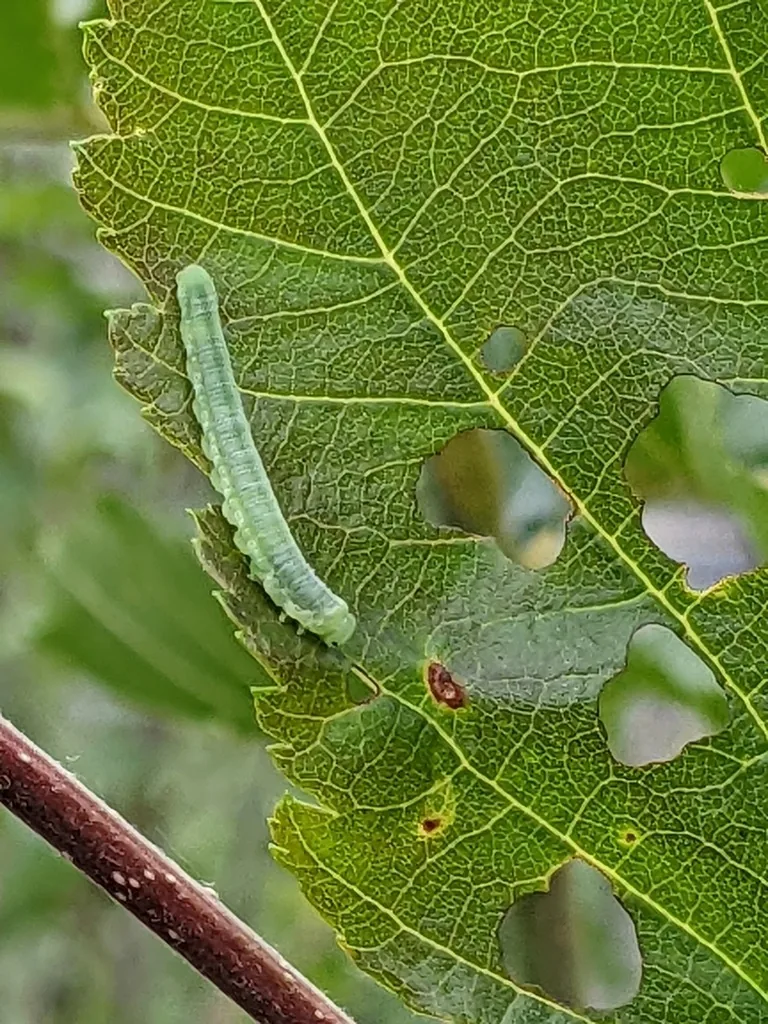
- Larvae hatch cream-colored to very pale green and turn a vivid bluish green as they grow; full-grown larvae can exceed 18 mm (about three quarters of an inch). They feed singly on the underside of the leaf, though at high densities five or more may share a leaf.[1]
- Early feeding punches numerous small holes in the leaf, a shotgun or shot-hole pattern; as the larvae grow the holes merge until only the stout veins and midrib are left, and the attacked shrub looks thin and brownish from the ground or the air. The damage is very like that of the native alder flea beetle and striped alder sawfly.[1][2]
- It is the first of the alder sawflies to appear in spring: egg laying starts in mid-May at about 60 F, as the alder leaves are just flushing, with eggs placed on the upper leaf surface. The woolly and striped alder sawflies do not emerge until mid to late June.[1]
- Mature larvae bore into stumps, broken branches and down logs and spend the winter there, a habit thought unique to the genus; the native alder sawflies burrow into the soil instead.[1][2]
Look-alikes
| Look-alike | How to tell them apart |
|---|---|
| Woolly alder sawfly | Another alder sawfly whose larvae wear a white, waxy, hair-like coat until the last instar; green alder sawfly larvae are naked and bluish green, lay eggs on the upper leaf surface rather than the underside midrib, and emerge a month earlier.[1] |
| Striped alder sawfly | A native alder sawfly whose yellowish to greenish-brown larvae carry two black side stripes and feed in groups; green alder sawfly larvae are plain bluish green and feed individually, and the striped species lays its eggs along the leaf petiole.[1][2] |
| Woolly alder aphid | The green alder sawfly is a chewing larva that riddles and skeletonizes alder leaves; it produces no white woolly covering.[1] |
| Alder flea beetle | A native leaf feeder whose shot-hole damage on red alder looks very similar; the green alder sawfly is a bluish-green, caterpillar-like larva that pupates in dead wood.[2][1] |
Where it lives
Established across southcentral and Southeast Alaska on thin-leaf and other alders, and detected in 2010 near Vancouver, Washington; cooperative trapping in Oregon, Washington, Idaho and Montana found it widely distributed across 27 counties, and museum specimens suggest it has been in the region since at least the mid-1990s.[1][2]
Biology and life cycle
Hosts in Alaska are all species of alder; in the Pacific Northwest it feeds on red alder, where defoliation has been minor. Eggs laid in mid-May hatch in one to two weeks, and the larvae move to the lower leaf surface and eat the soft tissue between the veins.[1][2]
When full grown the larvae excavate chambers in dead or decaying wood, in stumps, broken branches and down logs, and overwinter there before emerging early the next spring. Oregon notes this habit may have helped the insect spread in firewood.[1][2]
Two or even all three alder sawflies can share one plant, or one leaf. In Alaska the green alder sawfly's larval biomass on riparian alder peaks in midsummer.[1][3]
Damage and signs
- Alder, like most hardwoods, withstands several seasons of severe defoliation with no more than growth loss and occasional branch dieback, but severe defoliation can cut an alder stand's nitrogen contribution to the soil by more than 70 percent a year, and mortality has followed five or more consecutive severe seasons in other defoliator outbreaks.[1]
- Thin-leaf alder is mainly a riparian shrub along salmon streams. A study in southcentral Alaska found that the invasive sawfly changed the makeup and timing of the terrestrial insects falling into streams, with sawfly biomass peaking in midsummer, though it did not reduce the biomass of native insects, and juvenile coho salmon ate the sawflies only when they were most abundant.[3]
- Oregon's 2011 survey concluded the sawfly does not appear to threaten red alder, since defoliation where it was found had been relatively minor.[2]
Health risk
The sources mention no effect on people or pets; the adult is a small wasp whose larvae feed only on alder leaves.[1][3]
Control
Prevention
Homeowners do not normally have problems with alder-defoliating sawflies, and because infested thin-leaf alders usually stand along ecologically sensitive salmon streams, where some insecticides harm aquatic insects, they are generally excluded from spray programs.[1]
Sanitation
Because the larvae overwinter in dead wood and the insect may have spread in firewood, avoid moving alder firewood and woody debris out of infested areas.[2][1]
Traps and physical control
For a small group of infested alders on a property, effective control is hand-picking the larvae from the leaves or knocking them off with a strong jet of water, repeated several times through the summer.[1]
Common questions
- What is eating shot-holes in my alder leaves in late May?
- The first alder sawfly active in spring is the green alder sawfly, which lays eggs in mid-May as the leaves flush. Look for small bluish-green larvae on the undersides of the leaves; the native woolly and striped alder sawflies do not appear until mid to late June.[1]
- Is this sawfly going to kill my alders?
- Alders tolerate several years of heavy defoliation with only slower growth and some branch dieback; in Oregon, red alder has suffered only minor defoliation from it. Mortality has been seen in other alder defoliator outbreaks only after five or more consecutive severe years.[1][2]
- How is it different from the native alder sawflies?
- The green alder sawfly emerges a month earlier, lays eggs on the top of the leaf, has naked bluish-green larvae, and winters inside stumps, branches and logs instead of the soil. The striped alder sawfly feeds in groups and has black side stripes; the woolly alder sawfly larva is covered in white waxy hairs.[1][2]
Sources
- USDA Forest Service, Alaska Region, “Alder Defoliators (Forest Health, Alaska Region; updated February 2026).” www.fs.usda.gov/r10/natural-resources/forest-health/alder-defoliators (accessed 2026-11-10)
- Oregon Department of Forestry with USDA Forest Service Pacific Northwest Region, “Forest Health Highlights in Oregon - 2011 (May 2012), green alder sawfly entry.” www.oregon.gov/odf/documents/forestbenefits/fhh-report-2011.pdf (accessed 2026-11-10)
- U.S. Geological Survey (Ecology of Freshwater Fish), “Riparian defoliation by the invasive green alder sawfly influences terrestrial prey subsidies to salmon streams (D.A. Roon, M.S. Wipfli and J.J. Kruse, Ecology of Freshwater Fish, 2018) (abstract, USGS publications).” www.usgs.gov/publications/riparian-defoliation-invasive-green-alder-sawfly-influences-terrestrial-prey-subsidies (accessed 2026-11-10)
- iNaturalist, “Monsoma pulveratum taxon page (order and family).” www.inaturalist.org/taxa/479447 (accessed 2026-11-10)