On this page
How to identify it
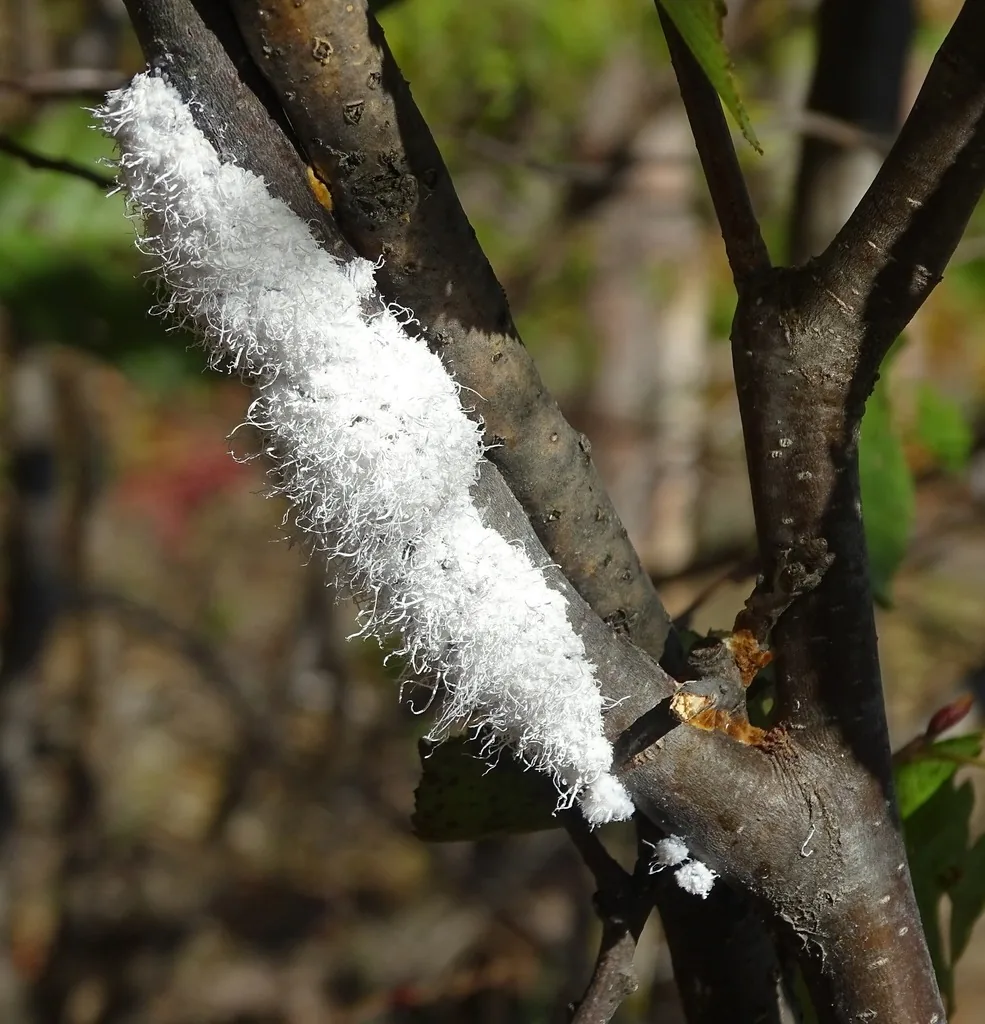
- Colonies look like dense masses of white wool or cotton on the leaves and twigs of silver maple in May and June, and on the branches and stems of alder later in the season.[1][2]
- Under the wax, the aphids on the maples are wingless, plump and gray.[1]
- Winged adults, some with their abdomens wrapped in white fluffy wax, take off readily when disturbed and drift like little cotton puffs. Caught gently, one shows a plump bluish-black body and clear wings towing the cottony tuft.[1]
- Another common name, maple blight aphid, comes from the white woolly masses it makes on silver maple.[1]
Where it lives
It needs both of its hosts, silver maple (occasionally red maple) and alder. Iowa State Extension reports it in Iowa, and Maine's Department of Agriculture, Conservation and Forestry reports it on speckled alder in Maine yards.[1][2]
Biology and life cycle
Eggs spend the winter in sheltered spots on silver maple bark and hatch in spring, and the young aphids feed on the tender new leaves.[2]
All the aphids on the maples in spring are females that reproduce without mating, essentially cloning themselves, so colonies grow quickly. They feed on maple sap from bud-break until late June.[2][1]
In early summer winged aphids leave the maples and fly to alder, in Maine usually speckled alder, where they start new colonies.[1][2]
As days shorten in fall, winged males and females fly back to silver maple, mate and lay the overwintering eggs. The aphid needs both maple and alder to complete its life cycle.[2][1]
Damage and signs
- Some infested maple leaves droop or fold downward, shrivel and drop early, but the aphids cause no permanent damage and do not reduce the vigor of healthy trees. Alders are not harmed either.[1]
- Honeydew and the sooty mold that grows on it have been a problem on cars and buildings under heavily infested trees in other parts of the country, though Iowa State notes not in Iowa.[1]
Health risk
None noted. Iowa State calls the flying adults intriguing, not harmful.[1]
Control
Prevention
No spraying is needed. Both Iowa State and Maine's agriculture and forestry department advise leaving the aphids alone because they do no lasting damage, and by the time the cottony winged adults are flying, their feeding on the maples is finished.[1][2]
Biological control
Leave the colonies for the insects that eat them: lacewings, lady beetles and their larvae, hover flies, parasitic wasps and the caterpillars of the harvester butterfly, the only butterfly in the continental United States whose larvae must eat other insects.[1][2]
Common questions
- What are the little white fuzz balls flying around my yard?
- In early summer they may be winged woolly alder aphids leaving silver maples for alders. Each is a small bluish-black aphid with clear wings carrying a tuft of white wax.[1]
- Will woolly alder aphids hurt my silver maple?
- No. A few leaves may droop, shrivel and drop early, but the aphids cause no permanent damage and healthy trees keep their vigor.[1]
- Why do I see the cottony aphids on alder?
- Alder is the aphid's summer host. Winged aphids fly there from silver maple, start new colonies on the branches and stems, and return to maple in fall to lay eggs.[1][2]
Sources
- Iowa State University Extension and Outreach, “Woolly Alder Aphid, Yard and Garden encyclopedia.” yardandgarden.extension.iastate.edu/encyclopedia/woolly-alder-aphid (accessed 2026-11-08)
- Maine Department of Agriculture, Conservation and Forestry, “Post-Script on Insect and Disease Conditions Report on October 3, 2023: Woolly Alder Aphid (Prociphilus tessellatus).” content.govdelivery.com/accounts/MEDACF/bulletins/3745a36 (accessed 2026-11-08)
- iNaturalist, “Prociphilus tessellatus taxon page (order and family).” www.inaturalist.org/taxa/143427 (accessed 2026-11-08)