On this page
How to identify it
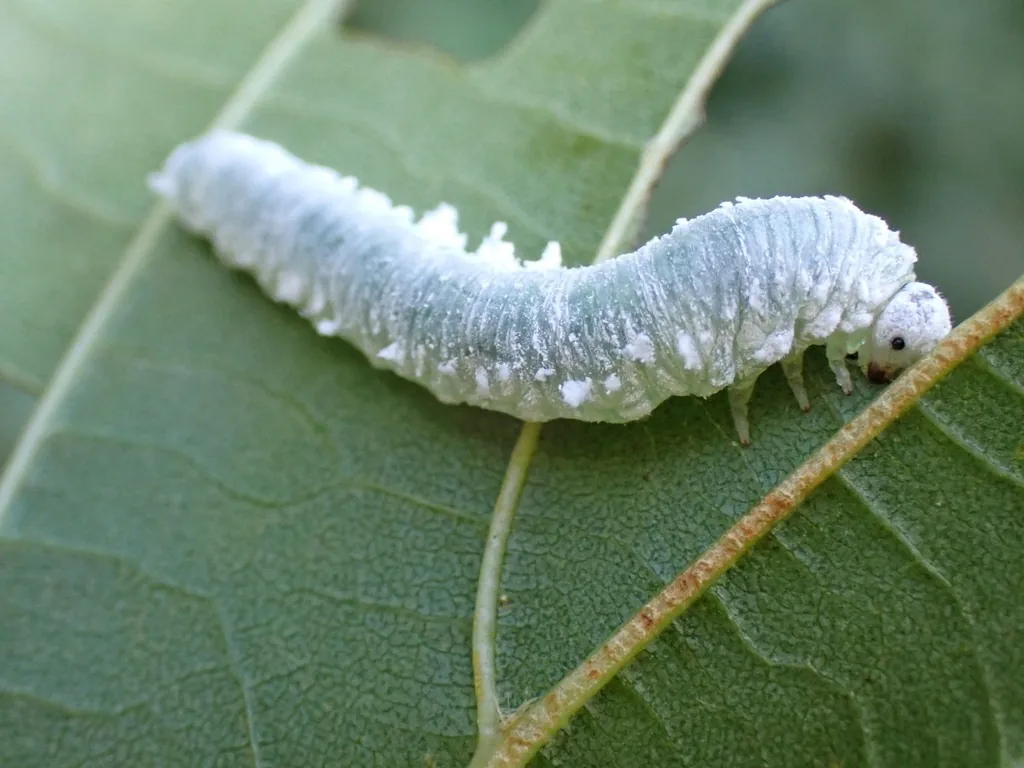
- Larvae are covered in a white, waxy, hair-like secretion that becomes denser as they grow; the coat is shed in the last instar to reveal a very pale green body. Mature larvae are 13 to 16 mm (about half an inch) long.[1][2]
- Feeding begins as numerous small holes punched in the leaf by the small larvae, a shotgun pattern; older larvae consume the whole leaf except the main veins and midrib, and a heavily attacked shrub looks thin and brownish.[2][1]
- The adult is a small sawfly 6 to 7 mm long with a black body and a red pronotum (the plate just behind the head). Adults emerge in mid to late June in Alaska and lay eggs on the underside of the leaf, along and into the midrib.[2][1]
- The larvae feed singly, though at high densities five or more may share one leaf, sometimes alongside green or striped alder sawfly larvae on the same plant.[1]
Look-alikes
| Look-alike | How to tell them apart |
|---|---|
| Green alder sawfly | An alder sawfly whose larvae are naked and bluish green, emerge a month earlier in mid-May, and winter inside dead wood; the woolly alder sawfly larva is coated in white wax and winters in a soil chamber.[1] |
| Striped alder sawfly | An alder sawfly whose yellowish to greenish-brown larvae have two black side stripes and feed in groups; woolly alder sawfly larvae feed individually under a white waxy coat.[1] |
| Woolly alder aphid | The woolly alder sawfly is a chewing larva that makes shot-holes in alder leaves and skeletonizes them, and it sheds its white waxy coat in the last instar before dropping to the soil.[1][2] |
Where it lives
Recorded on alders in Southcentral Alaska, including the Matanuska and Knik River area and Potter Marsh south of Anchorage, and in Nova Scotia, where it is treated as a non-native pest of the Acadian forest.[1][2]
Biology and life cycle
Hosts are alders. Adults fly from late spring to midsummer, emerging in Alaska in mid to late June, and begin laying at once; egg laying continues for several weeks as new adults appear. Eggs hatch in one to two weeks.[1][2]
Larvae feed openly on the leaves through the summer. When full grown they drop to the ground, burrow into the soil beneath the leaf litter and dig a small chamber 1 to 4.5 cm deep, where they pass the winter as prepupae. They pupate when the ground warms in spring and emerge as adults.[1][2]
Damage and signs
- Alder, like most hardwoods, withstands several seasons of severe defoliation with no more than growth loss and occasional branch dieback; Nova Scotia likewise lists growth loss and possible branch dieback as the consequences.[1][2]
- In Alaska's 2025 surveys the woolly alder sawfly caused pockets of severe damage, 68 to 75 percent of foliage, in Southcentral Alaska, although most alder damage statewide was light.[1]
- Severe defoliation can cut an alder stand's nitrogen contribution to the soil by more than 70 percent a year, and in other alder defoliator outbreaks mortality has followed five or more consecutive severe seasons.[1]
Health risk
The sources mention no effect on people or pets; the insect feeds only on alder leaves.[1][2]
Control
Prevention
Damage from this insect does not require insecticide use, and homeowners do not normally have problems with alder-defoliating sawflies. Many infested alders stand along salmon streams where some insecticides would harm aquatic insects.[2][1]
Traps and physical control
On a small group of alders, hand-pick the larvae from the leaves or knock them off with a strong jet of water, repeating several times through the summer as needed.[2][1]
Common questions
- What are the white fuzzy caterpillars on my alder?
- Larvae of the woolly alder sawfly. The white fuzz is a waxy, hair-like secretion the larva produces; it is shed in the final instar to expose a pale green body before the larva drops to the soil.[1][2]
- Do I need to spray?
- No. Nova Scotia's forest pest guide says the damage does not call for insecticides, and alders tolerate several years of heavy defoliation. Hand-picking or a hard spray of water, repeated as needed, handles a small planting.[2][1]
- When does it show up?
- Adults emerge in mid to late June in Alaska, about a month after the green alder sawfly, and the larvae feed through summer. The prepupae winter in small chambers in the soil under the litter.[1][2]
Sources
- USDA Forest Service, Alaska Region, “Alder Defoliators (Forest Health, Alaska Region; updated February 2026).” www.fs.usda.gov/r10/natural-resources/forest-health/alder-defoliators (accessed 2026-11-10)
- Nova Scotia Department of Natural Resources, “A Field Guide to Pests of the Acadian Forest (Report FOR 2017-14), alder woolly sawfly entry.” novascotia.ca/natr/woodlot/pdf/Woodlot-Field-Guide-to-Pests-of-the-Acadian-Forest.pdf (accessed 2026-11-10)
- iNaturalist, “Eriocampa ovata taxon page (order and family).” www.inaturalist.org/taxa/418164 (accessed 2026-11-10)