On this page
How to identify it
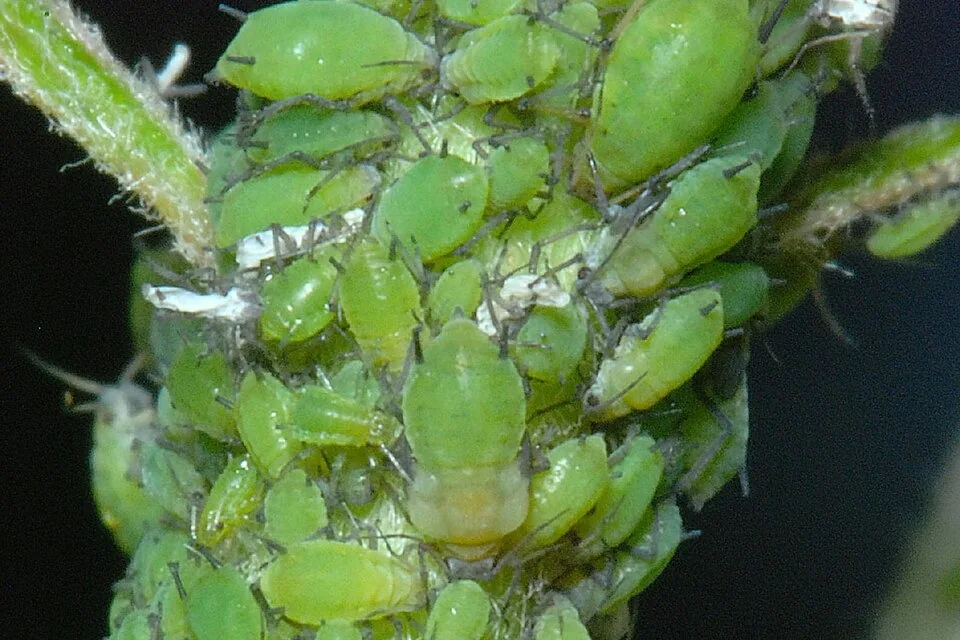
- Wingless adults have green bodies and pale brown heads and are about 1/12 inch (2 mm) long. Winged forms have clear wings.[1]
- Newly hatched aphids are dark green. In spring and summer, mature aphids on apple leaves have a bright yellow-green abdomen with darker green spots along the sides.[2][3]
- Overwintering eggs are shiny, black and football-shaped, laid on twigs of the previous season's growth and on fruit spurs. They look exactly like rosy apple aphid eggs.[2][1]
- Colonies sit on succulent terminal growth and water sprouts and, when severe, on the fruit.[2][1]
Look-alikes
| Look-alike | How to tell them apart |
|---|---|
| Spirea aphid | Looks and behaves so much like the green apple aphid that NC State manages the two the same way.[1] |
| Apple grain aphid | Light green with a distinct green stripe down the middle of the back. It infests apple buds early in the season and is typically not economically damaging.[3] |
| Rosy apple aphid | Rose-purple, and it spends part of its life cycle on plantain. Its feeding causes severe leaf curling, and its eggs look the same as green apple aphid eggs.[3][1][2] |
Where it lives
Widely distributed. NC State calls it very common in North Carolina, UC IPM says it shows up in most California apple orchards every year, and the Pacific Northwest handbook covers it in that region's apples.[1][2][3]
Biology and life cycle
Apple is the preferred host. It also feeds on pear and occasionally on hawthorn, loquat, pyracantha and quince.[2][1]
Eggs hatch around silver tip into wingless females called stem mothers, which feed on new buds and leaves and give birth to live young without mating. Generation follows generation this way, and winged forms appear as summer goes on.[1]
Late in the season, winged aphids move to other apple trees or host plants and produce males and egg-laying females. After mating, the females lay the eggs that carry the species through winter.[1]
Numbers swing widely from year to year.[2]
Damage and signs
- Aphids suck sap from leaves near the newest part of the shoot. Heavy feeding curls and discolors developing foliage, and on young trees can seriously slow growth and make shoot growth irregular.[1][2]
- Honeydew from heavy infestations coats leaves and fruit and grows black sooty mold, which hinders leaf function and lowers fruit grade.[2][1][3]
- Aphids feeding on immature apples can stunt and deform them; on mature apples feeding causes russeting. The PNW handbook notes it may be more of a problem on green and yellow apple varieties.[1][3]
- On mature trees, even high populations usually do not affect fruit quality or yield.[1]
Health risk
The sources describe it only as a pest of fruit trees; none mentions any risk to people or pets.[1][2][3]
Control
Prevention
Check growing shoots and water sprouts through early summer. NC State acts when half the sampled terminals carry wingless aphids; UC IPM says to assess predators when more than 45% of shoots are infested and that treatment may be warranted at 60% or more. Identify the aphid first, since apple grain and green apple aphids are typically less damaging.[1][2][3]
Liberal nitrogen fertilizing produces the succulent growth aphids prefer and tends to raise their numbers.[3]
Traps and physical control
Home orchardists can wash aphids off with a strong stream of water or wipe them off by hand.[3]
Biological control
Lady beetles, green and brown lacewings, syrphid fly larvae and parasitic wasps often keep it in check. Avoid broad-spectrum insecticides that disrupt them.[2][1][3]
Pesticides
A delayed-dormant oil spray prevents early injury and should remove the need for later sprays. Insecticidal soap, narrow-range oils and azadirachtin are acceptable in organic orchards. Young trees with severe spring infestations may need treatment.[2]
Common questions
- What are the green aphids on my apple tree's new shoots?
- Often green apple aphids or the near-identical spirea aphid. Both crowd onto tender tips and water sprouts in spring and early summer and are managed the same way.[1]
- Will green apple aphids ruin my apple crop?
- Usually not on mature trees. Heavy infestations can leave honeydew and sooty mold that lower fruit grade, and young trees suffer more.[1][2]
- How do I control green apple aphids without harsh sprays?
- Let lady beetles, lacewings and syrphid flies work, wash colonies off with water, avoid heavy nitrogen fertilizing, and use a delayed-dormant oil spray to head off early injury.[2][3]
Sources
- NC State Extension, “Green Apple Aphid / Spirea Aphid.” content.ces.ncsu.edu/green-apple-aphid-spirea-aphid (accessed 2026-11-09)
- University of California Statewide IPM Program, “Green Apple Aphid, UC IPM Pest Management Guidelines: Apple.” ipm.ucanr.edu/agriculture/apple/green-apple-aphid (accessed 2026-11-09)
- Pacific Northwest Pest Management Handbooks (Oregon State University, Washington State University and University of Idaho Extension), “Apple-Aphid, Pacific Northwest Insect Management Handbook.” pnwhandbooks.org/insect/tree-fruit/apple/apple-aphid (accessed 2026-11-09)
- iNaturalist, “Aphis pomi taxon page (order and family).” www.inaturalist.org/taxa/133474 (accessed 2026-11-09)