On this page
How to identify it
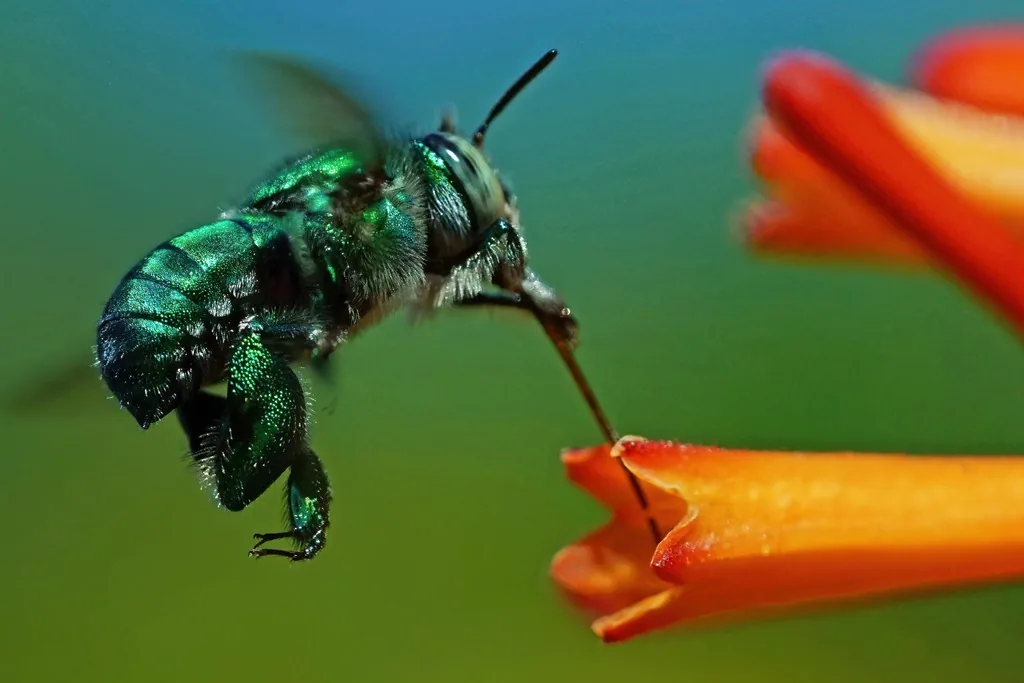
- It is about the size of a honey bee or slightly smaller, usually around 1.3 cm (about 1/2 inch) long, with bright metallic green coloring and darkened but transparent wings.[1]
- The tongue is very long, roughly two-thirds the length of the body.[1]
- Females carry pollen baskets on the hind legs. Males lack them but have greatly enlarged hind shins (tibiae), each with a hole leading into a spongy chamber where they store fragrances.[1]
- It is a fast, agile flier that darts from flower to flower between long periods of hovering.[1]
Look-alikes
| Look-alike | How to tell them apart |
|---|---|
| Metallic green sweat bees | Green sweat bees (family Halictidae) are the insects most likely to be confused with it, but their tongues are short compared with their bodies, while the orchid bee's tongue reaches about two-thirds of its body length.[1] |
Where it lives
Its native range runs from Mexico through Central America. In Florida, most reports come from Broward, Palm Beach and Miami-Dade counties, and its potential range has been predicted to take in the part of the peninsula south of a line from Tampa to West Palm Beach.[2][1]
Biology and life cycle
It probably reached Florida in a nest hidden inside a wooden item such as a pallet imported from Mexico. The bees were at first identified as Euglossa viridissima; in 2011 researchers found them to be E. dilemma, a newly described sibling species that looks almost identical.[1]
Although closely related to highly social bees, orchid bees are mostly solitary, at most sharing a nesting site now and then. Females build nest cells from plant resins inside almost any enclosed cavity, including an empty beekeeping hive box, often seal the entrance with resin and plant debris, and stock the cells with nectar and pollen; a mature nest can hold up to 20 cells.[1]
Males collect fragrant compounds with mop-like brushes on their front feet and store them in their hind legs, apparently to display to females. In Florida they gather these scents from wood-rot fungi, decaying vegetation, fragrant flowers and oils such as clove and cinnamon oil.[1]
A study of its plant use from 2003 to 2022 recorded it on 259 kinds of plants in 56 families. About half of the flowers it used were visited mainly for nectar and 60 mainly for pollen, including 42 that need buzz pollination, and females collected resin from five plants for nest building.[2]
Its long tongue and its ability to shake pollen out of buzz-pollinated flowers let it use flowers whose rewards are out of reach of most other visitors; about 72 percent of the species it used have such protected rewards.[2]
Damage and signs
- Neither UF nor the research papers report damage to plants or buildings. The concern is ecological: in southern Florida it pollinates the invasive shrub Solanum torvum, which needs buzz pollination, nearly twice as efficiently as native sweat bees, and where the orchid bee was kept away the flowers set only a quarter as much fruit.[1][3]
- The researchers warn that this partnership could make the weed harder to manage in the region's fragmented, endangered tropical hardwood forests. Their 2009 paper calls the bee Euglossa viridissima, the name then used for the Florida population.[3][1]
Health risk
Females have a stinger and males do not. Females are quite timid about stinging, and the sting is less painful than a honey bee's, but unlike a honey bee a female can sting more than once.[1]
Control
Prevention
The UF/IFAS fact sheet gives no control measures for this bee; it describes it as a conspicuous, charismatic, recently introduced bee whose females are timid about stinging.[1]
Common questions
- Is the green orchid bee native to Florida?
- No. Orchid bees are native to the American tropics, and this species comes from Mexico and Central America. It was first collected in Florida in 2003 and probably arrived in a nest hidden in imported wood such as a pallet.[1][2]
- Can a green orchid bee sting?
- Only females can, and they are timid about it. The sting hurts less than a honey bee's, although a female can sting repeatedly.[1]
- How can I see orchid bees up close?
- Male green orchid bees come quickly to a small piece of paper soaked in clove oil and placed outdoors, according to UF/IFAS.[1]
Sources
- University of Florida IFAS Extension (Featured Creatures), “Green orchid bee Euglossa dilemma Friese (Insecta: Hymenoptera: Apidae), EENY576/IN1013 (A. Mullins, 2013; archival copy).” journals.flvc.org/edis/article/view/125874 (accessed 2026-11-09)
- MDPI (Insects), “Pemberton RW. Plant resource use and pattern of usage by the naturalized orchid bee (Euglossa dilemma: Hymenoptera: Apidae) in Florida. Insects 14(12):909 (2023) (abstract).” doi.org/10.3390/insects14120909 (accessed 2026-11-09)
- Springer (Oecologia), “Liu H, Pemberton RW. Solitary invasive orchid bee outperforms co-occurring native bees to promote fruit set of an invasive Solanum. Oecologia 159(3):515-525 (2009) (abstract).” doi.org/10.1007/s00442-008-1232-6 (accessed 2026-11-09)
- iNaturalist, “Euglossa dilemma taxon page (order and family).” www.inaturalist.org/taxa/474465 (accessed 2026-11-09)