On this page
How to identify it
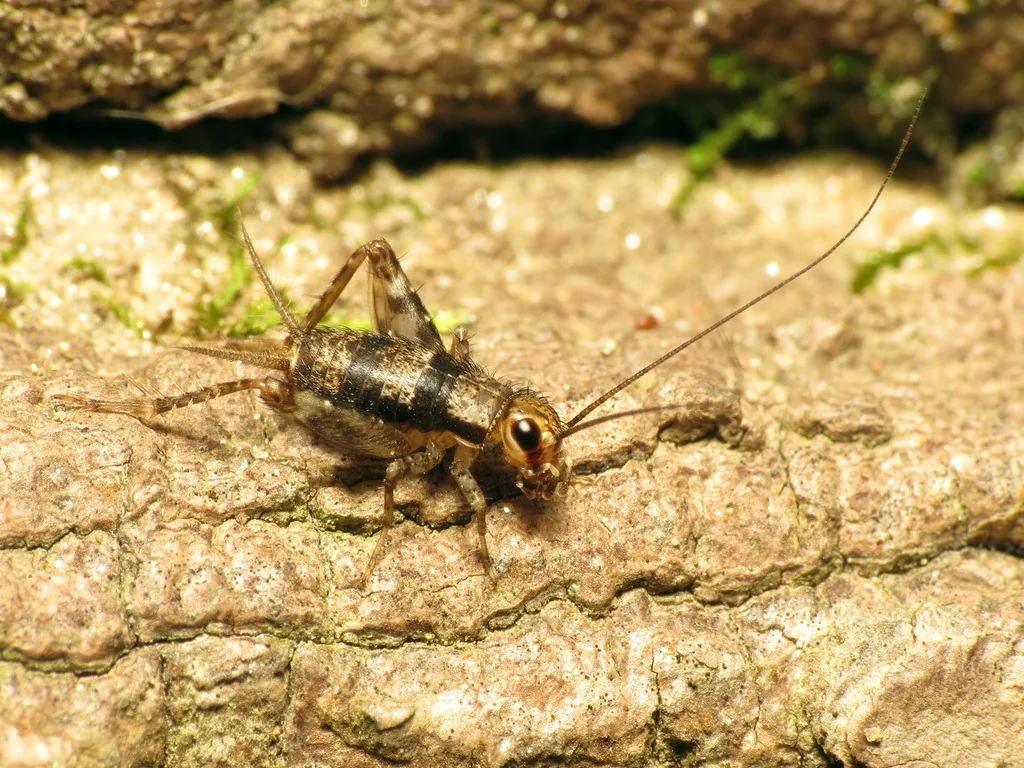
- A very small cricket, about 3/8 inch and under half an inch long, dark brown or black, with large compound eyes, long threadlike antennae, enlarged hind femurs and spiny tibias like other crickets. A winged individual this small is an adult, since only adult insects have wings; it is not an immature field cricket.[1]
- The song gives it away: males rub their wings together to produce a high-pitched trill rather than the chirp of a field cricket, and the sound is loud out of proportion to the body, so ground crickets are heard far more often than seen.[1]
- Numbers swing widely from year to year and place to place; outbreaks are seldom reported, or perhaps ground crickets simply go unnoticed most years.[1]
Look-alikes
| Look-alike | How to tell them apart |
|---|---|
| Field crickets (Gryllus) | The larger black crickets whose males chirp rather than trill; they are the more consistent indoor pest and the noisier one.[1] |
Where it lives
Iowa State describes them as a late-summer and fall presence in Iowa yards and under lights. The striped ground cricket (Allonemobius socius) is studied along a season-length gradient in the eastern United States, with two generations a year in the southern lowlands and one in southern highlands and northern populations, where it meets its sister species A. fasciatus at the northern edge of its range.[1][2][3]
Biology and life cycle
Ground crickets have a simple life cycle of egg, nymph and adult. Most spend the winter as eggs in the soil; nymphs appear by late spring and feed on tender plant tissue, debris and other insects; adults mate and lay eggs in late summer and fall. They are more cold-tolerant than most insects and will be among the last to sing in late fall.[1]
In the striped ground cricket the eggs come in two kinds: diapause eggs that arrest development and survive the winter, and direct-developing eggs that hatch within a 16-to-18-day incubation period and add another generation when conditions allow. Southern lowland populations are bivoltine and adjust the share of diapause eggs to temperature and day length; populations at higher altitude and farther north are univoltine, and the chance of a single yearly generation rises with latitude. Egg-incubation temperature and the parents' own diapause history both influence how many eggs enter diapause.[2][3][4]
Gene flow in A. socius runs asymmetrically northward, so peripheral northern populations keep laying some non-diapause eggs that are poorly suited to a one-generation climate; at that edge it competes with Allonemobius fasciatus, a sister species that lays only diapause eggs.[3]
Damage and signs
- Ground crickets are scavengers on a wide variety of plants and other insects and are generally not pests of crops, gardens or landscapes; Iowa State says control in the lawn and garden is not usually warranted.[1]
- Like field crickets they are attracted to lights, and very large numbers can gather on pavement under street and store lights early in the night. From there some wander indoors as accidental invaders, though not as consistently as the larger field crickets; if large numbers get inside they could damage fabrics, paper and other household materials.[1]
Health risk
A nuisance only; the extension source describes no harm to people or pets.[1]
Control
Prevention
Outdoors, leave them alone: they are not pests of lawns, gardens or crops, and control there is not usually warranted.[1]
Keep them out
To keep fall invaders out of the house, seal cracks and gaps around the foundation, doors and windows, the same measures that exclude other accidental invaders.[1]
Pesticides
Where ground crickets keep coming in, Iowa State lists perimeter sprays of a residual insecticide applied outdoors to sills, thresholds and other potential entry points.[1]
Common questions
- Why are there hundreds of tiny crickets under the gas station lights in September?
- Ground crickets are drawn to lights like field crickets, and late summer and fall is when the adults are out mating and laying eggs; very large numbers can collect on pavement under street and store lights early in the night.[1]
- Are these baby field crickets that will grow up and get into my house?
- No. They have wings, which only adult insects have, so they are full-grown ground crickets, a different group from field crickets. Some wander indoors by accident, but they are not as consistent a household pest as field crickets.[1]
- What is that high trill I hear in the grass after the first frosts?
- Probably ground crickets. Males trill rather than chirp by rubbing their wings together, and ground crickets are more cold-tolerant than most insects, so they are among the last insects singing in late fall.[1]
Sources
- Iowa State University Extension and Outreach, “Ground Crickets (Yard and Garden, reviewed October 2021).” yardandgarden.extension.iastate.edu/encyclopedia/ground-crickets (accessed 2026-11-10)
- Evolution (Society for the Study of Evolution), “Winterhalter and Mousseau (University of South Carolina). Patterns of phenotypic and genetic variation for the plasticity of diapause incidence. Evolution 61: 1520-1531 (2007), PMID 17598737.” pubmed.ncbi.nlm.nih.gov/17598737/ (accessed 2026-11-10)
- Journal of Evolutionary Biology (Wiley), “Fedorka, Winterhalter, Shaw, Brogan and Mousseau (University of Central Florida). The role of gene flow asymmetry along an environmental gradient in constraining local adaptation and range expansion. Journal of Evolutionary Biology 25: 1676-1685 (2012), PMID 22694151.” pubmed.ncbi.nlm.nih.gov/22694151/ (accessed 2026-11-10)
- Oecologia (Springer), “Huestis and Marshall (University of Texas at Arlington). Interaction between maternal effects and temperature affects diapause occurrence in the cricket Allonemobius socius. Oecologia 146: 513-520 (2006), PMID 16133190.” pubmed.ncbi.nlm.nih.gov/16133190/ (accessed 2026-11-10)
- iNaturalist, “Nemobiinae taxon page (order and family).” www.inaturalist.org/taxa/324788 (accessed 2026-11-10)