On this page
How to identify it
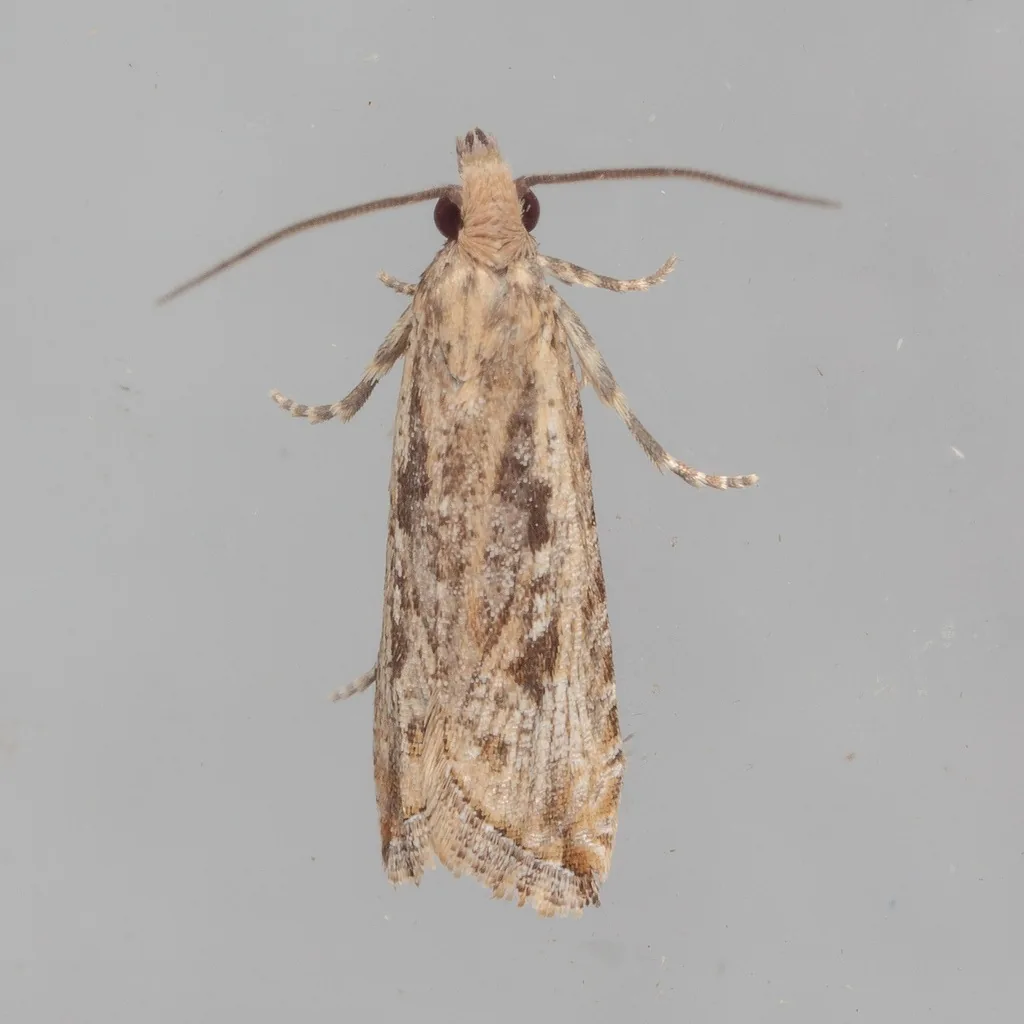
- Adults are small moths with a wingspan of 1/2 to 3/4 inch. They are usually light brown and variously spotted and mottled, and some are nearly spot-free.[1]
- The forewings are narrow and somewhat pointed at the tip, sometimes with darker brown patches; the hindwings are sooty brown.[1]
- Adults come readily to lights at night, especially near marshy areas.[1]
- NC State notes that descriptions of the eggs, caterpillars and pupae don't seem to be available; the caterpillars bore inside their host plants.[1]
Where it lives
USDA researchers describe it as a native moth. NC State reports it in North Carolina, and it was studied at the USDA Southern Weed Science Laboratory in Stoneville, Mississippi.[2][1][3]
Biology and life cycle
Its caterpillars, like others in the genus Bactra, specialize on sedges and rushes. They bore into the plants and feed on the leaves, the leaf bundles and the bulbs at the base.[1]
It infests purple and yellow nutsedge as early as May but becomes more common later in summer into September and October, when as many as 84% of wild yellow nutsedge plants may be infested.[1]
Natural populations peak from late July through September. The larvae develop more slowly in the cooler temperatures of May and June.[4]
There are probably two generations a year in North Carolina.[1]
Damage and signs
- The caterpillars can damage ornamental sedges and rushes grown in landscapes, often along waterways and ponds.[1]
- In USDA greenhouse tests, two to four weekly infestations of three larvae per shoot cut purple nutsedge dry weight by 77% on average, and eight weekly infestations cut it by 98%; nitrogen-deficient plants were affected much less.[2]
- In temperature-controlled tests, larval feeding significantly reduced the number of nutsedge flower heads and cut the total dry matter the plants produced by 28 to 49%.[4]
Health risk
NC State notes only plant damage, and the USDA studies concern its effect on nutsedge; none of these sources mentions any risk to people.[1][2]
Control
Biological control
Where it attacks nutsedge, it can be an ally: in six years of USDA field studies in cotton, repeated early-season releases of young larvae cut nutsedge top growth 30 to 68%, and in 1976 and 1977 they brought cotton yields up to those of nutsedge-free plots.[3]
Pesticides
To protect ornamental sedges and rushes once caterpillars are noticed, NC State suggests a pyrethroid insecticide at monthly intervals. Pyrethroids are very toxic to fish, so apply them in a way that keeps them out of lakes, streams and ponds, where many of these plants grow.[1]
Common questions
- Is the javelin moth good or bad?
- Both. Its caterpillars bore into nutsedge, a weed, and USDA studies used them to suppress purple nutsedge, but they also damage ornamental sedges and rushes.[2][3][1]
- Has the javelin moth been used to control nutsedge?
- In research, yes. USDA scientists released moths and larvae in field plots: early-season releases of young larvae suppressed purple nutsedge, while establishing the moth from adult releases took at least 10 pairs of moths per release.[3]
Sources
- NC State Extension, “Javelin Moth (PDIC factsheet, J. Baker; reviewed May 8, 2025).” content.ces.ncsu.edu/javelin-moth (accessed 2026-11-08)
- Weed Science Society of America / Cambridge University Press, “Biocontrol of Purple Nutsedge by Bactra verutana Zeller in a Greenhouse (K. E. Frick and P. C. Quimby Jr., USDA ARS; Weed Science 25(1): 13-17, 1977; abstract).” www.cambridge.org/core/journals/weed-science/article/biocontrol-of-purple-nutsedge-by-bactra-verutana-zeller-in-a-greenhouse/5CD9683221277E40B2934CDA36A508C8 (accessed 2026-11-08)
- Weed Science Society of America / Cambridge University Press, “Augmenting the Moth (Bactra verutana) in Field Plots for Early-Season Suppression of Purple Nutsedge (K. E. Frick and J. M. Chandler, USDA; Weed Science 26(6): 703-710, 1978; abstract).” www.cambridge.org/core/journals/weed-science/article/augmenting-the-moth-bactra-verutana-in-field-plots-for-earlyseason-suppression-of-purple-nutsedge-cyperus-rotundus/9C71A53514F73A26F2AAE4B77F8DA9D5 (accessed 2026-11-08)
- Weed Science Society of America / Cambridge University Press, “Interactions between Bactra verutana and the Development of Purple Nutsedge Grown Under Three Temperature Regimes (K. E. Frick, R. D. Williams and R. F. Wilson, USDA; Weed Science 26(6), 1978; abstract).” www.cambridge.org/core/journals/weed-science/article/interactions-between-bactra-verutana-and-the-development-of-purple-nutsedge-cyperus-rotundus-grown-under-three-temperature-regimes/3AD253E0916473C0861815C083701585 (accessed 2026-11-08)
- iNaturalist, “Bactra verutana taxon page (order and family).” www.inaturalist.org/taxa/214759 (accessed 2026-11-08)