On this page
How to identify it
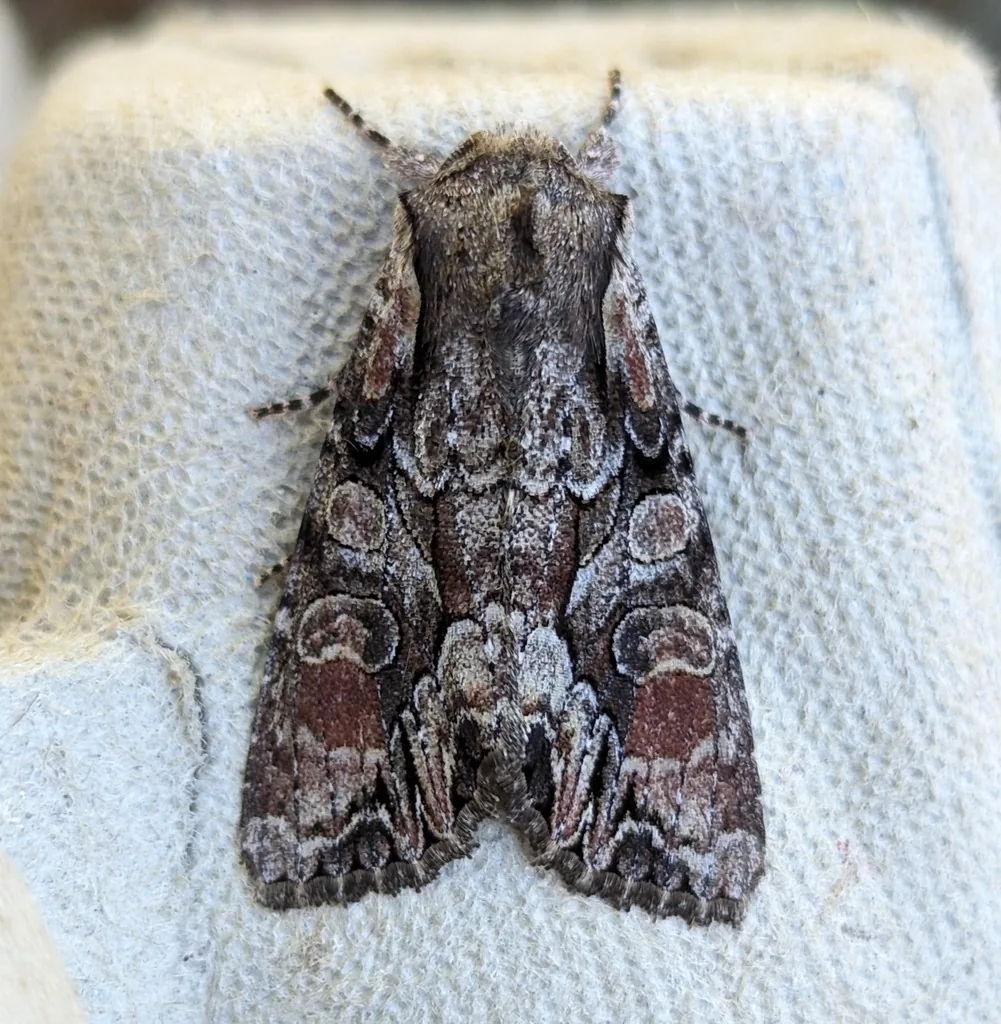
- The adult moth is about 1 inch long, with a distinctive pattern of wing scales in shades from light brown to black.[1]
- Young caterpillars are green with a stripe along the side. Older ones may be bright green, tan, light red or brick colored.[1]
- Mature caterpillars have a herringbone pattern down the back and can be up to 2 inches long.[1]
Look-alikes
| Look-alike | How to tell them apart |
|---|---|
| Green fruitworms | Young lacanobia caterpillars, green with a stripe along the side, look like green fruitworms. As they grow, lacanobia caterpillars may turn tan, light red or brick colored, and mature ones have a herringbone pattern on the back.[1] |
Where it lives
It is a pest of apples in the Pacific Northwest; researchers tracked its seasonal cycle in 30 apple orchards in central Washington and northeastern Oregon from 1998 to 2001.[1][2]
Biology and life cycle
It spends the winter as a pupa in the soil, and the moths emerge in May and June. Eggs may be laid on fruit trees or on weeds.[1]
First-generation caterpillars appear in June and July and feed mainly on leaves, though they may also eat fruit. Second-generation moths start flying in late July and stay active through October, and their caterpillars feed from mid-August into October.[1]
In Washington and Oregon orchards, pheromone traps first caught moths at about 216 degree-days (base 6.7 degrees C, or 44 degrees F) after March 1, and 5 to 95 percent of first-generation eggs had hatched between about 395 and 630 degree-days. The second flight began at about 1,217 degree-days.[2]
Washington State University researchers proposed that the moth's sudden rise as an apple pest was linked to its tolerance of organophosphate insecticides.[3]
Damage and signs
- The caterpillars are voracious and can strip the leaves from shoots in a few days. Older caterpillars also feed on the fruit, typically leaving a wound that looks like a small scoop removed from the apple.[1]
Health risk
The handbook and the orchard studies discuss it only as a fruit pest and mention no risk to people.[1][2][3]
Control
Traps and physical control
Home orchardists can catch the moths in black-light traps and hand-pick the caterpillars while thinning fruit.[1]
Pesticides
For home orchards, the Pacific Northwest handbook lists azadirachtin (neem oil), carbaryl, pyrethrins, spinosad and zeta-cypermethrin. Carbaryl, spinosad and zeta-cypermethrin are highly toxic to bees, and some neem oil, pyrethrins and spinosad formulations are OMRI-listed for organic use.[1]
In Washington field trials, spinosad, methoxyfenozide, indoxacarb and an aluminosilicate particle film proved effective, while the neonicotinoids acetamiprid, thiacloprid and clothianidin showed too little activity in lab tests even to be field-tested. For commercial orchards the handbook lists chlorantraniliprole, emamectin benzoate, indoxacarb, novaluron, spinetoram, spinosad and tebufenozide.[3][4][1]
Monitoring in orchards
Shortly after fruit set, check fruit clusters for the small green caterpillars. They tend to occur in clumps, so look thoroughly.[1]
Pheromone-baited traps track the moth flights, and a degree-day model built from four seasons of trap catches and egg monitoring can predict when moth flight and egg hatch begin and end for both generations.[2]
Traps baited with the chemical attractants acetic acid and 3-methyl-1-butanol have also caught both male and female moths in roughly equal numbers.[5]
Common questions
- What does lacanobia fruitworm damage look like on apples?
- Older caterpillars feeding on the fruit leave a wound that looks like a small scoop has been removed. On leaves, the caterpillars can strip a shoot in a few days.[1]
- How many generations does the lacanobia fruitworm have?
- Two in Washington and Oregon apple orchards. Moths from overwintering pupae fly in May and June, and a second flight starts in late July and continues into October, with caterpillars feeding into October.[1][2]
- Do neonicotinoid sprays control lacanobia fruitworm?
- Not well. In Washington State University tests, acetamiprid, thiacloprid and clothianidin showed too little activity against it to justify field trials, while spinosad, methoxyfenozide and indoxacarb worked.[4][3]
Sources
- Pacific Northwest Pest Management Handbooks (Oregon State, Washington State and University of Idaho Extension), “Apple: Lacanobia fruitworm (Pacific Northwest Insect Management Handbook).” pnwhandbooks.org/insect/tree-fruit/apple/apple-lacanobia-fruitworm (accessed 2026-11-09)
- Journal of Economic Entomology (via NCBI PubMed), “Phenology of Lacanobia subjuncta (Lepidoptera: Noctuidae) in Washington and Oregon apple orchards (M. D. Doerr, J. F. Brunner and V. P. Jones; Journal of Economic Entomology 98(6): 2100-2106, 2005; abstract).” pubmed.ncbi.nlm.nih.gov/16539138/ (accessed 2026-11-09)
- Pest Management Science (via NCBI PubMed), “Integrated pest management approach for a new pest, Lacanobia subjuncta (Lepidoptera: Noctuidae), in Washington apple orchards (M. D. Doerr, J. F. Brunner and L. E. Schrader; Pest Management Science 60(10): 1025-1034, 2004; abstract).” pubmed.ncbi.nlm.nih.gov/15481830/ (accessed 2026-11-09)
- Journal of Insect Science (via NCBI PubMed), “Role of neonicotinyl insecticides in Washington apple integrated pest management. Part I. Control of lepidopteran pests (J. F. Brunner et al.; Journal of Insect Science 5: 14, 2005; abstract).” pubmed.ncbi.nlm.nih.gov/16341246/ (accessed 2026-11-09)
- Journal of Economic Entomology (via NCBI PubMed), “New chemical attractants for trapping Lacanobia subjuncta, Mamestra configurata, and Xestia c-nigrum (P. J. Landolt, USDA-ARS; Journal of Economic Entomology 93(1): 101-106, 2000; abstract).” pubmed.ncbi.nlm.nih.gov/14658518/ (accessed 2026-11-09)
- iNaturalist, “Lacanobia subjuncta taxon page (order and family).” www.inaturalist.org/taxa/222554 (accessed 2026-11-09)