On this page
How to identify it
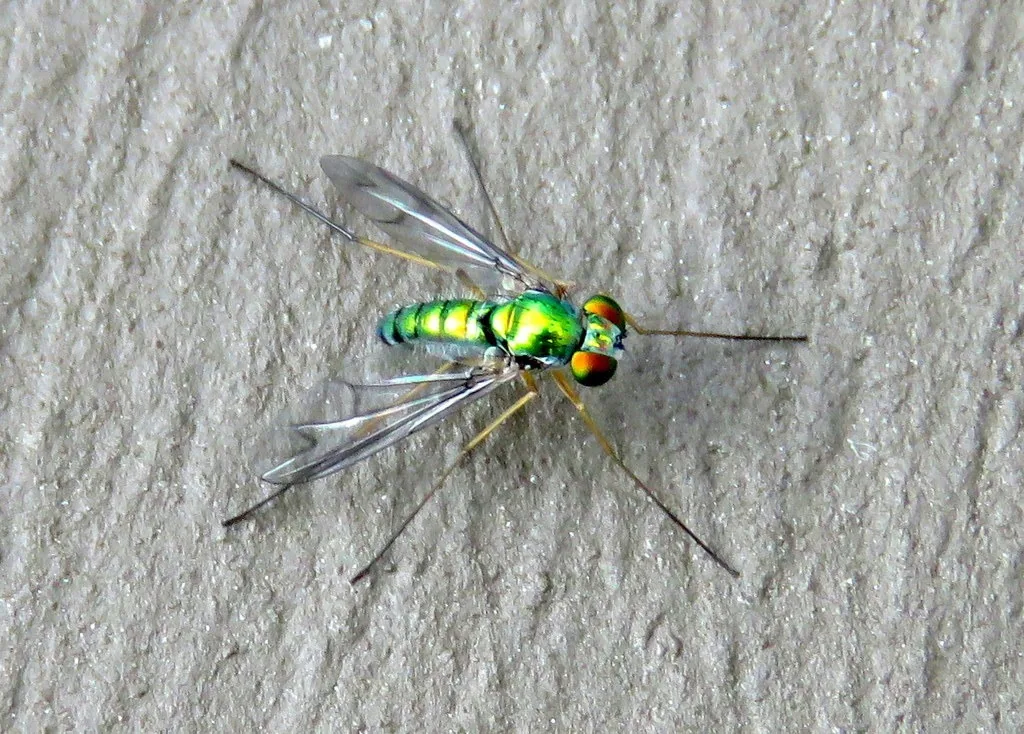
- Small: usually 1 to 9 mm long, most under 1/4 inch. The body is slender with a thin, tapering abdomen and long, thin legs.[1][2][4]
- Many are metallic green, blue, bronze or coppery and shine in the sun, and the abdomen is often banded with a darker color. Some species are drab brown, gray or black.[1][4]
- Wings are about as long as the body, usually clear and iridescent; some species have dark spots or bands near the wing tips. Depending on the species, the wings are held out at about a 45-degree angle or folded down the back.[1][2][4]
- In Condylostylus, a common garden genus, several species have two smoky bands on the outer wing that join into a C shape, and the eyes are sometimes reddish against an emerald body.[4][1]
- Males of many species have decorations used in courtship, such as flag-like front feet or modified antennae.[1][4]
Look-alikes
| Look-alike | How to tell them apart |
|---|---|
| Robber flies | Adult longlegged flies hunt like miniature robber flies, but they are small and slender, and many are metallic.[4][1] |
| Hover flies | Flower (hover) flies are among the flies that can look similar in shape and size. Look for the longlegged fly's slender body, long thin legs and, in many species, metallic color.[4][1] |
Where it lives
A large family found across North America, with about 1,300 species north of Mexico and nearly 7,400 worldwide. In Missouri they occur statewide, and NC State lists them as native throughout eastern North America.[4][2]
Biology and life cycle
Adults rest on leaves in sunlight and run or fly short distances from leaf to leaf when disturbed. They are most common in light shade near water, such as along streams, wetlands and moist woods, and some skate on the water's surface.[1][4]
Adults catch small insects such as aphids, leafhoppers, small midges and gnats, and also mites, thrips, whiteflies and springtails. They pierce prey with knifelike mouthparts, inject digestive enzymes and drink the liquefied insides, often carrying the prey as they fly.[1][3][4]
Females lay eggs in moist soil, or sometimes under tree bark. Most larvae live in soil and prey on other small animals there, but larval habits vary: some are scavengers, some feed in plant tissue, and Medetera larvae hunt bark beetle larvae in their tunnels under bark.[1][3][4]
Adults are sensitive to cold, so they are seen from after the last spring frost until the first frost in fall. In some crops they become very abundant from mid-season to harvest.[1][2]
Damage and signs
Health risk
Control
Prevention
No control is needed. Longlegged flies are generally considered friends to gardeners because they prey on aphids, mites, thrips and other small pests, so leave them alone. They are not sold commercially as biological control agents.[4][2]
Common questions
- What are the tiny shiny green flies on my plant leaves?
- They are very likely longlegged flies: small, slender, metallic green, blue or bronze flies with long legs that rest in sunny spots and dart between leaves.[1][2]
- Do longlegged flies bite?
- No. They do not bite and pose no threat to people; they feed on small insects and mites.[1][4]
Sources
- Ohio State University Extension (Ohioline), “Ohio's Natural Enemies: Long-Legged Flies, ENT-69 (A. Kautz and M. M. Gardiner; 2016).” ohioline.osu.edu/factsheet/ent-69 (accessed 2026-11-09)
- NC State Extension, “Dolichopodid Fly (Biological Control Information Center; D. Orr, 2018).” entomology.ces.ncsu.edu/biological-control-information-center/beneficial-predators/dolichopodid-fly/ (accessed 2026-11-09)
- Colorado State University, “Natural Enemies of Insects: Long-legged Flies (hemp insects series).” webdoc.agsci.colostate.edu/hempinsects/PDFs/Longlegged%20Fly%20with%20Photos.pdf (accessed 2026-11-09)
- Missouri Department of Conservation, “Longlegged Flies (field guide).” mdc.mo.gov/discover-nature/field-guide/longlegged-flies (accessed 2026-11-09)
- iNaturalist, “Dolichopodidae taxon page (order and family).” www.inaturalist.org/taxa/68020 (accessed 2026-11-09)